

The Melanie Avalon Biohacking Podcast Episode - #381 - Dmitri Leonov
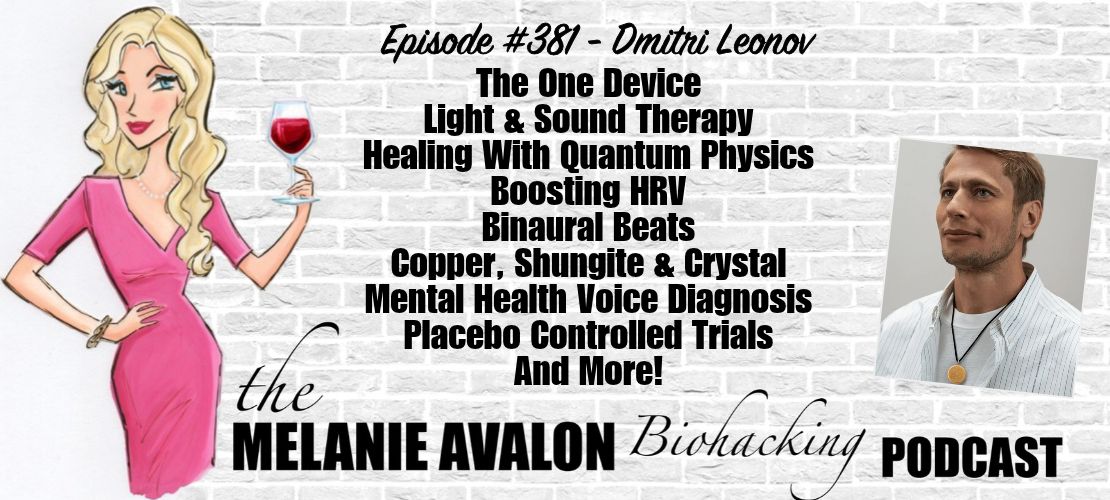
Serial entrepreneur in the wellness tech space, Dmitri has co-founded several companies focused on improving lives for people with MS, Parkinson’s, ADHD, and burnout.
He is the co-organizer of HumanTechWeek.com, a cutting-edge summit that brings together innovators shaping the future of wellness technology. His work has been featured in TEDx, Forbes, Fox News, Thrive, TechCrunch, and more.
Beyond business, Dmitri is a proud father of three, plays six instruments, and splits his life across four countries.
LEARN MORE:
SHOW NOTES
FACEBOOK: Join Melanie's Facebook group for a weekly episode giveaway and to discuss and learn about all things biohacking. All conversations are welcome! IF Biohackers: Intermittent Fasting + Real Foods + Life
INSTAGRAM: Follow Melanie on Instagram to see the latest moments, products, and #allthethings! @melanieavalon
AVALONX: AvalonX Spirulina is out now! AvalonX supplements are free of toxic fillers and common allergens (including wheat, rice, gluten, dairy, shellfish, nuts, soy, eggs, and yeast). They are tested to be free of heavy metals and mold and are triple-tested for purity and potency. Get on the email list to stay up to date with all the special offers and news about Melanie's new supplements at avalonx.us/emaillist! Get 10% off at avalonx.us and mdlogichealth.com with the code MELANIEAVALON. Plus, text AVALONX to 877-861-8318 for a one-time 20% off code for avalonx.us.
FOOD SENSE GUIDE: Get Melanie's app to tackle your food sensitivities. Food Sense includes a searchable catalog of 300+ foods, revealing their gluten, FODMAP, lectin, histamine, amine, glutamate, oxalate, salicylate, sulfite, and thiol status. It also includes compound overviews, reactions to look for, lists of foods high and low in these compounds, the ability to create your own personal lists, and more.
EMF: Stay up to date on all the news on Melanie's EMF collaboration with R Blank, and get the launch specials exclusively at melanieavalon.com/emfemaillist.
TRANSCRIPT
Dmitri Leonov
Essentially, by dealing with things on a frequency level, you're kind of catching any kind of disorders or imbalances before they materialize into 3D in your body. There was a woman who, through her voice, she got diagnosed with cancer. And she's like, "There's no way. I get screened all the time." She went and got screened, and sure enough, she had cancer. There's still kind of, I don't want to say a stigma, but it's hard for our brain to kind of intuitively get how this works.
Melanie Avalon
Welcome to the "Melanie Avalon Biohacking Podcast," where we meet the world's top experts to explore the secrets of health, mindset, longevity, and so much more. Are you ready to take charge of your existence and biohack your life? This show is for you. Please keep in mind, we're not dispensing medical advice and are not responsible for any outcomes you may experience from implementing the tactics lying herein.
So friends, are you ready to join me? Let's do this. Welcome back to the "Melanie Avalon Biohacking Podcast." Oh my goodness, friends, I was honestly blown away by today's conversation. I've been using the ONE device for over a year now. This is a device which you wear like a necklace, which integrates light and sound therapy, among other things, to optimize your nervous system and bring you to a higher state of health. And I noticed so many benefits in my nervous system regulation, my HRV, my mood, and yet I was always wondering, is it placebo? How much of this is actual science? Is it woo-woo? I was so impressed by the founder, Dmitry Leonov. And to be honest, I'm really embarrassed that I hadn't watched his TED Talk before, so I'm going to go watch that now. In any case, he knew his stuff. The technology in this device has been validated in thousands of studies for its health benefits. I noticed the difference so much, and I think most people will as well. Get one for yourself and also get one for your loved ones. It makes an incredible gift. It's literally applicable to anybody looking to just feel better in their daily life. You can get 30 dollars off with the code MELANIEAVALON at theonedevice.com/melanieavalon. In today's episode, we dive deep into so many things, including how light and sound therapy affect your body on the cellular level, the role of quantum physics when it comes to healing, how to boost your HRV, how binaural beats actually work, whether or not copper, shungite, and crystal are, quote, "woo-woo," the future of technology that can diagnose your mental health state based on your voice, the role of placebo-controlled trials, the future of health tech, and so much more.
We even went into a tangent on Schrodinger's cat, as well as robots and imprinting chickens. The show notes for today's episode will be at melanieavalon.com/theone. Those show notes will have a full transcript as well as links to everything that we talked about, so definitely check that out. I can't wait to hear what you guys think. Definitely let me know in my Facebook group, IF Biohackers: Intermittent Fasting + Real Foods + Life. Comment something you learned or something that resonated with you on the pinned post to enter to win something that I love, and then check out my Instagram, find the Friday announcement post, and again, comment there to enter to win something that I love. All right, I think that's all the things. As a brief reminder, you can get 30 dollars off the ONE device, which comes in many colors and makes an epic gift for yourself and loved ones at theonedevice.com/melanieavalon.
Melanie Avalon
That's theonedevice.com/melanieavalon with the coupon code MELANIEAVALON for 30 dollars off.
And now, without further ado, please enjoy this fabulous conversation with Dmitry Leonov. Hi, friends. Welcome back to the show. I am so incredibly excited about the conversation I am about to have. It is with an incredible person who founded a device that is very applicable in the biohacking world, and the backstory on this conversation is, I think it's been a while ago now that we actually got introduced. I think your company reached out to me and just told me about the device and everything, and I was very allured by it because it combines many things that we talk about on this show, often separately, so things like light therapy, sound therapy, vibrational therapy. However, it combines all of those into one, no pun intended, one wearable device. Wait, I'm having an in real time epiphany. Is that why it's called the ONE?
Dmitri Leonov
Partially, yes.
Melanie Avalon
So, I am here with Dmitry Leonov, yes, the founder of the ONE device. And what's really stunning about this device, friends, and everybody go to the website so that you can see it and get one for yourself, is that it is in the form of wearable jewelry.
So, I have the rose gold one, and we'll dive into all of this, but I think when it comes to these sorts of technologies, there's two aspects to it. There's the clinical studies and trials, and what do we know about these different technologies that are combined in this device? Oh, and I didn't even mention it has quartz and shungite and copper, so we'll talk about that as well. And then there is the side of, and it's funny because Dmitry and I, one of the questions he asked me right before we started was, "Do we go more woo-woo or do we go more biohacking?" And I think there's that whole, I don't even know the word besides woo-woo, but there's that whole aspect of how certain things in the world are resonating and affecting our energies. And I'm sure it's a really, really interesting path to walk when you are combining all of that into, again, no pun intended, one device, and seeing the health effects and how it benefits everybody. So, when I wear it, well, we'll get into my experience, but I have so many questions about this, and Dmitry, thank you for all that you do, and thank you so much for being here.
Dmitri Leonov
Thank you for having me.
Melanie Avalon
So, to get things started, your personal story, I'm dying to know. Were you always wanting to do something like this company, or did you have an epiphany one day?
What were you doing as a child? What led you to- ... to what you're doing today.
Dmitri Leonov
Sure. So, no, I definitely did not always want to do this.
I started my career in investment banking and then worked in startups, mainly software and tech. For about a decade ago, actually, no, more than that, got really into physics and kind of how everything works. And around the same time, started looking into health tech and just the quantum physics, and just really got a sense that our understanding of how everything works, our understanding of the world, of the universe, has dramatically changed over the last 100 years. Right? So we know that physics is quantum. We know everything is vibrating. We know everything is mostly empty space. But then when it comes to our health and biology, we still haven't really changed that point of view. We're still very much thinking of it in terms of molecules and pills and scalpels, and really hard things. I kept digging into this more and more and got into a light therapy space, and we had another wearable device before this, which was a light therapy product, and I really just saw what incredible results pretty faint light can have on your body. Around the same time, started thinking, "What else can we do?" And so, hired a team and realized that what we should be doing is combining different modalities together in a smart way. So, combining light with infrared light with sound, and do this all kind of in a synchronous way. That just seemed like the right thing to do. And then, turns out that the effects have been pretty, I don't want to say magical, but definitely more profound than expected. So, it's one of those one plus one plus one equals 100 kinds of things.
Melanie Avalon
Yeah. So, the word magical, that is a really good way to describe the... Well, I love the word magical, but it's a good way to describe just the feeling I have had wearing it.
And I did notice changes with my HRV, like on my Oura Ring and such, using it. So, going back, so you said you noticed the effect of faint light. Do you mean directly on the body or just experiencing light in your atmosphere, like colored light? What do you mean, the role of light?
Dmitri Leonov
Before this, we had a light therapy wearable that basically emitted very faint light. It was a full spectrum, so all the way from... It was mainly red, but there are different sub-products of different colors. And essentially what happens is different color of the light has a different effect on the body, as it turns out. And then depending on where you place this light, it also has a different effect. And so what we found is you can place it on different meridians and different acupoints on the body, and it would have a different effect. So instead of essentially affecting your nervous system and your body through acupuncture needles, you could place the light there, and it would work on the same systems that Chinese medicine works with, with needles.
Melanie Avalon
And just thinking about it, it's so interesting, like you're saying how, well, the views of the world have changed and evolved and more of an acceptance about quantum physics and how things affect each other, and yet it doesn't... It's interesting to me that there's so much resistance to these ideas when it comes to whole body health and wellness, when if you just sit back... I know for me, I can experience certain vibrations or certain lights, and it can immediately change how I feel in my body. And that's my cognitive perception of it.
I'm sure things are happening on the surface below that. But for me, I guess, what do you think it would take for things to be more accepted in the medical sphere when it comes to these things?
Dmitri Leonov
It's happening already, right? And so, I gave a TED Talk on this topic last year, and as part of that, I had to do a lot of research on what's going on specifically in the medical sphere. And so there is a tremendous amount of research. So on PubMed, which is the National Library of Congress database of studies, so it's essentially a database of peer-reviewed studies that are as proven as can possibly be, there are 14,000 studies on light therapy, sound therapy, vibrational therapy, and electromagnetic waves. Essentially, I call it frequency medicine, right? So again, instead of dealing with molecules, we're dealing with waves. And so the research is there. We know we can heal bones, we can heal tendons with light, with electrical, with microcurrents. We can shatter tumors with ultrasound. And that's been, by the way, that's not even cutting edge. This is FDA approved now. So it's happening.
However, there's still kind of, I don't want to say a stigma, but it's hard for our brain to intuitively get how this works, right? So we know that the research is there, we see the results, but we still don't quite understand the mechanism, how this very faint light can have this kind of an effect. And so, I think that's why it's taken us 100 years to get here, but it really is catching up.
Melanie Avalon
What's really interesting is the role of setting. So, for example, if you were to hold your one device, wear it as a necklace, I feel like if a person is out on the street wearing it, people might be skeptical. But if you were to take them and put them into a room doing a clinical study and a trial, then I think they'd be like, "Oh, okay. That makes sense." It's literally the story around it is, I think, a barrier to some of this stuff being more accepted or more mainstream, possibly.
Dmitri Leonov
For sure. But again, it's definitely happening.
I am really confident. I've made a bet with my career that this is going to become mainstream just in the next five- ... 10 years max, but we're doing everything we can to make this happen even faster.
Melanie Avalon
And you do have a background in investment banking, so you know where to invest. Okay, so going more into the technology. Well, actually, so I'm obsessed with product development, because I have a few brands myself, but nothing that is like this level of technology. So I'm fascinated by that.
So when you had the idea and it came down to actually creating the device, what was that process like? Where do you even start when you decide to create something like this? Do you start with the manufacturers? I mean, do they even make manufacturers for this? Yeah, what was the process like?
Dmitri Leonov
This was a really interesting process because my background is in software, so I understand what it's like to build a software product. There's a saying that hardware is hard, and I don't think I truly understood how hard it is exactly at the time. It was definitely a process.
It started with getting the right engineering team, and I think we went through six different engineering teams to do this. And it's really not rocket science if you look at the technology, but to actually make it work and to actually build it so it's doing what you need it to do, it turns out to be much harder than it seems. And it's a different level of challenges, a different level of complexity that I just guess I wasn't used to. And then the next thing that happens is then when you want to scale, and so going from hundreds of units to thousands of units, that's a whole other level of challenges. I did not expect that to be an issue. But yeah, if I knew how hard it was going to be, I guess I still would do it, but I would have thought about it much more.
Melanie Avalon
You know what's so funny about that? They say, I think they did a poll or something where they asked a lot of really successful people, like, "If you could do it again, would you?" And everybody said no.
But everybody's happy that... And when I think about that with my life, I'm like, "I don't know if I could start all over again." Okay, so when you were creating it, because, so I'm mentioning the three, the light, the sound, the vibration. Did you make the individual decisions of the versions of those that you wanted and then put them together, or did you have to first come up with something that could start? Did you have to start at the end point with what can do all of these three things simultaneously? Just what was the process of actually making those decisions and putting it together and making a prototype?
Dmitri Leonov
It definitely evolved over time. I had a kind of an idea, and this might come out, we agreed not to be too woo-woo.
Melanie Avalon
Oh, you can be woo-woo, it's fine.
Dmitri Leonov
Okay. Well, I cannot really take the credit for it because I have to say it was kind of channeled, meaning I believe that we don't really have thoughts. We tune into them, right? So thoughts kind of come to us. And in this case, I clearly remember what that's like.
You kind of start with somewhere and then just this thought pops into my mind. Just to give you an idea, one of the things I was thinking about is, how do we make an off switch, right? The thing looks like a pendant. There's a light, there's a USB port, but I wanted to have no moving parts, right? And so then how do we make a button to turn it off? And then this just random thought pops in my mind, "Oh, you can put a sensor, an accelerometer, which understands the position, like the orientation of it in space, right? So we know it's vertical or horizontal. And then if you lay it down, it knows that it's laying down, meaning you're not wearing it, and that would be the off switch." And I didn't really know anything about accelerometers, so it clearly was just like an idea that was downloaded.
Melanie Avalon
I remember when I first got it, and I was like, "Wait, how do you turn it on and off?" I was so confused, and then I read the instructions.
I was like, "Whoa, this is brilliant. Amazing." Okay. So going back to... And so for friends and listeners, the way the device looks is it's a circular device, and it's like a necklace. On the back is a peephole of sorts, and that's where you can, when it's on, and it's funny, I'll wear it in the movie theaters, and if it's turned a certain way, it's glowing. But it emits light from there. I'm just so fascinated about all the different things. So I guess starting with the light, is this also like your prior device where it's full spectrum, and what is the role and the benefits of the light? And like I said, it's so small. How can it have that much of an effect?
Dmitri Leonov
Exactly. That's a really good question.
Well, so it is full spectrum, and you can pick which color it's playing. But the thing is, so the color of the light, the LED, the sound, or the frequency of the sound, and then also the pattern of the infrared light. So there's visible light, infrared light, and sound, and they're all working together, meaning they're all synced. And so by choosing which color the light is, it also affects the sound and the infrared light. So it's all kind of synchronous.
Melanie Avalon
Are there a lot of studies of the overlap, like how those synchronize, the overlap of those three things?
Dmitri Leonov
Yeah, so there's not a ton on the different... Most of the studies are done on the red light. That's what everyone knows.
There are definitely different... The second biggest is the ultraviolet and kind of the bluish light. So for example, we've been using ultraviolet to disinfect, right, so to kill microbes for a really long time.
And there's- ... there's nuances for the others. There's much less studies on those other colors. But we do know how, for example, blue light can affect our circadian rhythms, or the color of light can affect our circadian rhythms. There's definitely some nuances.
Melanie Avalon
It's so funny with the light, personally, I don't know how you light your space, but at night, my whole apartment is just red light. I don't have anything that's not red at night. I love it.
And then the sound, so this may go without saying, but there, again, no pun intended, these are not audible sound frequencies. What frequencies are used? So what are the, and I'm going to mispronounce it, it's the solfeggio. Okay, so what is the solfeggio frequencies?
Dmitri Leonov
So, it is audible if you put it right on your ear.
Melanie Avalon
Is it really?
Dmitri Leonov
Yeah. So if you put it on your ear or, I would say, just an inch or so away from it, you can hear it. Yeah, we made it quiet enough where it doesn't annoy you if you're sitting in a quiet room. But yeah, you can hear it.
So, okay, if you go on YouTube and you search for music or frequencies for meditation, for focus, for sleep, what will come up is solfeggio frequencies. They're kind of commonly accepted as frequencies that put you into a certain state. So, the science behind it is essentially, why do frequencies interact with our body? They interact with our body because we know that everything vibrates and everything resonates with the surrounding, right? And so, for example, listening to certain waves through your headphones will entrain your brainwaves, right? So because, essentially, if you're listening to 8 hertz or especially with binaural beats... Should we talk about those for a second?
Melanie Avalon
Sure, yes. I was actually thinking about them.
So those are one of the things that... So I do play every night, I play certain frequencies. I have a YouTube channel that just plays frequencies. The binaural beats, those are one of the things that I hear about all the time, and I should be engaging in them, is my point. So, can you please tell me more about them?
Dmitri Leonov
Well, so binaural beats is essentially, it's a really weird thing because it doesn't exist in nature. And so the idea is, you play one frequency in one ear and a different frequency in the other ear. And so, for example, if you play 100 hertz in your left ear and 110 hertz in your right ear, your brain creates this phantom frequency that doesn't actually get played anywhere, but your brain hears it, of 10 hertz. So it takes the difference between the two.
And then, it basically... So first of all, it synchronizes your left and right hemisphere, brain hemisphere, and it entrains your brainwaves to 10 hertz, meaning your brainwaves will begin to vibrate with the same, emit the same frequency of the brainwaves. And so, for example, if you're trying to put yourself into a relaxed meditation state, you want to be in theta, which is, let's say, 7, 8 hertz. And so you would, in that case, play 100 in your left ear, 108 in your right ear, and then your brain would hear 8 hertz and will begin to resonate with that frequency, which will then kind of slow it down to that meditative state. And if you want to go to sleep, you would pull into delta waves, which are slower, right? So you would reduce that difference between your left and right ears to, say, 4 hertz. So it would be 100 and 104, and then your brain will slow down even further. So it's a really interesting thing. And so what we're doing is we're playing those frequencies of sound, again, with corresponding light and infrared light, but instead of putting it in your ears, we're putting them into your... It's sitting on your chest, which is where your vagus nerve is, which is where your Ren meridian from Chinese medicine is, or where your heart chakra is, depending on what you're into. But it's all the same thing.
Melanie Avalon
Okay, so quick question about the binaural beats. So, what is the difference between listening to the two different hertz, hertzes, and then creating the one in the middle, the phantom one in your brain, versus just listening to that phantom one to start with?
Like, what if you just listen to 10 hertz in both ears?
Dmitri Leonov
So, it works as well. The binaural beats is a little bit more effective because it causes your left and right hemisphere to kind of work together.
It's a real biohack because, again, it doesn't exist anywhere in nature. It's impossible for that to happen. And so it really tricks our brain, and it's more effective. But you can also listen just to that frequency as well, and those are called isochronic, isotonic tones.
Melanie Avalon
Okay, fascinating. And I also, I can't believe I never realized it was audible. I've been wearing it for so long. I'm going to have to listen after this.
Okay. And then with the vibration, what is the role of that? And especially because we're talking about sound waves versus vibrational waves. Is it all just a different level on the spectrum, or what's the difference there?
Dmitri Leonov
Well, so actually, it doesn't really vibrate. So, there are micro-vibrations which are... Well, okay, so technically speaking, the device that's emitting the sound is a transducer, so it is vibrating, but the bandwidth that it's playing in is high enough where you can actually hear it, so it vibrates the air. So you wouldn't be able to feel it on your body.
It's not that strong, but that doesn't matter. And then we also have two crystals inside which are also being vibrated with the same transducer, which is also creating a field around it as well.
Melanie Avalon
Okay. And let's definitely dive into the crystals, because I feel like it's like when we were talking about light and sound and vibration and all of that, I think people are more open to that. But sometimes when you bring up crystals, it's like, "Oh, no. Now we've entered the woo-woo territory." So, please tell me all the things.
Dmitri Leonov
Honestly, I normally don't talk about it for that exact reason.
Melanie Avalon
We have a very open-minded audience, and I think you've established your level of credibility, so you're fine.
Dmitri Leonov
Here I go, about to bring it back down. No, I'm just kidding.
Okay, so there are two crystals. There is the shungite, and the shungite is a really interesting crystal. So it's a carbon molecule called C60. Another name for it is fullerenes. This molecule was discovered a couple decades ago, in the '80s or, yeah, I think in the '80s, a long time ago. And it has a really profound effect on all sorts of things. So we now know it can essentially block EMF, electromagnetic frequencies. When the light passes through it, it's kind of polarized in a really unique way. And so friends of ours make glasses with it. It's kind of like blue blockers, but with C60. So it's a different level of polarization. Then you can also have another friend who has made a supplement out of it, and it has all sorts of healing effects on your body. So yeah, it's a really wonderful molecule, and it's just carbon arranged in kind of like a spherical shape. So it's 60 carbon molecules in a sphere. It's really strange.
Melanie Avalon
It's like the Epcot ball is what it looks like, in Disney World, I think. Do you know that ball in Disney World?
Dmitri Leonov
I don't think so.
Melanie Avalon
It's this shape. Yeah, if you Google Epcot ball, I think that's the shape of what C60 is. And I actually am wearing Hyperlite right now, if that's who you're referring to.
Dmitri Leonov
Oh, perfect.
Melanie Avalon
Yes. I love these glasses. Oh my goodness, I'm obsessed.
I thought my prior blue blockers were good, which they are, but there's something about the C60 transforming the light into a more beneficial form of light. And then on the supplement side of things, yeah, there's a few different companies. I'm really good friends with Chris Burres. He's been on the show a few times, and he makes a C60 supplement. But, okay, I didn't realize C60 was in shungite. I don't know how I've studied that for so long and somehow missed that. Okay, so then how about the copper? Well, so that's different than the quartz, right? Or shungite is the one that's the C60?
Dmitri Leonov
Yes.
Melanie Avalon
Okay. And then how about the quartz or the copper?
Dmitri Leonov
So yeah. Well, okay, so the copper is the casing, is made entirely of copper, and it's plated in different metals. Yeah, so gold and rose gold and platinum.
So especially the combination of copper with the shungite has a particular, it has that magical effect. And so same thing for the quartz. Quartz is a... And it hasn't really been studied as well, so that's the reason why we don't really talk about it, because I cannot point to specific studies that talk about it. But we know that the effect is really profound when you combine all of those things together.
Melanie Avalon
The effect of it just in your space, when it's touching you, when you see it, what is required to receive the theoretical potential effect?
Dmitri Leonov
Of the device?
Melanie Avalon
Of the metals and shungite and quartz and copper.
Dmitri Leonov
Okay. We haven't studied them separately. We've studied them together. And so we actually just finished our first study.
It's a pilot study. It was only 74 people, so it's nothing major, but the results are really very statistically significant. The first thing, the most common effect is 88% of people report less stress. So that's an obvious one. Then it's followed by more energy, more overall daytime energy, more overall well-being, better emotional regulation. So people say that they are less annoyed at annoying things. And then sleep better. Right now, we're doing a study on HRV, so we haven't properly done this, but anecdotally, as you've noticed, it's through the roof. And the thing is, we cannot really explain why it would do this through expected effect of these therapies individually. Right? That's why I'm saying this one plus one plus one seems to be equal a lot more than three.
Melanie Avalon
Wow. And just for people with daily use, what is the use time required to see effects? And is it additive? Is it cumulative? Is there a biphasic response? Yeah, what is the role of session timing?
Dmitri Leonov
Yeah. So we do notice there is an improvement over time.
Most people feel something within, it ranges from immediately to a couple of weeks. People who are really sensitive, they put it on and they're just like, "Oh my God, I'm feeling something." Some people say they're feeling kind of like an energy jolt up and down their spine. Other people report kind of like this sudden grounding, which is hard to describe. And then we had some people who cannot wear it. They put it on, it's like, "Oh my God, it's too much."
Melanie Avalon
Do you think if they push through, they would eventually adjust?
Dmitri Leonov
I think so. So one other really odd thing that a few people pointed out, the way they describe it, and this is not a lot, this is probably a handful of people who have mentioned this so far. It seems to be like bringing up difficult- ... states and difficult emotions. So you put it on, and you kind of feel like your body's working through something. And we know this also from other forms of therapy. Sometimes there's kind of like a detox effect, where it's making your body work through something that it needed to work through anyway, but now it's kind of bringing you to the surface. And so, the one way I would analogy that would describe this is it kind of works like a layer of the onion. So, what we think is actually happening when you put it on is it essentially puts you into that state of sympathetic-parasympathetic balance. Your stress response goes down, your rest and digest state goes up, and so you're kind of in this balanced, calm, but focused state. That's another effect that people are reporting.
And so when you're in that state, again, rest and digest, this is when your body can go into healing. And so, depending on what your body needs, that healing looks different for different people. And so, it seems that for some people, it's like bringing up difficult emotions that they needed to process.
Melanie Avalon
It creating this parasympathetic state, and earlier you were mentioning the different forms of brain waves. Does it also tend to activate a certain form of brain wave? And then also, what if you're wearing it in a more... And I should know more about the different brain waves, but I think the beta state is a very productive, higher energy state. So, would this be counterintuitive to that?
Does it amplify the benefits of any brain wave state? How does it relate to that?
Dmitri Leonov
We haven't done a proper study, but we've measured what happens to brain waves on a few people. So, it wasn't a massive placebo-controlled study.
But what we are seeing is your theta waves go up and your alpha waves go up. And so theta is this kind of calm, meditative, and alpha is more focused. By default, the device rotates through different frequencies. So we have the 10 Solfeggio frequencies from 174 to 963 hertz, and everything in between. And so, we think that there is... So different frequencies have a different effect on the body. So one of the things we started doing, and we should probably talk about it, so we are about to launch our mobile app. As part of this mobile app, we have different customizations you can do, and one of them is called circadian mode. And so what we realize is we can play different frequencies throughout the day. So more energizing frequencies in the morning and more calming frequencies at night. And that mode is really popular.
So that seems to be really striking something with our customers. So you can control it. To answer your question, you can pick different frequencies depending on what you're looking for, or you can kind of just let them rotate, which is honestly what I do all the time. And it kind of puts me into this, I would call it this calm, focused state by default.
Melanie Avalon
I am so excited to hear about that app because I've been intrigued, because like you, I wear it in just the default rotating state, and that is how I feel, like you said, like a calm, focused feeling. But I've been intrigued because I knew that you could do the different things, so if there's a mobile app to make that easy to understand, that will be so exciting.
And I'm just thinking about it more, I really do set up the light and sound in my life already to support circadian rhythm, just like ongoing. I only listen to certain types of music in the morning and certain types in the afternoon and certain types in the evening, because I find that they create a certain effect in my body. And then, like I said, with the light, it's all red light at night, and during the day, I do have the blue light exposure, and I just do it. And then with the sound, the audible sound, the frequencies beyond the music, I engage with that. And for me, that has a profound effect. But it's just so... I can't imagine not doing that. So, being able to have a device that would catalyze and enhance that, that is very exciting. So, yay. Is it going to have other programs as well in the app?
Dmitri Leonov
Yeah. Well, so what's really cool is, so remember we talked about the accelerometer that was the off button? So, one of the nice side effects of that turned out to be that if you have this accelerometer, it picks up movement, it picks up vibration. And so, the way you can control different frequencies is by tapping it, right? So if you hold it flat and tap it, it rotates through the different Solfeggio frequencies.
But then, okay, so then we had the second thing. So we wanted to make this app that would sync with your phone. And so the reason to sync with your phone is there's a couple of modes that we built in. One is circadian, the other one is HRV. So basically what it's doing is your phone can sync with your Oura or Whoop and understand what your HRV is compared to your baseline, and then we know what your state is at the moment. And then the other way we can figure out your state at the moment is by your voice. So, there are a ton of markers in your voice, just by listening to your frequency. And so the ones we're using are pretty straightforward. It's figuring out kind of how energized and positive or negative you are. And then based on your state, we can play the right set of frequencies for you. And the technologies, we can talk about that separately. That's really interesting. The voice analysis is just a fascinating field that's going to be... That's another one I'm placing bets in. But, okay, so then the next question was, okay, so if your phone knows so much about your state through your HRV or through your voice, how would we sync between your phone- ... and the device. And a really, really important thing for us is no Bluetooth, no EMF of any kind.
Melanie Avalon
I was going to ask about that, yeah.
Dmitri Leonov
Yeah. And so, okay, so how would it sync? So, okay, well, we don't want to do Bluetooth, so no Bluetooth.
And on top of it, the device is made of copper, which is a Faraday cage, so we couldn't really do Bluetooth.
Melanie Avalon
Couldn't do it if you wanted.
Dmitri Leonov
Okay. And then this whole thing with the accelerometer came up again.
And we figured out that the phone can vibrate, kind of like Morse code, and the device, if you touch it to the phone, that same thing can pick up the pattern in the vibration and get programmed.
Melanie Avalon
Oh my gosh. That's brilliant. Oh my goodness. Wow. Was that a thought that you tuned into, that idea?
Dmitri Leonov
Essentially, yes. It turns out, so like that protocol already existed, but we had to build a bunch of things to make it happen. But yeah, it turns out, it took some time and some effort, but it's actually super cool.
So now you can touch it to your phone and literally through vibration, program it.
Melanie Avalon
Did you have to create new devices for that, or retroactively the existing hardware does that?
Dmitri Leonov
Retroactively existing hardware does it. If your device is a little bit older, we can just update the firmware.
Melanie Avalon
Yeah. Wow. Okay.
I'm so glad you said that because I was like, "I have to ask about the Bluetooth. I have to ask, but what if he says that it's like..." It's going to be an awkward moment. I have a EMF, it's only one product right now, but I have EMF-free air tubes, like a line for that, which I want to expand someday. I'm very, very passionate about reducing EMF exposure. So that's fantastic to hear.
Dmitri Leonov
Sorry, what are air tubes?
Melanie Avalon
So basically, I'm wearing them right now. So headphones that don't emit any EMF exposure.
It transforms. So like the first, basically, if you can envision normal headphones, it's normal headphones up until like a little bit around, actually around your chest, and then it turns over to completely analog. Like there's nothing digital, so.
Dmitri Leonov
Oh, so it's air?
Melanie Avalon
Mm-hmm. It's literally, yeah. So it's like the sound I'm hearing you right now in my head, but it's just air, nothing digital going in.
Dmitri Leonov
Whoa. Okay. I'm getting those. That's so cool.
Melanie Avalon
I'm going to send you a pair. I'm going to send you a pair to Germany. Here we come. Here we come.
Dmitri Leonov
Oh, wait. You're making those?
Melanie Avalon
Yeah. It's my product line, yeah.
Dmitri Leonov
Oh my God, it's amazing. Okay.
Melanie Avalon
They come in rose gold, which is why, by the way, the one device that I have is in rose gold. I was so excited that they had that.
I found that the world of EMF blocking products has tended to be, it's skewed very masculine, just as far as like the products are concerned. So I was like, "I'm going to make rose gold air tubes." I have a black pair too, but I will send you some for sure.
Dmitri Leonov
Oh, amazing. That's so cool.
Melanie Avalon
So, the only thing is it requires, I don't know what phone you have, but it does require an adapter for your phone to do that. Okay, okay.
Now, the voice thing. So, I first heard about this concept in a more in-depth way, or actually probably just period, first heard about this concept maybe, hmm, four or five years ago. And it was actually one of my business partners was thinking about either investing in or he was just telling me about this app or this technology that was coming out, and it was for that specifically, it was to diagnose mental health based on your voice. And there was the potential, and again, I don't know what company it was or whatever, but I think they were looking for even like a path towards like FDA or like approval where it could be used to actually like clinically diagnose people with depression or anxiety or whatever it may be.
And I remember I had two very intense questions about this at the time, so I'll be really curious, A, just I'll be curious to hear about this in general, how you're going to be integrating it, and then also your thoughts on my two questions. So my first question, trying to decide which one to go. Okay, my first question was, is that something, I'm dying to know about technology, is that something that you can fake? Or is it something where you, even if it's not perceptible to you, like you might be depressed, but you can think, "Oh, I can sound really happy." Is it something that you actually can't fake? Like there's something underneath that the technology picks up on. So basically, how perceptive is it and can it be tricked?
Dmitri Leonov
That's a really good question. I think it can be tricked to some extent, but there are also other things that cannot.
And so we've worked with, like we've licensed, looked at all the companies in the space doing this. There was one company that we actually ended up not working with for different reasons, organizational reasons rather, but they have just the most fascinating technology. They can diagnose, I'll just give you an example. So there was one person who basically as a child had a, not a serious injury, but like a mild injury on his, I think like fourth and fifth vertebra. Just like hurt his back a little bit, but he's fine. So through his voice, a 30-second clip of his voice, the program understood, specifically wrote up, "Hey, you have a injury on your fourth and fifth vertebra." There was a woman who was working in like a Stanford radiology department. Through her voice, she got diagnosed with cancer. And she's like, "There's no way. I mean, I get screened all the time." She went and got screened, and sure enough, she had cancer. So, I don't even understand. I don't think anyone truly understands how it works because it's not like an empirical database. It's not like we can look at a bunch of people with injuries in those vertebrae.
Melanie Avalon
Right. Yeah. Where's that information coming from? Wow.
Dmitri Leonov
But this is the power of frequencies. It's all math.
Melanie Avalon
Wow. Okay.
My other huge... I remember when he told me about this, which sounds like it... I don't know if that company's still in existence, but it's probably one of the types of companies that you said you're familiar with. I was concerned about being... It's probably because I was thinking about tricking it and everything, but I was like, "What if you're not depressed, but it now diagnoses you as depressed?" It made me concerned about AI taking over and prescribing health diagnoses on people based on their voice. I'm like, "What if it's not right?" What if it's not correct, or what if it doesn't have the whole context of the person? So, that's fascinating though.
Dmitri Leonov
Yeah, it's a really good question. I think it's one of those things that it's still pretty... Even though the technology is a few years old, but it's still pretty early, right?
It's far from mainstream.
Melanie Avalon
I found it really interesting, and this is way very much of a rabbit hole, but I found it really interesting, the AI voices that you speak to, like automated voices when you're calling in to different companies have evolved so much, back from the days where they literally sound like robots, and now they often sound very human-like. Or even talking with ChatGPT or Claude or something like that. I found it interesting how the voice that is chosen and the energy behind it. When I call Anthem, this is just feedback for Anthem if they're listening, their voice on the automated line, it always ends in a down tone, everything it says. And it always makes it feel like it's talking down to you or that it's not happy to be there.
I don't know. I've just been very, very fascinated by how much energy and tone you can communicate just through voice inflections. It's fascinating to me. So, for the app development, how is it going to... Will you talk to the app and then it will... Or will it just be listening to you throughout the day? How is it going to work?
Dmitri Leonov
No, you talk to it. It's ready now. It's in beta. I'll send you the link. Yeah, you just talk to it for 10 seconds.
Melanie Avalon
About anything?
Dmitri Leonov
It can be about anything. We did a standard thing for everyone to say just so it's... What we found the challenge is when people are faced with, "Oh, I have to talk about something," they just don't know what to say.
So, we put something for them to, like a script to read.
Melanie Avalon
No, it's funny. To that point, I'm just thinking about how, when I'm getting people to test their mic, I need to have a question there where instead of just say something, like a question they can answer. Yeah, because people don't know what to say when there's just nothing to say.
You know what I would actually... This is what I would want to study if I could study this technology. I'm obsessed. I'm a big wine lover, and I'm really fascinated by the different states that people get in when they're under the influence of alcohol. I would be curious how different states of inebriation or even psychedelics, and even, I guess, pharmaceuticals and such, I would be curious what that technology could show about how the person, how it affects the person, how they feel. Especially with something like alcohol, because people will feel like they're more open and confident and all the things, but it's technically a depressant. So, I would be curious how that would... Yeah, what it would say about that. That's the study I would do, just for a fun fact.
Dmitri Leonov
Thank you. We can do that.
Melanie Avalon
Oh, really? Okay. I'll do a little n of 1 experiment. Okay. This is absolutely incredible. So, how, for you personally, do you wear it all day? How long do you wear it? What is your protocol like?
Dmitri Leonov
I do. I just put it on and wear it. I don't really mess with the different colors, or I don't fine-tune it. I just kind of leave it on. Or I do the circadian mode, which actually works pretty well. Sometimes I take it off and charge it, but most of the time I leave it on.
Because it turns off when it's horizontal, we normally recommend taking it off at night. That said, we've had some people who kind of started hanging it by their bed, and it seems to, at least anecdotally, really improve your sleep. And then I was just talking to one of our customers today who is really into float tanks, and so he hangs it in his float tank, not in the water, but above. And he's saying it has almost like a psychedelic effect.
Melanie Avalon
Oh, wow. I've actually never done a float tank. Have you?
Dmitri Leonov
Yeah.
Melanie Avalon
I know it's apparently an experience I need to have.
Dmitri Leonov
Yeah. I would recommend it for sure.
Melanie Avalon
Aren't you supposed to be in complete total darkness? Does the light not bother him in the float tank?
Dmitri Leonov
It's a good point. I didn't ask.
Melanie Avalon
Take away from the sensory deprivation. What has been maybe the most surprising thing you've experienced in this journey?
Dmitri Leonov
I think the most surprising thing was something that I first experienced, and then I heard other people experience it, because I was patient zero, so I was wearing it for the longest time. I think the version we have now is version eight or nine. So, I've had it from V1. And so, the thing that I noticed is the amount of synchronicity in my life started to increase substantially. And I thought it was a coincidence or something else, and then other people started saying this too, people who had been wearing it for, let's say, many weeks or some months. That seems to be a consistent thing.
I don't know where that's coming from, but the theory I have is that it's essentially- It's kind of, I think I mentioned the layers of the onion, right? So it's putting you into that state of coherence and balance and resonance with your higher self, with ether, whatever you want to call it, right? Or just your sympathetic, parasympathetic balance, again, depending on what you're into. And so when you're in that state, it starts to work on different layers of the onion. And first, it's that your emotional state, your stress, and your calm. We've had really fascinating cases with physical health improving, especially people with neurological disorders. I want to be really careful because we're never going to talk about this publicly. We're never going to mention anything on the website because that enters into medical FDA land. But since it's between us, we had one of our doctors that's working with us, he has a patient who has this really bizarre disorder where essentially, I forget what it's called, but there's something with the ends of his nerves that are constantly agitated. And basically, the description that he gives is like he's on fire all the time, everywhere. Yeah, so just terrifying, absolutely horrible. And nothing could help him. And he put one device on, and basically immediately it went away, and it hasn't come back. And when he takes it off, it comes back. So I don't know how that works. My point is that it seems to be affecting different systems, starting from your emotional state to physical, but then it seems to be also moving towards your surrounding, right? So if it's indeed affecting or increasing the amount of synchronicity in your life, that essentially means that it's kind of affecting not just you personally, but your environment, and that's pretty cool.
Melanie Avalon
So is it things like weird coincidences and, yeah, things just in your life where it feels it's like this is either a simulation or somebody wrote this? Yeah, there's so many directions to go here.
One is sometimes I just wonder, which maybe this would actually go in line with the synchronicity, so it's like how much of that is just your reticular activating system where you've had an idea about something and so now you're just attuned to pick up on that because your brain's looking for it and not filtering it out anymore? And so you think it's a coincidence, but really it was always there, but now you're picking up on it because you have an intention to. But that would actually, in a way, be similar to tapping into something that's always there, like a state in a way that when you're more in tune, now you're noticing it.
Dmitri Leonov
Yeah. I don't have an answer for that.
In my personal life, I've had way too many things that just cannot be described that way. But I think most of the time, the reticular activating system is probably a good explanation, yeah.
Melanie Avalon
Yeah. And I'm glad you mentioned that about talking about getting into medical claim territory because, so I have a supplement line as well, and so I definitely know the struggles of making sure you're not ever making medical claims and all the things.
And so, is it similar? I'm assuming it's pretty similar in the tech world with the medical claims. Could it be ever be registered as a medical device, or would you make a medical device form? Is that even a pathway?
Dmitri Leonov
Honestly, I would rather not. It's just such a dirty world, unfortunately. And I don't want to dedicate years of my life trying to play by those rules.
It's just like, yeah. And we've dealt with this. So the product that I mentioned before actually was a medical device. Yeah. It's kind of a sad story, to be honest. It was doing incredible things for people with neurological, like debilitating neurological disorders, like MS, Parkinson's, fibromyalgia. People would put it on and within minutes to days, just the symptoms would just go away. And we had dozens of video testimonials from people crying on camera, talking about how amazing it is. And then one fine day, we get a letter from the FDA saying we have to take all those videos down because, yes, we are a medical device, but we were not... MS, for example, was not one of the use cases that was-
Melanie Avalon
That is sad. Like, all that, and it's like, man. Yeah, that's rough.
I could say how do you account for, however, I interviewed somebody, a doctor that had a book all about the placebo effect, and after reading that book, I walked away thinking, okay, the placebo effect in and of itself can actually be a real effect. Even if it's placebo, it can create the same end results often. So it's like, what does that even mean? So what I'm curious is, have you studied, would you ever study people? I would love to do a study with the one device where half of the people are all about it, like all the things from the quartz to the everything, they're all in, and then the other half think it doesn't do anything, and see the effects on the people. That would be fascinating to me.
Dmitri Leonov
Absolutely. Same here.
So we actually are designing a placebo control study right now. So we're just making sham devices that are just playing some nonsense frequencies. Yeah, placebo control. Okay, so placebo is the only- ... consistent outcome of every study ever done, right? So, yeah, I completely agree. Our mind is incredibly powerful. Yeah, so we do want to study it. It's just there were logistical issues with how to actually set it up, but we're working on it.
Melanie Avalon
Yeah. And it could be multi-layered because there's the two aspects.
There's the placebo where, like you said, it's a real device and it's a sham device, so that's one aspect. So, is the device itself real or not? And then there's the layer of a person's perception of it. So, I don't know how many different versions there'd be, but somebody who really believes in it who wears the real one, somebody who really believes in it who wears the fake one, somebody who doesn't believe in it who wears the fake one, and somebody who doesn't believe in it who wears the real one. I would die to see what happens with that dataset.
Dmitri Leonov
That's really cool. Okay. Nice.
Melanie Avalon
And then AI could probably... Thank goodness for AI because now it can quickly analyze larger datasets easier, I think.
Dmitri Leonov
Well, thank you for the idea. That's great, actually.
Melanie Avalon
Oh, report back if you do. I guess I would be... Okay, well, I could only be the person who believes in it, and then I guess I wouldn't know. I would like to know on the flip side which one it was. Oh, man. Wait, sorry, I'm going to stop.
But then if you wanted to double the data, then you could also do people who know or don't know if it's the real one or not one. That would add a whole another... And then now you're off to the races. Okay. Wow. Okay. So, anything else that you would like to let listeners know about just this device, misconceptions, or what it can do, or... By the way, for listeners, this makes an incredible gift. This is a really, really good universal gift. I'm always looking for things that I can... I'm a big gift giver. It's one of my love languages. So, I'm always looking for things that I can give to literally anybody, and I really like when I can give something that makes their life better. So, don't only get it for yourself. It makes a perfect present.
New Christmas presents? Stock up. So, anything else, like the future? What's next up? Are you working on a new model? You said this is version eight right now. Are you always creating new prototypes or, sorry, new models?
Dmitri Leonov
Yeah, so we are working on the next version of the device, and that one is still very much in development, so we're trying to see if we can add the voice analysis into the device itself. That would be really cool, but it's very hard.
But much sooner than that, we are coming up with two things. One is kind of like an attachment to pet collars.
Melanie Avalon
Oh.
Dmitri Leonov
Yeah, so this is a really interesting thing. So, we're seeing pets seem to really like it. They just come and hang out with it. So, we wanted to take that further.
So, that's one, and then we're coming up with a home device. Yeah, this one is really interesting. So, we've kind of tested the prototypes of this, and the technology is really fascinating. So, you're familiar with the HeartMath, right?
Melanie Avalon
Yes.
Dmitri Leonov
So, they have this thing called random number generator device, and basically the way it works is it's like a machine that's generating random numbers, but then in spaces where there is increased coherence, where people are meditating, where there's some kind of healing work is happening, the numbers become less random, or a lot less random. And so, we have our prototype near one of these machines, and it's apparently measured the highest coherence anywhere in the world.
So, I'm really excited to bring that to market.
Melanie Avalon
Oh, wow. That's exciting. So, I don't know how much you can say. How big is it? What is it going to look like?
Dmitri Leonov
Honestly, it's going to look like a little bit bigger version of the One device.
Melanie Avalon
Okay. And then you can just set it on your shelf or something?
Dmitri Leonov
Yeah, exactly. It's kind of the same thing as just you can charge it with USB and just put it on a table or in the room somewhere.
Melanie Avalon
Oh, wow. Oh my goodness. Speaking of gifts, that's exciting. The random number generator, it reminds me of the robotic chicken, the robot and the chicken study. Do you remember that one?
Dmitri Leonov
Yeah. Oh my God, I love that study.
Melanie Avalon
Yeah. Apparently, and I'm going from memory, but I think the concept was it was a robotic something, but there were baby chickens and it affected the random, like how the robot moved around.
Dmitri Leonov
Yeah, so basically, okay, I'm trying to remember, but this one is worth looking up for everyone who's listening. So, we know chickens follow whoever they think is their mom. So, whenever they're born, if you're around, they'll follow you.
And so, this chicken was born near this robot that was just walking around in random patterns on this kind of like a board with a fence around it. And so, wherever the robot went, the chicken would follow. And then they put the chicken in kind of like a, I guess, a cage in one corner of this platform, and the robot stopped walking around randomly and was basically hanging out right by the chicken.
Melanie Avalon
That's crazy. Oh my goodness. Whenever I think of the chickens imprinting... Such a sentence, but do you remember the book "Are You My Mother?" Do you remember that book?
Dmitri Leonov
Yeah.
Melanie Avalon
Okay. So, that book bothers me so much once I realized about chicken imprinting because I was like technically, because in that book, the chicken walks up and it's like, "Are you my mother? I am not. Are you my mother?" But technically, it would have thought the first thing it walked up to was the mother. There is no story there in real life.
That story ends with the first thing. "Are you my mother?" "Yes." Okay, that's fascinating and so, so exciting. I cannot wait for these new products. And so, I will say for listeners, so if you go to theonedevice.com/melanie Avalon, you can use the discount code MELANIEAVALON, and that will get you 30 dollars off. So, thank you. Thank you so much for that. I cannot recommend this enough. And again, I have the rose gold, and I'm- I have it in front of me right now. The design on the front, does that, quote, "do anything" or mean anything, or is that decorative, merely decorative?
Dmitri Leonov
Okay, so this is where we can say it's decorative, but we can also say that everything has some kind of a meaning. But, oh, this is actually kind of interesting.
So, the design is called the Seed of Life, or the Flower of Life. It's one of the oldest forms, and it can be made just by intersecting a few circles. So, it's one of the earlier forms that people could make. But what's really interesting, so we were just planning another kind of mini launch where we can... Okay, I'm going to say this, but this may not even happen. So, okay, I'll just tease it, but it's a big if whether we're going to do this. So, we're talking about basically engraving custom personal mandalas on the back of the device. So, we figured out how to essentially make your own personal mandala, so not a pattern, essentially. There are some logistical challenges with it, but, so that one will have a lot more meaning to each person wearing it.
Melanie Avalon
Oh, wow. So, and I understand that may or may not happen, but if it does, would people take a quiz to figure out... How would you decide what to engrave?
Dmitri Leonov
It's actually really simple. You just put in your birth date and name.
Melanie Avalon
Oh, so I can figure out what mine is?
Dmitri Leonov
Yeah. I can send it to you. We already have the app that designs it. We just need to figure out how to engrave it without killing us, our logistics team.
Melanie Avalon
Oh my gosh. Wait, so I'm going to figure out, I'm going to see what mine is. And is that something where just having that design in your life is supposed to be beneficial, or looking at it?
Dmitri Leonov
Yeah.
Melanie Avalon
Drawing it?
Dmitri Leonov
Mm-hmm. And it's interesting, different people have different level of beauty on that thing. Mine is kind of not so pretty to look at, but other people have really nice.
Melanie Avalon
Wait, I have to... Wait, I wonder if I feel I can get mine really fast. If I type in mandala.
Dmitri Leonov
No, it's pretty proprietary, yeah.
Melanie Avalon
Never mind. I want to see what mine comes up with. That is fascinating. Okay.
So, what are you most excited about with the future of all of this, and where do you see it going? Where do you see us in five years, 10 years?
Dmitri Leonov
Well, so, it's happening with or without us, this whole frequency first, I'm calling it the frequency first movement. And this means that there's still very much a place for scalpels and pills and pharmaceuticals, very grateful for Western medicine.
But for many things, especially if you catch them early enough, you really don't need that stuff, right? And what's really interesting about frequency compared with something more molecular is if we... Okay, if we assume, this is very woo-woo. If we assume that matter is basically condensed or slowed down light, or slowed down frequencies of some kind, essentially by dealing with things on a frequency level, you're kind of catching any kind of disorders or imbalances before they materialize into 3D in your body. And so, by doing this on frequency level sooner, you can kind of prevent things from happening. And we're seeing this already. And so, that's my personal mission, is to help that become kind of the norm for health and wellness. And again, nothing against our doctors and surgeons. There's very much a place for them. But for less extreme things, we should be able to do less invasive treatments.
Melanie Avalon
Is it kind of similar to Schrödinger's cat? Basically, there could be different disease states existing or not existing until they collapse into reality?
Dmitri Leonov
That's a difficult question. I think it's probably... We can measure... I don't think it's as binary as Schrödinger's cat, right? It's not like you have a disease or you don't. You probably are on the way of having it, or you're X percent towards having something, right? Or an imbalance has already started to... It happens kind of gradually, right? Most things. It takes a while. And this is one of the... We get asked a lot, "Well, how fast will this thing work?" And actually, it does work pretty fast, but most of our disorders have taken our entire lifetime to materialize. And so, you shouldn't expect them to go away immediately.
So, I think it's just being able to kind of gently guide yourself back into that state of balance. And really, it's really all about that state of balance, because if we look at any, let's say, holistic medical practice, like Chinese medicine or Ayurveda or all of those Eastern holistic practices, they're essentially all aimed at bringing you to balance, right? And enabling flow, enabling balance. That's their main goal, because they realize that our body is a self-healing organism if it's in balance. If it's not in balance, then nothing can help you. And so, really all they're trying to do is bring you back into that state, and then once you're there, your body does all the work.
Melanie Avalon
Yeah. No, it's so true.
And one of the other, and this just speaks more to the trickiness of established medical systems, but when something is working preventatively, it's harder to prove it's working because then if you don't ever get the thing, you can't- It's hard. It's like if something works and it makes you not get something you would have gotten otherwise, you can't test that against having gotten it otherwise because you didn't get it. So, it's harder to validate preventative stuff.
Dmitri Leonov
Exactly. Yeah, that's a really good point, actually.
Melanie Avalon
System is set up against us. Well, this has been absolutely amazing, Dmitry.
Was there anything else you wanted listeners to know about what you're doing, your work, anything they need to know about the ONE device?
Dmitri Leonov
I don't think so. I think we covered just about everything. Thank you so much for a great conversation.
Melanie Avalon
No, thank you. I'm so excited about all the things in the future. And it's funny, so leading up to this, I was very, like I said, I've personally experienced so much with this device. Perceptually, a calm, grounded state with it. I definitely see a difference in my HRV on my Oura Ring.
I was excited to dive into the science of everything, and I always even... because this is a biohacking show, so I interview a lot of different companies and products and things and stuff like this, and I'm always a little bit nervous. I just hope and please let them know the actual science behind everything. And so, I feel so... I'm like, "Yes, I'm all in." I was already all in, but now I feel very, very all in. So friends, go to theonedevice.com/melanie Avalon. Use the code MELANIEAVALON to get 30 dollars off. Yes, cannot recommend this enough, and just thank you so much for all that you're doing for our world. Really, really, it's really incredible. And lastly, so the last question that I ask every single guest on this show, and it's just because I am very much obsessed with the power of mindset, so what is something that you are grateful for?
Dmitri Leonov
Honestly, just everything. I do this every day, and before sleep and in the morning.
Honestly, one of the things I'm grateful for is that this thing chose me to help bring it into this world. I believe it's a technology that had to be born. Yeah, just grateful that it picked me to help shepherd it.
Melanie Avalon
Well, we as well are so grateful. So, thank you so much.
I will eagerly look forward to all of the future things to come with this. And yes, have a wonderful, I guess it's probably late where you are, rest of your evening.
Dmitri Leonov
Thank you so much.
Melanie Avalon
Thank you so much, Dmitry.
Dmitri Leonov
All right. Thank you.
Melanie Avalon
Bye. Thank you so much for listening to the "Melanie Avalon Biohacking Podcast." For more information and resources, you can check out my book "What When Wine," as well as my supplement line AvalonX. Please visit melanieavalon.com to learn more about today's guest, and always feel free to contact me at contact@melanieavalon.com. And always remember, you got this.