

The Melanie Avalon Biohacking Podcast Episode - #376 - Ashley Koff
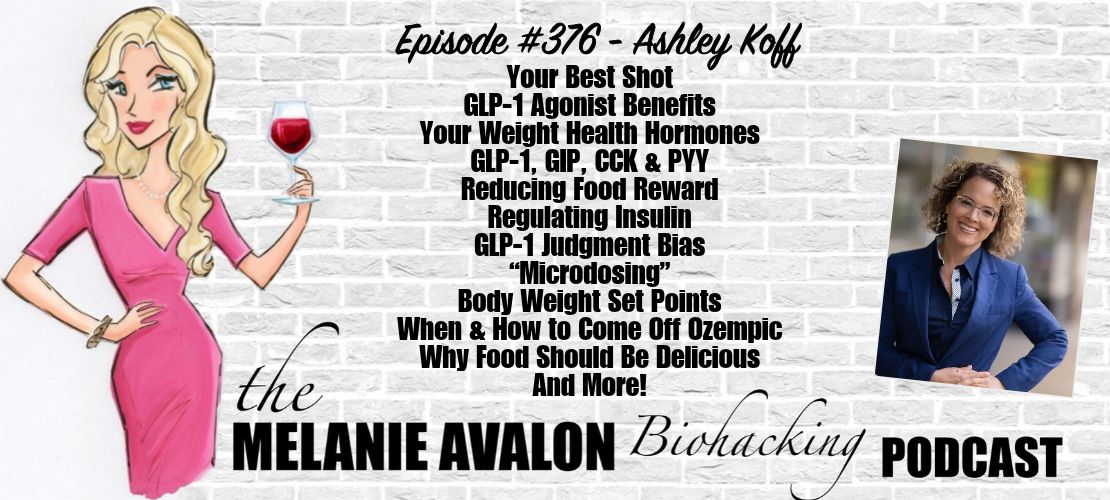
Ashley Koff, RD, is the founder of the The Better Nutrition Program (BNP), the nutrition course director for UC Irvine’s Susan Samueli Integrative Health Institute’s Integrative and Functional Medicine Fellowship, and a faculty member at the Integrative and Functional Nutrition Academy (IFNA), where she teaches “An Integrative and Functional Nutrition Approach to Obesity and Weight Management.” She is also the author of the upcoming book Your Best Shot (HarperOne, Jan. 6, 2026).A practitioner for more than 25 years, Koff is leading a transformative movement in personalized nutrition, turning “better, not perfect” choices into practical, sustainable strategies that deliver real health outcomes. Through patient stories and personal experience, she shows that optimal health is not just possible — it’s essential to living your fullest life. Koff has been recognized as one of CNN’s Top 100 Health Makers, featured in InStyle as “Hollywood’s Leading Dietitian,” and selected as Westin’s global nutrition ambassador.
LEARN MORE:
Website | Instagram
Book: https://amzn.to/3QrB5bZ
SHOW NOTES
FACEBOOK: Join Melanie's Facebook group for a weekly episode giveaway and to discuss and learn about all things biohacking. All conversations are welcome! IF Biohackers: Intermittent Fasting + Real Foods + Life
INSTAGRAM: Follow Melanie on Instagram to see the latest moments, products, and #allthethings! @melanieavalon
AVALONX: AvalonX Spirulina is out now! AvalonX supplements are free of toxic fillers and common allergens (including wheat, rice, gluten, dairy, shellfish, nuts, soy, eggs, and yeast). They are tested to be free of heavy metals and mold and are triple-tested for purity and potency. Get on the email list to stay up to date with all the special offers and news about Melanie's new supplements at avalonx.us/emaillist! Get 10% off at avalonx.us and mdlogichealth.com with the code MELANIEAVALON. Plus, text AVALONX to 877-861-8318 for a one-time 20% off code for avalonx.us.
FOOD SENSE GUIDE: Get Melanie's app to tackle your food sensitivities. Food Sense includes a searchable catalog of 300+ foods, revealing their gluten, FODMAP, lectin, histamine, amine, glutamate, oxalate, salicylate, sulfite, and thiol status. It also includes compound overviews, reactions to look for, lists of foods high and low in these compounds, the ability to create your own personal lists, and more.
EMF: Stay up to date on all the news on Melanie's EMF collaboration with R Blank, and get the launch specials exclusively at melanieavalon.com/emfemaillist.
TRANSCRIPT
Ashley Koff
The weight is a signal. It's a signal of your operational status.
So I believe the right question is are you healthy, or more importantly, are you weight healthy at your current size, right? Or what is your fat trying to tell me? If a hormone replacement therapy is what helps you, one of the great things about it is it may mean that we don't need other medications. When you are hearing things in the research, you're hearing them through the lens of weight bias and through the medications that are deemed for weight loss or for diabetes that are not looking at a weight health ecosystem.
Melanie Avalon
Welcome to the Melanie Avalon Biohacking Podcast, where we meet the world's top experts to explore the secrets of health, mindset, longevity, and so much more. Are you ready to take charge of your existence and biohack your life? This show is for you. Please keep in mind we're not dispensing medical advice and are not responsible for any outcomes you may experience from implementing the tactics lying herein.
So friends, are you ready to join me? Let's do this. Welcome back to the Melanie Avalon Biohacking Podcast. Oh my goodness, friends, I am so excited about today's episode. It is the deepest dive with all of the nuance for everything that you need to know about GLP-1 agonists, AKA the shot, whether or not you should take it, the benefits of it, how to go off of it, all the things. I cannot recommend checking out Ashley's book Your Best Shot enough, and you guys are really in for a treat in today's episode. We talk all about the different weight health hormones because, yes, it's not just GLP-1. There's also GIP, CCK, PYY. We talk about how those hormones actually affect your weight, including when they are natural in your body versus taking them exogenously in a shot form. We talk about the future of these pharmaceuticals, again, including the benefits, and the problems with judgment surrounding them. We talk about whether or not the body weight set point is real, why food should actually be delicious if you want to lose weight, and so much more. The show notes for today's episode will be at Melanieavalon.com/bestshot. Those show notes will have a full transcript as well as links to everything that we talked about, so definitely check that out. I can't wait to hear what you guys think. Definitely let me know in my Facebook group, IF Biohackers: Intermittent Fasting + Real Foods + Life. Comment something you learned or something that resonated with you on the pinned post to enter to win something that I love, and then check out my Instagram Find Me Friday announcement post, and again, comment there to enter to win something that I love. All right. I think that's all the things. Without further ado, please enjoy this fabulous conversation with Ashley Koff. Hi, friends. Welcome back to the show. I am so incredibly excited about the conversation that I am about to have. So it is on a topic that I know you guys are very much intrigued about and interested in, and something that I am as well, and which I am always, always looking for, I guess, the most nuanced perspective, the correct perspective, you know, just trying to figure out w- how people should approach this topic. So the title of today's book is Your Best Shot: The Personalized System for Optimal Weight Health, GLP-1 Shot or Not, and it's written by Ashley Koff, who ... She's an RD. I'm here with her today. She is the founder of the Better Nutrition Program, and she is the nutrition course director for UC Irvine.
Melanie Avalon
She's also been recognized as one of CNN's top 100 health makers, featured in InStyle as Hollywood's leading dietician, which she talks about in the book, so I'm sure we, we'll touch on that, and she's been selected as Weston's Global Nutrition Ambassador, among many other incredible accolades. And friends, so when I got the book, I was, like I said, really excited.
I was really curious what the, you know, what the perspective was going to be on everything, and I was blown away by this book. Not only does it go into GLP-1, it goes into all of our other what Ashley calls switch hormones, which we will talk about, including CCK, GIP, PYY, all of these different things and what they're actually doing in your body. And what's so interesting is Ashley talks about our body's natural production of these, how that functions, how that compares to taking them exogenously in a shot, whether or not there is a, quote, "nature's Ozempic." She talks about how you can support this natural system and what that system actually is, and then there's just so much as far as everything involved in that, so your digestive system's role, the role of hydration. Are you a, a sponge or a hose? Which we're gonna talk about. You know, even the role of joy in weight loss. And it's a beautiful book, very comprehensive. Goes into all of the science while being super approachable. I have so many thoughts and so many questions and just can't wait for this conversation. So Ashley, thank you so much for what you do, and thank you so much for being here.
Ashley Koff
Oh, thank you. You made my day with the introduction and your curiosity, so I'm, I'm really looking forward to this. Yeah.
Melanie Avalon
It's so funny. Like, when I ... So whenever I talk about this topic, 'cause I've been podcasting every single week of my life without stop for, you know, I don't know, like, almost a decade now. So I can remember when topics like this first become popular and we start talking about them, and I can almost, like, see myself sitting there podcasting being like, "Hmm, what is this Ozempic?" And like ... And I ... It's been so interesting to see the rollercoaster just as far as, like, the, the response to it and is it good, is it bad? Should everybody b- be on it? Should nobody be on it? Will you be on it for life? Like, it's so, it's so confusing, honestly.
So for you, your personal story, first of all, what led you to what you're doing today? You know, w- what was your personal perspective the, of the shot throughout that? And also just, like, as a very, as a quick side note ... Wait, by the way, do you, do you narrate the, um, the audiobook?
Ashley Koff
I did the audiobook. Yes, I did. Yep, five days.
Melanie Avalon
Can I tell you that I laughed out loud?
Ashley Koff
Good, yay.
Melanie Avalon
Out loud with the worm part. Like- ... out loud. I, I think I even like, I don't know that I have actually like rewound to listen to, like to listen again to something 'cause it was so funny. I was dying.
Good job. Your personal story, 'cause you had your, your, your whole, you know, journey with weight, with weight and all of that stuff. So yeah, what led you to doing this that you're doing today?
Ashley Koff
Thank you, uh, so much. Okay. So I really think about it this way. If at age seven slash eight when I had gone to the doctor and I was deemed a healthy child and every, you know, check every box, and then it was the, "And now we have to talk about her weight," if my 52-year-old self could have said anything to my eight-year-old self, it was like, "Honey, in, you know, 30 years for you and in 40 years for the rest of the country or even, you know, a little bit, uh, longer on that time period, we are going to understand that your, you act- your body makes weight health hormones, and when they're not working optimally, you're going to struggle. Your body is going to struggle with weight health, and that may mean it may show up in a variety of ways. It may mean that you make fat or are unable to lose fat, and it's in a type and a location that it's not helpful for the body or for, for you. It may impair bone health or muscle health. It may shift where water function is, blood sugar, and your satiety, your ability to, to feel full." But those are all signals that we have to decode. Unfortunately, at age seven or eight, the doctors were not equipped with that.
They were equipped with a societal norm of when you are a certain place on a chart, if your weight is higher versus vis-a-vis your height, then you're going to be deemed overweight or obese, and we are going to tell you that you need to lose weight. It's a you thing. It's not a partnership thing, and it really is, you know, diet and exercise are the tools. So you just need to eat less, and you need to move more. And that was my, my... That was my story at seven or eight. You know, I... And as a why now, because as really when I hit the, uh, about 2004 and was already a practitioner and was working with patients, I realized that none of us had gotten that message, and all of our eight-year-old selves needed it or whatever age our body started to not work the way that it's intended and it started to show us signals. Instead of decoding those signals, we were thrown on a different path, and that weight loss path, the one, especially the path of eating less or eating less often or eating less of a certain group or exercising more or calories in, calories out or drink this amount of, uh, ounces of water or take this amount of, you know, get in this amount of, uh, grams of protein, that all of these messages were missing. They were not aligned with how our body's physiology worked. So my journey, while very unique in that I don't think many people or anyone did a goat's milk cleanse to kill a worm that didn't really exist that was discovered via, you know, blood being looked at under a Fisher Price microscope, that stuff is the stuff of stories and of laughter and of, you know, it was a fun date at a bar, but the reality is that, like, literally everyone that I have encountered has some version of that story in that they, they diverged into either I have health issues, or I have weight issues instead of I have weight health issues.
Ashley Koff
And why I do what I do today is that when I first met GLP-1 in 2004, I met it and its partner GIP as incretin hormones, and I met them as hormones that solely work to help regulate blood sugar. That was all that they were talked about.
And it was ver- it was actually just talked about almost in a blood sugar is this thing that's, like, almost outside of our body or separate from our body in that we didn't look at all the different factors that impact blood sugar, and we didn't look at all of the ways that these hormones could be suboptimally functioning. That became my interest, my work, my obsession, if you will, you know, 'cause it was really how I was helping patients in that time period primarily without the medication, even though, you know, I started to use it pretty early on with patients or w- was involved with patients on it, you know, at that time period. And then a, you know, really interesting intersection happened around the pandemic, and then I think post-pandemic it just kind of blew up, and it was the access to these medications, but they were being called GLP-1 agonists as if somebody had just discovered this medication but not this body, this part of the body. And then the secondary part to that was they were being deemed that they were tools for weight loss and for blood sugar. And when I heard that and saw that and saw how quickly that was becoming the conversation, I was like, "Oh, no. It's not going to go that way," because we are going to either double down on what has absolutely not worked for us for decades, or we're going to use these medications to pivot and learn how our body actually works, and I felt like I wanted to be part of the second 'cause I think it's the most exciting opportunity probably of my lifetime.
Melanie Avalon
Oh my goodness. Okay, so many things here. I promise I won't go on the whole tangent. I did at one point contemplate doing a goat milk cleanse.
Ashley Koff
Come on. Did you have a real worm, or did you have a, a, a, uh, something else?
Melanie Avalon
I always thought I had, like, parasites in me or something. So I, I think the closest I did was I was like, "Maybe I can do..." 'Cause there was this, like, leafer- There was, like, a goat milk, like, ice cream, and I was like, "Maybe I could just eat the goat milk ice cream." Like, but, um, yeah. So I've, I've been there.
Ashley Koff
We've all been really low, right? Like, that's the... We've all had our goat's milk cleanse moment.
Melanie Avalon
We have. We have. Oh my gosh. Okay, so to speak to how nuanced I appreciate your perspective of everything, like, you're mentioning blood sugar and- Even in like, you have one section of the book where you talk about even like with blood sugar, we think it's like, oh, we'll just look at, you know, fasting blood sugar and it means X, Y, Z. But you point out like, there's, you know, like 40 factors that can affect, and you list them, that can affect your blood sugar. They're not even all nutrition-related. And you even make the case that even looking at like A- you know, your A1C, which is like a three-month average, might not even paint a picture. So I just really appreciate the nuance with everything. It's very, very helpful.
Okay. So maybe we can start with a, a really foundational question because I think people are, like you said, you know, people are pretty familiar with GLP-1s, and then they think of them in the terms of GLP-1 agonist, and they think of them for weight loss, maybe blood sugar control, but probably a lot of it is weight loss. You call the book, you know, Your Best Shot, and you talk about this thing called the switch, like you call them switch hormones. So what is the difference? What are the main hormones? And I kinda wanna like... I wish I had like a chart. I don't know if there are pictures like in the actual book. I would kinda want a chart.
Ashley Koff
Yeah, there's a chart there, and I also feel like on my Substack, I have a chart. I forget which post it's in, but my... There's a good chart in there, I think also at, on my website.
But I'm gonna say something a little controversial, and that is it just gives you more insight... not controversial, helping me as a person understand better. I love analogies, and you'll know that about my book. The people who maybe have struggled with my book were like, "There were a lot of analogies, Ashley." And so the switch made so much sense to me because these hormones work like a motion detector or a switch. They switch on, and they switch off. And they switch on in the presence of food primarily, or the anticipation of, and they switch off very quickly, two to five minutes. That's why that made sense. Here's what I want everybody to do. I want you to forget about that term. I want you to think of these as weight health hormones. I think that's the better... Like as I've now been talking about it for so long since the launch of my book, I think there's something actually so much more important to understand. When we understand that our weight is made up of key components, bone, muscle, fat, water, and a little bit of ash, that's me, just a little bit. So when we have those, what really matters, we can't like forget about weight. We can't be healthy at every size.
We can't be thinking like i- in our world like, "Let's just forget about fat. Let's just forget about weight." And that might really upset people. The weight is a signal. It's a signal of your operational status. So I believe the right question is, are you healthy? Or more importantly, are you weight healthy at your current size, right? Or what is your fat trying to tell me? So when I get really foundational with these hormones, and we think of them w- as weight health hormones, I want to explain why. They direct all of the functions and are involved of literally all of the functions that comprise your weight. So I want us to pause there. These hormones exist in your osteoblasts and your osteoclasts and interact with calcitonin. They are, as a result, having impact. GLP-1 and GIP, made in the lining of your digestive tract, that's two of them, have impact on your bone health.
GLP-1 exists in the lining of... receptors for it exist in the lining of your arteries, in the endothelial tissue. That means they're part of cardiovascular health. GLP-1 and GIP and PYY and CCK have receptor sites in your brain and on your tongue. When we in- when we're involved in the brain in that capacity... Actually, CCK does not have receptor sites in the brain. I think I misspoke there. Those... W- when it has receptor sites in the brain, what that tells us is it's regulating and helping the gut-brain conversation of telling, uh, hormones like leptin and ghrelin, dealing with appetite, satiety, with taste, having these things register for us, having the body register it is in receipt of things that it is going to process and should be getting resources.
Ashley Koff
Notice I used the word should there. CCK is involved in the digestive tract with telling acids and, uh, the enzymes to break down, to go to work to break food down. Remember, food isn't healthy or not healthy outside of the body. It becomes a tool for our health, or it detracts from our health depending on if it becomes resources that actually get to the cells or get where it's supposed to be used. So al- like, and also GLP-1 and GIP we know, 'cause I mentioned at the beginning, are incretin hormones. They're involved in our blood sugar. And these are just the foundational places that these particular hormones operate, and they also are involved in muscle, and they also are involved in inflammation. So you cannot be weight healthy if these hormones don't work optimally. And what do I mean by weight healthy? I mean that you can't have fat, muscle, bone, and water in the amounts they're supposed to be in the right types and in the locations for your body to, for your body to be expressing that it is happy and healthy as it is based on your choices. So that is the massive difference that's there.
I was just responding to a conversation that's really popular right now about how the, how these medications... They're-- remember, they're just talking about the medications. They're n- not talking about the hormones. How these medications are involved in cancer outcomes, and everybody has their surprised face on that it might be more than weight loss. Yeah, because weight loss is not something at all that the body wants to experience with cancer. In fact, it's often one of the worst side effects. But one of the things that's interesting is if we can optimize our weight health, our bone, muscle, fat, inflammation, satiety, blood flow, I'm forgetting something else in there, while we're recovering from cancer, you bet your bottom dollar that our outcomes are going to be better.
So to me, that's the huge opportunity here when we get foundational is to understand the body- That the body wants to be weight healthy. It has these weight health hormones that tell other hormones and neurotransmitters to go to work and do what they're supposed to do. They go on and off for about, in about two to five minutes. And now today we have a couple of them that are made as weight health hormone replacement therapy that will work in much higher, higher amounts, so they're exponentially working. They're turned on for a lot longer. They're not a switch. They're more like a force field. They're on for a day or they're on for seven days. But in helping the body achieve that higher sustained level, the positives of the medications are that it actually helps the body work the way that it was intended. There are of course considerations, which we can discuss.
Melanie Avalon
Like the four different ones you talked about, so GLP-1, GIP, CCK, PYY. So when they're naturally in the body, how interconnected are they? Can one of them be not working properly and the others are? Or if one's not working properly, are they probably all not working properly?
And then, like, the flip side question of that would be, you know, based on how interconnected they are, so if you're just doing, you know, an exogenous GLP-1 situation, then is that downstream affecting all of the other ones as well?
Ashley Koff
Melanie may be my favorite person ever. Come along w- for a ride right now, 'cause she just opened the Pandora's box into geeking out. I'm so excited.
I'm also gonna say that, like, for those of you that really love this, like, I d- there's a new agonist that went through some research, and now as a result it's being talked about, called amylin. Uh, it's an amylin agonist, and they combined it also with semaglutide, and it's teaching people that we have another weight health hormone, amylin. Nobody just yet has done one with oxymodulin, so I feel like I'm one of, like, the geekiest out there, 'cause I'm talking about these others. And I actually debated putting all of these into my book, and then I was like, "Okay, I'm gonna lose everyone. Like, four is the max." You know what I mean? So I love that you asked the question.
Melanie Avalon
I was gonna ask if there are any others.
Ashley Koff
Oh, yeah, yeah. Yep, we're getting there. So there's a couple of different ways to think about this. There's one way to think about, which is the hormones at work in... It, it's a whole system that they're working in, a whole, like, if you will, series of dominoes, right? Like, we taste something or we smell something or we think about something, and then the presence of what we're taking in, it, it sends off, like, maybe it sends off GLP-1 and GIP first, and then it triggers, as things, as stuff actually comes down along, it triggers PYY and CCK. But we also know that our brain thought process, the vagus nerve can actually deliver some of these signals and, and that triggers the cells in the gut to say like, "Okay, I wanna activate these," and then they're deployed through our bloodstream, and they're also deployed back via our vagus nerve. So I bring up that whole, like, infrastructure, if you will, to say that, like, any challenge or suboptimal function, like, if there's a roadblock in one of those or there's, it's too crowded or something isn't, you know, going the right way or food is designed or, like, is chemically designed or restructured to not allow something to be picked up, which has happened, like, all of those things will be affecting.
So could... Like, is it, is it possible that we have one that's suboptimally functioning? Absolutely. I think that's... Uh, like, what semaglutide has showed us is that for many people GLP-1 by itself is one of the biggest factors. Now, what's interesting is when you add GIP, GIP is one of the ones that has more of a, a dominance in things like bone health, more of a dominance in the, some of the liver fat conversation, the glucagon, so actually breaking down and creating and releasing sugar, you know, i- in the absence of, like, changing how that mechanism happens. So I would say GLP-1 and GIP are, like, probably tied closer together, so my expectation would be... You have your L cells and your K cells. My expectation would be that if those, if one of those is suboptimally functioning, I think it would be hard for us to expect that the other one would just be totally optimal, you know? That it might be a, a one-two punch there. PYY and CCK are a little bit different just because they're, they're located a little bit differently. But I have this conversation, and tell me if this lands for you. So when you're on a GLP-1 agonist, you are instead of having... And I'm gonna say just GLP-1 for a moment, so semaglutide. When you're on it, your own GLP-1 probably doesn't have to go f- to work, because what's happening is you're taking either a shot or a, an oral that then goes right to the receptor sites, and it means that the receptor sites are satisfied. So it means, like, if you took a whole neighborhood, all the cars are, like, in the garages. Like, you're not trying to, like... Y- the garages are already full.
Ashley Koff
So your body, it might still get the signals for your own hormones to be, like, it, they're gonna come and the signals are gonna be like, "Okay, you should deploy those," but if the receptor sites are full, at a certain point the body's gonna be like, "Why would I send you to a garage that's already full?" Right? Like you're, it's, "We're already satisfied. I don't need that." So there was o- To the best of my knowledge, there's only one study that has looked at this, and it was on liraglutide, which was a once daily injection. And it showed that when you're on that, um, this is an oversimplification, but this would be my takeaway, when you're on it, your own hormone is suppressed. It's not turned off, but it showed a suppression, and a suppression of a couple of weeks on that part. So what's interesting about that is, like, we could think about, like, as an example, if I'm a smoker, I probably use m- or a caffeine drinker. Maybe caffeine is, is easier to think about. If I drink coffee to go the bow- to have a bowel movement, then after, let's say, like, a month of having a couple shots or a shot of espresso every morning and then having a bowel movement, if I go without it, I might not have my bowel movement that morning. And it's not that my body can't do it. It's that it got used to another agent coming in. It just got lazy or, like, turned off, you know, if you don't like to call your body lazy. And so it was like, oh, it's suppressed, it's just, you know, on, on that part. So I think what you're bringing up that's interesting to me that people have not been looking at, 'cause I don't think there's any financial incentives to it, although there might be incentives when drugs are developed to mitigate side effects of the medications, um, you know, as, as that happens, is that if you're on a GLP-1 agonist and now your own GLP-1 ... d- your own isn't going to work. Like, the, the vagus nerve is getting the messages, it's knocking on the door of the L-cell, you know, it's coming, it's like, "Hey, go to work, GLP-1," but GLP-1's like, "Why should I?" Like, "I got the day off of school." So then do- at that point, do GIP, PYY, and CCK also get messages that they, they're off school, right? And one of the reasons we know that to be a little bit true is that the delay of gastric emptying that happens when the GLP-1 goes to effect at that sustained level, that is messaging for CCK. That is messaging for PYY, that it doesn't need to do its job, because that's part of the mechanism that it's does its job for. Does that land at all? Like, I, I... Like, it makes so much sense in my brain, I just don't know if it lands for anyone else, so I'm just a- asking you.
Melanie Avalon
Yeah. So, so PYY and CCK would normally promote motility?
Ashley Koff
Or they would... Or their mechanism of action would be part of working with GLP-1 further downstream to make sure that the delay of gastric emptying occurs. And since they're not needed because the delay of gastric emptying is already occurring, the question mark becomes do they need to go to work?
Melanie Avalon
The natural production would get down regulated and the body's getting the signals that everything is happening with the intended functions of the GLP-1, and then some of those, a lot of that overlaps with what, like, PYY and CCK are doing, so they might not step up to the plate as much.
Ashley Koff
At the same pacing or in the same amount. So I don't think what anyone has done is tested in a person on a GLP-1 what are the changes in your CCK and PYY levels, right? Of your own, or the production of, and even the attempt of deployment of your own GLP-1. And that's actually a really good point, too, because testing in a non-medication, a person not on a medication, it's pretty close to impossible to test our own... We can test the potential of GLP-1 in the microbiome to see, like, how are my L-cells functioning. But because they turn off after two to five minutes, you're mostly... The most of the tests actually just test the upstream, like, have it, has it been deactivated or have other signals occurred? And that's really important for research as well because a lot of the research is still more speculative about what the impact, what's happening to our own GLP-1.
So maybe someday in the future, I think it would be really cool if there was a GLP-1 continuous monitor, right? Like we have for glucose. Like, that would be super cool, but we don't have it right now, you know? And we don't, uh, likewise have continuous insulin monitoring. We have a... We can draw our fasting insulin or, or like H-O-M-A... Like, we've got oth- other labs that we can do to get a picture, or we can get a 90-day average of what's happened with blood sugar, but we're not actually seeing, like, how insulin, what's happening to insulin in every moment in terms of its messaging, and we're definitely not seeing in terms of GLP-1. So a lot of this is around... One of the reasons I actually created the assessment that I put in the book was that I wanted people to have a functional way to assess their own hormone operations because I don't have a way of saying to you, "This is what your level is," right?
Melanie Avalon
Mm-hmm. Yeah.
And actually, okay, this is a huge question, not to go in a rabbit hole, but that I have had. This is probably the question I've been most confused about ever since I started learning about GLP-1 agonists, which is, like, the messaging for so long has been we wanna reduce insulin, we don't want too much insulin, all the problems with too much insulin. And so I was so intrigued that GLP-1s actually promote the release of insulin, and that is a good thing. So what is happening there?
Ashley Koff
Yeah. It, it... I would say ins- I think we should get out of the world of good or bad when we come to talking about what happens in the body. It's information, right? Like, even with genetics, I don't say like APOE4 is a bad gene or, like, or a bad version of the gene. I'm like, this is telling me data. It tells me about inefficiencies and efficiencies. And so what we really wanna do is understand how your body works, right? So what we do know is that if insulin is not going to work on time, then we know that there are more cars on the bloodstream freeway or highway, and they hang out there and they don't get into the cells. So promoting insulin to go to work in people who are insulin resistant, where insulin is not going to work, could be very favorable, right? So what it's doing is it's helping that insulin go to work. It's like if you show up at the airport and there's a bunch of Lyft or Ubers, like, waiting for you instead of, like, you have to wait a period of time for them to become available. You can tell my, the bane of my existence.
So we're like, okay, that will... Th- and then they get there and they pick up the, the sugar and they go and they take it to the cells. Now, the consideration, and this is why I think your brain is, like, struggling with this part, and remember, that's really what GLP-1 does and also GIP, but they modulate it with, with glucagon as well. But what they're... The consideration is what if I now tell insulin to go to work all the time? What if I'm telling insulin to be ready to go to work or even are telling it to go to work all the time, including while I sleep, including when I don't have food in my system? That's the place where we have to look at what you're doing is. It is... That's a metabolic activation mode. That is the opposite of rest and digest. That's what's happening to, in people is where, what it's doing is it's challenging rest and digest, and it's pushing out being metabolically active. So another way of thinking about it is it's basically making you a Forrest Gump. Like, you're gonna just keep running all the time, and your body's like, "Forrest, could you please sit down? I need to take a break." So one of the other things that I wanna, and this is why I really believe in developing a personalized nutrition plan around it, is I wanna then make sure that we're eating in a way and that our total nutrition is resourcing in the body in a way that it's giving it what it needs for rest and digest, and that it's also hopefully giving it what it needs at more regular intervals so that that insulin can just pick up and use what it's, what it's getting. So I have people, like, pit stop about every three hours. Like, one of the worst things that can happen on a GLP-1 is when somebody says, like, "I'm on, I have no hunger." Like, one... It's one thing to have no appetite, which means I'm not interested in food. It ha- is another to literally be like, "I don't experience hunger. I literally don't get the call to action that my body needs nutrition, that it needs resources." So when that's happening, somebody might not be eating.
Ashley Koff
Like, they'll tell me they don't eat all during the day, and then they'll have something to eat at, like... I have a lot of patients like this, at, like, five, six, 7:00, you know, that, uh, at that point. I'm like, "Okay, that's not okay." That usually means to me it's too high of a dose, or it means to me that digestive health is, is so far compromised, maybe even with preexisting compromise, that we have to work on, you know, we have to come back and, and restore it. Because when your insulin is going to work like that, we want it to have... We want it to pick stuff up. We want it to work, right? Like, we want it to... It's a part of a whole infrastructure, a whole system that's going on. So I like to have people, you know, within about an hour or two of waking, I like for them to get in some nutrition, and then they pit stop every couple of hours to get in nutrition. It's also why when somebody's on a GLP-1 agonist, I'm very focused on their, like, pre- and post-workout nutrition, right? To make sure that the act of then working out doesn't so deplete the body of resources that they then don't have something in the body, and insulin is going to work and it doesn't have anything, because you could end up with low blood sugar, right? What if you stay on? What if you're on a diabetic medication in complement with your g- your GLP-1? We've had people where they've had breakthrough really low blood sugar, and it's scary, you know, incidences like that. So anything that we're using at a supraphysiologic or really exponential level like this, we really have to make sure that we're under, that we're looking at that. And a big place, you know, one of the biggest side effects of, that are talked about with a GLP-1 agonist is very mis- misunderstood by the physiology. It's the fatigue. And when we have the experience of fatigue on a GLP-1 agonist, it's often the remark is, well, yeah, 'cause that person isn't eating enough. And that is absolutely one factor. That could be. They could not be eating enough or not enough in that moment or not enough, like, in the diversity of what they need to get in, you know, carbs, fats, proteins. But it could also be, more often than not, what I'm seeing is that it's the suppression of rest and digest. Even if they're going to sleep, they are not having the depth of sleep and the, the, the depth of rest and recovery that they were having prior to that. And especially if you weren't having good sleep and recovery before, which many of us are not, like, exceptional at sleep and recovery and digestion before, this could really be amplified. So one of the things that's just missing in this whole conversation, and it's why I think it's so easy to be pro or con a, a GLP-1 agonist, but I also think it's the biggest mistake, is that it's not... When you don't understand that the medication is actually illuminating where are the issues in the infrastructure or creating possible challenges in the infrastructure, then that's, like, you're, you're... And, and you just, like, kinda go patently, like, eat more protein, extra strength train more, get in enough fiber, drink enough water.
Ashley Koff
You're going to be missing, you know, what somebody really needs in that space.
Melanie Avalon
So I understand, like, the analogy of, like, insulin coming in and, and, like, finally clearing out the blockages and, like, you can actually do what you need to do with the food nutrients. So a person not on a GLP-1 agonist who is experiencing hyperinsulinemia, so they have high insulin levels, you know, perpetually, and then they go on this, and now they're releasing the... That's encouraging insulin release.
Is it that it's just adding more insulin, or it's helping the insulin function better?
Ashley Koff
Yeah. Usually they're not having too high of insulin. Like, usually it's insulin resistance, right, that we're correcting for, where it's that the insulin challenge, like in a diabetic as an example, 'cause this is where the medication was designed for, it's that you're... I think you're, I think where you're struggling is hyper versus hypo. So let's talk about hypo 'cause that's the most common on that part.
I think if you are... If the body is not producing or deploying enough insulin to cover what's in the bloodstream, that's where we're going to see issues, and that's usually what we see. Now, the person that produces too much insulin, that's gonna be someone, and it really, it depends a little bit more also on glucagon and what's going on there. That's gonna be a little bit of a different, like... I think you would have to be careful with how you're using a GLP-1 agonist in that situation, and also which GLP-1 agonist you were using.
Melanie Avalon
Okay.
Ashley Koff
Is that helping or, or d- And maybe there's a case that you're thinking of that you wanna share with me.
Melanie Avalon
So I guess, I guess with, like, stepping back in a more general approach, it seems like a lot of people have high insulin levels.
Ashley Koff
High insulin. That's right. Okay. So high insulin is hyperinsulinemia.
That's where you're go- I now understand. Okay. We actually want... These are where labs are a little bit different. We want our fa- we don't want it to be too low, but we want our fasting insulin to be on the lower side. But when you have a higher fasting insulin, this is the same with leptin, it's actually telling us that your insulin is not working better, that it's the low, but it's the lower side, it's not the higher side. It's an insulin resistance. So we're, w- we're... I think what you're... Because it's the fasting side of it, where it's like the, the insulin levels are not... How do I say this? It's a lab ... distinction that's not, we're not getting the right messaging for the body. So when a person who has high fasting insulin, we will use a GL- we can use a GLP-1 to help lower that, but what we're actually doing is addressing insulin resistance, the use of insulin in the body.
Melanie Avalon
Okay, yeah. So that, so that's my question.
Is it... That's, 'cause that's it exactly it. So my question is, the way that works, is it that it just barrels through by adding more insulin, or does it actually let the current insulin get into the cells better? Like, does it change how insulin is functioning, or does it just release more insulin so there's just enough insulin to get through? Maybe it's not either/or.
Ashley Koff
No, no, I'm b- I'm try- where I am trying to look at is I'm trying to look at an anal- I'm trying to come up with an analogy, and it's not landing. So what I want us to think about is that the higher that your fasting insulin is, is that your pancreas is trying to... There's insulin resistance. So you're going to be, it's gonna be pumping out more insulin, which is what we're going to see, but the insulin is not going to be being used effectively, right? So it's not going to be... So you've got the, you've got excess of the hormone just to try to normalize blood sugar. So it's not working effectively.
So when we c- because remember, GLP-1 then goes to the pancreas, to the beta cell, and it comes over and it acts as a crossing guard, and it starts to regulate the pacing of how we pump out that insulin. So you're not pumping it out as fast. So in a weird way, you're lowering insulin while enabling insulin to work better. I think it's one of those, you know, it can often be tricky for us to see high things as a lab and be like, "Well, I just have to lower it, but now I'm gonna go on a medication that actually promotes it." What I think we want to do is we want to think about that actually the medication is not promoting pushing out more insulin, right? What I think maybe where, where I could phrase things better, so thank you, is that this is not just about it tell, it telling insulin to go to work. It's telling insulin to go to work the way that it's supposed to go to work. And I think mistakenly communicating that is super helpful because if I see a, I'm just gonna use a high example. If I see a, a fasting insulin above 10, right? Then I'm gonna turn around and say, "Okay, I want it 5 or under in optimal land," right? Like, borderline is, like, 5 to 10, you know, on, on that part in my mind. So the, the 10 is telling me, oh gosh, like, you have somebody over there that's just pushing, your beta cells are just pushing and pushing and pushing insulin out, which is a huge thing that we get worried about because that's, like, overuse, right? Like, we don't want the body to then turn around and be like, "I can't do this any longer," you know? Like, "I'm done with this insulin thing," or like, "I'm gonna have a breakdown on that part." We want to slow down the pacing. So what we want to do is we want to come over to the beta cell, and we want to turn around and say, "Let's now have you pump less but more effectively." That's what we're doing.
Melanie Avalon
Okay. That an- yeah, that completely answers my question and why I've been so confused, 'cause we were always like, "We don't want high fasting insulin." And so then when I was hearing, you know, learning about it promoting the release of insulin, I just was like, "I don't understand." Okay, that, that makes sense.
And so when... Okay, so say a person is in a state of insulin resistance, not on a GLP-1 agonist, and then they go on and now it's regulating that production. And then if they go off, will they have fixed that problem in their pancreas?
Ashley Koff
Really good, really good point. Yeah. I th- I think it's really good, and it's like where... I love this. We get to so geek out on that part.
Okay. So what we're trying to do is we're trying to correct for a mistake that is happening, and the mistake that's happening is we really only want insulin to be triggering when blood glucose levels are elevated, like after you've eaten on that part, right? And then return on, on that piece. So what we're trying to do is we're trying to make it so that, like... 'Cause there's, we can't just look at the pancreas. We have to look at the liver because the liver will often add more stored, like when it's malfunctioning, that's the role of glucagon. It's going to s- g- glucagon can be releasing more sugar into the blood even when you already had sugar in there, when it, all of this is misfiring, right? So it's not just the pancreatic beta cells. It's the whole, it's an entire infrastructure issue that's going on. Okay. If we are on a GLP-1 agonist and we come off of it, and we just c- are we just like, "I'm on it today. It's working and it's doing those things for me. But tomorrow I just woke up, it was time for my new dose, and I just decided not to. I couldn't. Somebody told me to be off of it. I didn't have access to it," whatever the issues are. You, your body is not, at least for a period, I would speculate, especially if you've been on it for a bit, that it's probably gonna take about a month, in some of my patients it's taken over a month, for your body to actually return to where that two to five minutes, if it was wor- if your own was working optimally, where the two to five minutes could kick into gear and do at some level what it's meant to be doing. So what I mean by that is you come off of the medication, and you are in a suppressed and artificially suppressed state because you've been on the medication, 'cause remember, there's a half-life associated with that medication. That suppression is going to stay, which means your own hormones, which were likely sub-optimally functioning before, so not even every t- going on for two to five minutes every time there was the presence of food There's, they're not f- they're not going to even restart. So that, like, in that first month, that's why we see considerable amounts of blood sugar bumping back up or fat regain or other things happening in that first month, right? You know, on, on that part. Now, could they restart, and could you have an impact with your own? Absolutely. But you're only ... It's g- not gonna look anything like what was happening when you were on the medication, because your own work for two to five minutes, they get called to action for two to five minutes after food, versus the ones that were staying on in your system for seven days or were staying on your system for a day, depending on which medication they're on. Now, there's a caveat to that. Let's say that during the time period that you're on a GLP-1 agonist, you actually optimize digestive health, you optimize all of the components of the infrastructure.
Ashley Koff
We're eating more like a race car, we're optimi- you know, we're pit stopping for nutrition, we're moving after we eat, we're balancing our nutrients while we eat, we're optimizing hydration, we're sleeping better, we're, we've reduced, you know, things that are, like, sources of high added sugar or, you know, we're, we're consuming more nutrients. Our body has an optimal level of things like magnesium and vitamin D and, like, all these other things.
Then I decide to wean myself off of the medication, where maybe instead of if I've been taking it every week, maybe I either go down on the dose, or maybe what I do more often than not is now have somebody go to two weeks, and then they go to three weeks, and we start to see how long it, like, where in there it's working better for them. And then when they have any symptoms that it's not working so well, we lean in with some additional things that can help them, like that are non-medication related, that help them. Then can we start to have their... Can we, like, go through a process w- it's a parallel process of we're weaning you off the medication, and we're weaning and upleveling your own so that you arrive at this moment in time where you no longer are on the medication, and you also don't, and your own body's operations are enough or optimal for you and, and your needs? Absolutely. That can happen, but that can only happen if a- like, as all stars are aligning, if you're, if you can keep doing e- and everything that your body needs on that part. You know what I mean? That's why I actually focus on the time period where my work, especially as a clinician, you know, practitioner in this space, I think one of the places I'm most critical to your operations are the three months before you start weaning off of, and then the year that you're deciding to wean or even come off of the medication, and seeing how we're doing in that part.
Melanie Avalon
Okay. Wow. So it, it could be, it could take, like, a year.
Ashley Koff
Oh, I, I don't even give somebody... A year is my shortest time shot if I have the ideal world, and nothing about being a practitioner in 2026 with our healthcare system and with where our bodies and lives are and stress levels are is ideal. There are four reasons people come off a medication. One of them, one of them is I've optimized my weight health. I'm where I wanna be.
My body seems to be ready for it. Let's go experiment, and we start the weaning process. Everything else is I've either lost access because of availability of the medication or finances, I find the side effects so intolerable I can no longer handle them, or my doctor no longer thinks it's healthy for me to be on them, and t- and removes access, and then the fourth one on that part would be I have a health or a life stage change. I'm pregnant, I have a new cancer diagnosis, I have to have surgery, I'm traveling to another country. Like, there's something that has happened, and I don't, and I'm not gonna have the medication, and I go right off of it. And those are the cases that I'm working with almost all the time because we are, you know, we're really in a challenged spot in that space.
And so my job there is to try to mitigate the damage that will happen of coming off something. And I wanna be clear, this is the exact same, because of, I have to say this, because of the weight bias that exists in this country and around the world, that's the exact same for the majority of medications. If you told me today that for the last five years you've been on an SSRI or on a statin, and tomorrow you're going to be off of it, I'm gonna be doing the same thing. If you told me you're on a proton pump inhibitor or you're on allergy medications, like, and tomorrow you're gonna be off of them, I'm gonna be doing the same thing. So we don't, we don't look at this as a, oh my gosh, this medication, we have to use it differently than other medications. W- The only people that are looking at it that way are the people that are belying a true weight bias, w- and, and this is, you know, included in the practitioner space.
What we do need to remember is that anyone that's on a medication, if you are going to come off of that medication, we really have to make sure that your body can do whatever it i- like, we've fixed what was going on underneath, or we understand what is not fixable, and we have a backup plan for that.
Melanie Avalon
You mentioned the dose and people being on too high of doses. The conventional doses, do you think they are appropriate, or are they possibly too high? Like, where do, w- how do people even know what dose to start at?
Ashley Koff
Yeah. So I'm the backwards doctor, so instead of DR, I'm RD. So legally and scope of practice, I'm not supposed to dose or recommend dosing, um, uh, so this is all observational data, or, or I will say, uh, anecdotal data from my practice, um, and my work in this space, and again, since 2004. We have to remember that these medications have been used in persons with diabetes, type 2 diabetes, and persons who qualify primarily as morbidly obese.
It, it then became obesity, and then we've kind of moved into overweight with some additional factors. So The first thing that I would say is if you're... I hate total weight for height. I just hate looking at that. I find that such a useless tool at all, but we have to have an understanding that that's the criteria that dosing was developed against. So if that is not you in that space, if either you're not diabetic or you don't have... Your weight for height is not putting us in one of those categories, then definitively the dosage is not set for you. Like, you should not be following the dosage that the, that the preexisting dosage. You should be talking to your doctor about that. Now, in this country, we tend to dose most medication based on weight, um, sometimes related, obviously of course, to, to symptom, but I think that's an important thing for us to, to pay attention to. It also means that as somebody is on the medication and losing weight, we should be adjusting their dosage and not considering just increasing it or keeping it the same, right? And that often doesn't happen. The second thing is what isn't happening in the dosage conversation is assessing existing digestion, and we know that the mechanism of action for this particular medication is it will delay gastric emptying, which is going to reveal or potentially create digestive challenges.
So if you have preexisting digestive challenges, my belief, my protocols, my efforts that have proven successful with my patients is to adjust your dosage differently, and that includes women who maybe have real digestive challenges for one week or one and a half weeks of the month, you know, around their cycle or, you know, or, you know, s- a, a man who is on a medication or dealing with something, you know, as it relates to his digestive health. The third one that's important to think about is the dosage of the medications and the anointment of... Like, we, we're, like, running a race, like, and we're judging... We're, we're, we're doing a sprint contest, like, at the Olympics when this really should be a marathon if it was even going to be a race. But the sprints are always, like, who's the first person across the finish line, who got there faster? And so we're looking at faster degrees of total weight loss, and that's actually the worst thing for the body. When your body loses weight quickly, it goes into... It, it shuts down a lot of things, and it goes into a lot of states of stress.
Ashley Koff
So when we change what the goal is and we change the goal to a weight health outcome, and we say we don't want fast, we want consistent, I'm not trying to not have us lose fat mass, but we want to consistently shrink fat cells and make sure that the toxins, the emotional and the physical toxins that are in those fat cells are getting eliminated, and they're gett- they're, you know, um, getting... They're both liberated and getting eliminated, and the person, the whole being is able to keep up with not losing muscle, not losing bone, not losing hair, like the nutrition, uh, that allows their body to still perform and not be scared or afraid, like the body isn't, you know, going to this stressed out space, that's the better win.
So when I look at dosing, I absolutely think that the baseline dose is probably inappropriate for many of the people that are using it today, and if we didn't use just your weight for height to give us what your starting dose should... Like, we use the same dose for someone, whether they're 20 pounds, like theoretically, 20 pounds overweight or 300 pounds overweight. That's the same starting dose. Like, we would not do that for anything else about that person, and I think that that's, like, to me, the part where, you know, again, this, a lot of this is living in, like, either obesity medicine or in endocrinology and, you know, as the backwards doctor, I come in and I look at your body as a whole, and I'm like, "What signals is it giving me?" And it's gonna tell me that you are very likely to be... to encounter more challenges, and as a result, have less positive outcomes if we don't address your digestive health issues, and maybe that's gonna... And, and that typically requires us starting lower and going slower, but that's not gonna win the, "Hey, this is the best drug out there," pharmaceutical, patent, newsworthy race.
Melanie Avalon
Do you know if there's data on the amount of time you've been on a GLP-1 agonist and how long it takes to recover? So if a person went, like, really fast and lost weight fast, but then they're on it for a shorter amount of time, would there be benefit to that because they weren't on it as long, or does it not matter?
Ashley Koff
Well, let's, let's unpack a bias in there. What's... Why would we... Why would it be better for someone not to be on it for a longer period of time? If a medication is supporting, if it's agonisting, it's supporting our body's own hormones to work the way that we want them to be working, why is there... why do we talk about a, "This isn't a you thing, this is an everybody thing," why do we talk about it being better for them to not be on it? Now, there's one argument which is everyb- it would be so great if nobody needed any medications ever. Like, that's the argument, right? Like, everybody's like, "Hey, it would be great to just come off of all the medications." But, you know, I don't hear when people are started on a statin or when they're started on thyroid hormone or when they're started on estrogen r- hormone therapy anyone saying, like, "Well, if we could just have you get faster results so that you have fewer hot flashes, and we could just get you off that estrogen," right? Or, "We could get your thyroid working, and we could get you off that thyroid." This is weight bias. So first and foremost, if a hormone replacement therapy is what helps you, one of the great things about it is it may mean that we don't need other medications. That's cool.
Or it may mean that you're able to lean into choices to optimally resource your body, and when your body is optimally resourced, it is going to reduce risk of disease and, you know, other things from happening. So that would be number one. So the argument that being on it for a shorter amount of time is in any way better, the only time that argument plays out is also if it's a financial argument. Could I just use this for a quick period of time? And I would say no. I would say I would so much rather that you used one dose every ... two months and you used it over the course of a year and we had slower results around it, there's a lot of holes in my argument right now, than if you only used it for one month and you took it four times. You know, or that kind of thing. I think it's a flawed concept if somebody's saying like, "I'm only gonna go on this for this short amount of time." That's a very diet approach, and this is not a diet tool. The second thing that I think you were asking, I think re- is a really great one, and it allows us to bring up the whole conversation around amylin as an agonist. So amylin exists, the receptor sites are next to, in the beta cell also, but it also goes into the... So it's released from, from, excuse me, it's released from the beta cell. The receptor sites are in the brain. So it's a pancreas to brain, not a gut to brain. This one's gonna be very interesting because it really works on the reward structure that we get from fat and sugar. It's really like tackling so much of what's been created in our food supply and, and, you know, what people really are finding challenging. So when we look at that one, that one, people are like a little meh on the data. You know why? Slower weight loss. When the data came out, they were like, "Ugh." And I'm sitting here going, "Wait.
Ashley Koff
We could leave your gut alone. We could optimize something that might be suboptimally functioning from your pancreatic beta cells to your brain. We could help messaging in your brain around dopamine, which also has everything to do with reward." Now, if we abuse it and you also are no longer feel reward or pleasure, I don't, I, that would be an abuse of it, right? But we could actually have your body not get high from sugar or from fat, and it was just like, "Ah, great. Take it or leave it." I liked the icing on the cake, but it didn't have me like running to the store to eat the whole cake. That would be an Ashley Koff, uh, situation. So in that situation, that's crazy. And you know what happened with the medica- with this medication? It was like 60% less vomiting, right? Like, I mean, it was like all, there were these studies. Now to be fair, they did a mix of amylin and semaglutide, and that one looked almost the same as semaglutide, and the amylin alone had less of this, but it, the weight loss was so slow they, they're like, "Ugh, I don't even know if I wanna explore that further." That's the problem that we're in right now. We're still in a society, we still have practitioners and pharma and insurance and individuals ourselves because we were trained to g- to judge our own success based on a number on the scale or to be judged by it, and that's the core problem. When we flip it and we say that what we're really supposed to be doing is looking at the check engine lights to see what is not working optimally in our body and helping optimize it, we're not supposed to have a degree of cravings or to experience a reaction to a food that is similar to a reaction to a drug that is that intense of a reaction, right? Or a need or like an addiction or that kind of thing. So if those are signals, if we're experiencing that, that tells us that there is something that we can work on, you know, that we can h- and, and we can optimize, and if in doing that, that means that we shrink fat cells at a slower pace, but we continue to shrink them, and we also don't accrue them, that's pr- you know, accrue fat in the fat cells, that's pretty cool, you know, on that part.
Melanie Avalon
Wow. Okay. So many things there.
So that one that's working on the pancreas to the brain and the reward system, amylin, so it could even, even in the face of ultra-processed foods that are engineered to, you know, create this reward response, it, it calms that down? Like Funfetti would not be tempting to me?
Ashley Koff
Yeah. Wouldn't it be really interesting if it w- it basically turned around and said, and this is what I think will be so interesting, is if it works on the neurotransmitters there, are we going to find, and this is where I think what the f- the thesis is with com- with combining it with semaglutide and not having it alone, is it that we really need the one-two punch of the physiologic I'm not going to have the craving even though it was designed to override my satiety, it is not gonna work, and I can now punch back, but my memory of Funfetti could so override the physiologic response, like so do you need the one-two there? And I think that's what's interesting. We don't have that information.
The o- the thing about that that I think is also so interesting is you started off the conversation talking a little bit about, and you're, I love this about you, you're very interested in the data and the research. My problem with the data and the research in all of this, and I am not, not, I'm not anti-evidence, I'm not anti-science, any of that, but it is very difficult. Like we cannot evaluate this stuff in rats, right? Like, or in mice. They are not sitting there like sitting outside of a Starbucks wondering, "Do I go in or not?" You know what I mean? They might be scratching at the outside of a garbage can and wondering if I could go back in there for the, you know, what I threw away in the garbage can, but they're not like living in a day. And they're also, to the best of our knowledge, not thinking back to the real reason that I wanted the Funfetti is I really miss my mom, and I remember when I was really sad and I was 10 years old, she gave me Funfetti, and I just right now really need, I need to feel safe and loved and I like feel that way right now. Like the pr- that's the problem that we have in research in the same way that we have the problem there are statistics that say that six, you know, when people go off these medications, they will regain their weight and 65% will regain their weight within a year. Okay. Well, I just told you four reasons why somebody is going to go off the medication. If we don't parse that out, my expectation is that of those people, probably only 10% of them had optimized their actual weight health. The rest of them may have gone off for a variety of those other reasons, and I would've expected it to be 90% weight regain. You know? I'm like, "Oh, look at that." Like, in the absence of all... You know, that... So what, what isn't happening, uh, you know, and what really the void that I'm trying to fill by having these conversations is to help people think through that when you are hearing things in the research, you're hearing them through the lens of weight bias and through the medications that are deemed for weight loss or for diabetes that are not looking at a weight health ecosystem and looking at the infrastructure, and that the research is not looking at the infrastructure. So as a result, it is very unlikely that that is going to be the outcome for you personally. I can guarantee it will be the outcome for you personally if certain things aren't in place, absolutely.
Ashley Koff
You know, if you're one of the ones that just stops it and comes out, like I can tell you, here's what's going on in your body. This is very likely to be the issue for you, you know, or the outcome for you.
But the positive outcomes that ma- so many people are having are really dwarfed in response because we're not, we're not able to ar- you know, to talk about that part in the same way.
Melanie Avalon
I love what you were saying about, you know, the judgment of different medications and how we... Like we don't, we don't really judge people for being on thyroid medication or, you know, if you're type 1 diabetes, we, we don't judge that, but we judge type 2 diabetes. It's, it's so interesting because I remember, like when I started seeing like system-wide that people were getting metabolically healthy again on these, on these medications, it- it's just so interesting to see all of the judgment about it, like that it's like taking the easy way out or that it's like a bad thing, and I'm like, "But all these people are actually losing weight now."
Ashley Koff
Well, and I, I say, I say, and it's... So let's, so let's talk about they're not actually losing weight. These people are becoming weight healthy. They're empowered.
So you're talking to somebody who had 20 years of practice in Los Angeles where Los Angeles people were always finding ways to lose weight. They were abusing Adderall. They were on cocaine. They were not eating at all. They were having colonics on a daily basis. Like, I have seen what people will do in the name of losing and maintaining weight loss. When I see them using these medications now or when I'm helping them use these medications, not to abu- not in an abusive way, but using it to become weight healthy, this is the first time I'm like, "Wow, you're actually d- this is, like this is a way to do this where you're actually helping." Like this has a longevity or a health span component to it. I'll flip it another way. I'm not gonna talk about, I don't work with, I'm not gonna talk about Serena or, you know, Chuck or Shaq other than I just like to, you know, think about them and, uh, I'm a big basketball fan. But, you know, they're out there publicly talking about they're using these medications, and they either had sleep apnea as a result of obesity or had, you know, had, uh, health issues or like any of this on that part. I will share with you that I have several pro athletes, um, one who comes to mind who, um, just came very close to winning a, a national championship. He was a consult for me. His dietician and his trainer team reached out because he was just ha- battling, battling. It first started with them being like, "Why is your A1C so high?" And many of them were smart enough to be like, "In athletes, we just don't look at A1C the same. We, this is not like... And especially in-season athletes, we cannot look at this the same way because of those 40-plus factors, right?" And then we started to unpack what was going on, and it was about November of last year, and I said, "What do you guys think about trying a low dose of a GLP-1 agonist?" And they at first were like, "We're not, there's no way." Like, "We're not bringing that over to him." And also like, I think one of them was like ready to fire me, and I was like, "Hey, it's cool. Like I, I'm, I'm great. This isn't an issue. Here is my rationale." And I went through and I was like, "There are, what we are seeing is infrastructure issues." And the two things that were flags on the field for me were the, were blood sugar related and also inflammation. And this is somebody who has had injuries, and we're like, I'm like, "I want you to be able to play in June. Like I know what you are, you know, you're having to deal with." This was such a game changer, uh, that that individual has never had better both blood sugar and inflammation levels through this season and played really to, to optimal, uh, the t- rest of the team didn't, but played to really optimal performance, you know, and, and did really well. And what we had to do was we had to then in using the medication really address hydration and digest- the implications of hydration and digestion.
Ashley Koff
We dosed, you know, when he was taking his dose was very specific to their travel schedule because of flying and, you know, some other factors. And it would be even harder, I would say, equally doable, but even harder with a menstruating woman who was also a pro athlete, but we did beautifully, right?
Beautifully. And that person, uh, like we, and we've had conversations 'cause they're like, "Oh, we should have this case study out there," or you know, like, uh, I even had a conversation with his agent about, you know, he was just asking me about like, you know, if you were gonna... He wanted to know if you were gonna do like a deal with one of these, you know, like the companies and whatever, and I was like, "Here, I can just g- tell you what I'd love to see the story," but I also shared the problem that you're gonna have is we could present this whole story the exact right way that it should be presented, and it sounds like compelling in the way that we just had this conversation about it. That's not what's going to ultimately get, like when it trickles on down to the consumer, it's, you're, you're not gonna get that sharing. You know? You're gonna get what people are responding to with Serena and saying like, "Isn't it so sad that like here's a, you know, a beautiful woman who had kids and her body was bigger and she's no longer a pro athlete, and she felt that she needed to do this?" Well, Serena had plans for herself, and some of them, I mean, we're seeing play out in real time. Like she's back on the court. You know what I mean? It's like, like it's just so crazy to me when we s- the amount of judgment that comes in around these. Now, we have not talked about something, Melanie, that you absolutely have to put into your brain and your conversation moving forward.
The current medication, semaglutide and tirzepatide, and then we're gonna have this new one, retatrutide, which is a triple agonist. It adds glucagon. Those are GLP-1, GIP, and glucagon. They are peptide. They're peptides. They are... That means we inject them because the digestive tract would break, would break apart the peptide chain, and so it wouldn't survive and get where it's supposed to go. Or in a couple of instances, they've created an oral form where they've added a compound that, in the digestive tract, temporarily lowers a spot of the-- or increases a spot of the pH so that the acid, the acidity lowers... Sorry, the acidity improves. It becomes more alkaline so that the peptide doesn't get broken down, and it's absorbed. Then we have a new class of medication. That's orforglipron, that's Fontnio, and that is a small molecule nonpeptide. It's a partial agonist. It is not a peptide hormone. It is not even similar to our own. It's bio-- Like, it, it's being used, and it, it-- they've figured out how to engineer something that part of the receptor sites is going to pick up. So it's agonisting a part of, right? It's, it's a GLP-1 partial agonist, but it's a small molecule nonpeptide. The problem that I have with that is it's still being sold as a GLP-1 agonist.
Ashley Koff
It's still under this umbrella of GLP-1 agonist. That's really alarming to me for a couple of reasons.
If somebody on a GLP-1-- if somebody on Fontnio goes into the emergency room and they have profuse vomiting, I'm just gonna make this up, and they, they're-- it's determined that it was the medication, what gets listed as a side effect of GLP-1 agonist is profuse vomiting from a GLP-1 agonist. It doesn't get listed as Fontnio, right? As a small molecule nonpeptide. So that's gonna be... And that's just, like, one example, right? I don't know what partially agonisting a receptor site means. Maybe to our earlier conversation, maybe it means that, and this could be a total positive, maybe it means your own do half the work, and it does half the work, right? And suddenly I change my tune, and I think it's the greatest thing out there because we're not actually, like, using, y- you know, a, a version of a peptide, but we don't know, right? And the research is not being done the, that way. The research is being done to just see, can it get maintenance weight loss? Like, can it help somebody maintain their weight loss? Can it help produce more weight loss? Could it be a tool for somebody who doesn't tolerate semaglutide or tirzepatide? We're not asking enough of the clinical infrastructure ecosystem interrelated questions that you and your audience are, are known for. So that's where I get really nervous about, you know, what the future looks like in that space.
Melanie Avalon
Wow. Yeah, I had, I had no idea about that.
Question about the, the microdosing. So I, I've been really intrigued by that, like the potential, like the potential health benefits of microdosing. Yeah, is that, is that something that you work with, that you recommend?
Ashley Koff
Totally. So first of all, the term is totally misused. So the majority of individuals are on a low dose. To your point before in our conversation, they found that either starting and staying at the main, the, the lowest dose or starting at a lower than the low dose, what pharma has set out as the low dose or what the protocols have set out as the low dose, that that was plenty for them, that that worked.
Well, somewhere along the way, that became called a microdose. A true microdose would be a microscopic amount of the dose. So like instead of it being two point five, it would be like point zero two five, right? Like a microscopic amount. We're talking about people who instead of two point five are using two point oh or using one point oh or even using point five, right? So there, there's tons of advantage there. What if you only need-- If you use a lower dose, and also if you start at a lower amount, maybe we can see what impact it has on your digestion. We can optimize. We get you familiar with it, and then we escalate as needed, right? Or maybe if we're on a higher dose, we use a lower dose. I have some people where they're on two low doses in a week as opposed to one main dose, right? It was more better tolerated. It worked better for them. So I think any of that is open. My-- I do have some colleagues who are using microscopic amounts, microscopic in the sense that they are trying to enact a change in insulin, maybe in a Type 1 diabetic. Maybe they're trying to enact a ch- an m-- not in just the insulin, in the impact of insulin, maybe lowering your insulin needs, you know, that kind of thing.
And also some people where they don't, it's we're trying not to lose any weight. We're trying not to like fat, you know, obviously that fat loss, you know, et cetera there, and maybe we're working on an inflammation thing. You know, maybe it's an autoimmune or something else. The bulk of my experience is low dose, not microdose. I think it's highly effective. I think it has a lot of value. I have case, cases that I've worked on with individuals where working with their clinician, I've said, you know, this is a can- this is somebody who you guys have either decided or, you know, uh, just for some reason it's inappropriate or not an option for them to use estrogen as a hormone replacement therapy, and we're looking at bone health, we're looking at w- uh, fat, and we're looking at cardiovascular health. What about using a GLP-1 in that space? And that's when we're using it in that way. So I think there's a lot of opportunity here, a lot of opportunity.
But I think the terminology got out there. I will also say that the microdosing feels appealing to people because the, I have heard on repeat, "I am on a microdose." As soon as it comes up, "Oh, yes, I'm using it. I'm on a microdose." And inferred in that is, "I am not a," what I perceive as, I'm putting this in quotes, "somebody who is of a higher weight or a fat person who would need, or a diabetic person or whatever my judgment is, who would need a real dose.
Ashley Koff
I just needed a microdose." And that, I'm hearing that, like, there was somebody, uh, uh, that I challenged them on social media. They didn't like it very much, but he was going on about he's using it for Alzheimer's, and he said, "I know the data isn't even clear there. I'm so paranoid about my, like, my, I have APOE4. Like, I just, I wanna use this. I feel like if I can do anything that I can to prevent Alzheimer's, I wanna do it." Okay, great. He then said, "But I'm only doing a microdose." And I was like, "There was no reason. You didn't need to say, 'I'm only doing a microdose.'" Now, if somebody had asked you, "What is your actual dose?" I could totally see where that's an appropriate question, and you answer and you say on that part. But he was making it clear he was microdosing that for that part of it because I'm not someone who needs it for the other part of it, right? Like, so I think a lot of this, there's a lot of communication... A lot of the work that I do today is try to course-correct communication that has bias built into it.
Melanie Avalon
Yeah, so it's interesting because I can see the importance of mentioning the dose because we don't want people being like, "Okay, I'm gonna take it for Alzheimer's," and then they go and try to take a conventional dose when maybe they just need a way smaller one.
But the, like, what, uh, what I'm hearing you say and what I'm, what I agree with and see is that people mention the microdose as kind of like a badge of honor or, like, an ego thing, or it's to say that they're not, you know, this other thing.
Ashley Koff
Well, and it could turn out for this individual that to reduce his, the, or for my Al- Alzheimer's prevention or that it... You know, we didn't see it in the data, but it might be that we didn't unpack the data fully of who, you know, it, who these Alzheimer's patients were that maybe they needed a higher dose, right? Like, and then, and then that has all sorts of digestive health and other, you know, implications.
It's interesting because what we know with APOE is that it's also a marker of... It loo- It helps us really understand blood flow and inflammation, efficiencies and inefficiencies in the body. And so, you know, that's, it, it tells us where to look, and definitely GLP-1 could be involved in that. You know, I, I unpack that in a podcast with David Perlmutter, and I feel really strongly about what we're going to be learning. But I think that, you know, we can't also make a disease like Alzheimer's about a dose of it, like what's the right dose of GLP-1. We really have to look at how are, what are we using it for, you know? And how is, how is it being used. Yeah.
Melanie Avalon
Speaking of, I'm, I'm actually interviewing Austin Perlmutter on Friday.
Ashley Koff
Oh, yay. Yes.
Well, we, we love him, and I think one of the things that Austin does so beautifully is not just talk about brain health and make it so applicable and, or, or like... I mean, he's so good about, like, looking at the exact opposite of the things that I've gone so deep into here in, in things like nature and joy and, you know, like, uh, just all of the, like... I, I, I love collaborating with him in that space. But where he's also just so brilliant that we haven't gotten into is the concept of looking at pollution and air, you know, and air pollution and things like that and those pollutants and their impact on our brain health. Well, I focus on them not just from a brain health standpoint, but part of the toxins that are in our fat cells and one of the reasons I pace people on their fat cells shrinking, you know, and their fat, uh, is the liberation of those. So that's, like, a really, like, so, you know, some of his work around preventing, reducing our exposure to, to air pollution, he's the first person I called when my, found out my neighbor was smoking and it was coming in my window. And I was like, "Okay," like, "I need your fil- like, get me..." You know, on this part was 'cause I'm like, "I'm not storing that in my fat cells. Yes, I wanna protect my brain health, but I'm also like, I don't want that stored in my fat cells," you know? So it's really interesting, so you'll have a great conversation.
Melanie Avalon
I know. I'm, I'm, like, taking notes.
I'm like, "Okay, talk about this." Um, and actually two quick questions 'cause I was gonna ask this earlier about the fat cells 'cause I think at one point you, you used the word eliminate. I'm curious, have you seen that fat cells themselves can actually be eliminated, or do they just shrink? Like, are they perpetually there waiting to fill back up?
Ashley Koff
Yeah. I think to the best of our knowledge, the majority of fat cells stay there.
There is some, with adipose tissue, there is some question of can we with our lifestyle choices, our nutrition, et cetera, can we change their type, right? Like, can we move something from can we have more brown cells that, br- brown fat than white fat, you know, and that kind of thing. But in terms of eliminating the cells, that, that's not, that's not what... And, and certainly I wouldn't bring that into the GLP-1 conversation.
Melanie Avalon
Yeah, okay. And do you see... I recently interviewed Jason Fung as well, and he talks a lot about the, like, the body weight set point.
Do you find that people have a, like, a different set point after going off of these?
Ashley Koff
Yeah. I don't think I agree with... I... So I love his work, and I, it's, I don't think it's a... There's a disagreement that I have. I find that there's a lack of utility of the set point conversation, but that's also the, uh, probably the RD in me. And the reason for that is what I like to talk to somebody about is when we, when we're looking at our, the composition of our weight, that's really what I want us to be looking at. And there are, really where the rubber meets the road is we are going to hit places where your body can't do something, can't do a different composition. So as an example, I have someone who, you know, we were talking and he's like, "Well, like, come on, like, like I wanna, I just wanna lower my body fat percentage." And I said, "Well, percentages aren't that helpful. Let's actually look at your pounds of fat right now and your pounds of muscle, and let's, and we'll use skeletal muscle mass, so we'll include bone in there, right? And we know what your water is. Let's just pretend for a moment that water is just gonna stay equal." So if we want to increase muscle and skeletal mass, like if we want it as muscle and bone, that's one option, and that would shift our percentage. Another option, which is I think where he was going with his health goals, is I want to reduce the amount of fat pounds that I have, and we can also look at where you have fat pounds in the body, right? Belly fat versus upper arms versus, you know, et cetera on that part. So we can look at that and we can target that place. Now, if I have you lose fat and maintain your muscle and bone, that's gonna be one percentage. If you lose fat and you lose muscle and bone, you're gonna have another percentage. See where I'm going with all this? So when I was setting the goal with him, I was like, this ... And if we have a set point conversation, we're still having a total weight conversation, or even if you move set point to some type of a percentage conversation, you haven't really gotten into what can the body do or can't it do. And so when I had the fat conversation with him, I said, "All right, now I want to remind you, we have..." 'Cause this person is really in opti- like, I won't say optimal health, but we've, like, optimized, o- like, when you look at fat amounts and muscle and everything else, and he's just like, "I just, I really, this is important to me. This is my goal." He's like, "I'm curious what could happen if I really leaned into this." And I said, "Okay. So now I'm gonna tell you, I need you in bed by 9:00. I need you done eating probably, you know, you're done, like, most nights, you're done eating at 7:30, 8:00. I need it, like, almost every night, you know, 7:30 or 8:00. And I know how you, you know, at least once a week, or when you're traveling, it might be twice a week, that goes off the rails and alcohol gets involved, and that can't happen if we wanna get to these numbers." And he was like, "Oh, okay." So the issue is, is I think the set point has been used to communicate a place where the body is going to feel comfortable.
Ashley Koff
It, like, it's gonna set there, right? Like, it's gonna be real hard for it to move.
The issue there is not that we can't do it, it's that what we would have to do to get it to the next place is going to s- is going to start to cause a malalignment or not be a misalignment with what you, how you wanna be living your life or how you can live your life, right? So I think that's how I would, I, I would pop into that conversation.
Melanie Avalon
Okay. Okay, gotcha.
And then, okay, here's just one question I'm just dying to ask. And c- because for listeners, we've only, like, barely scratched the surface of the book. Like, there's so much in Your Best Shot, so get it now because we're not even remotely touching on everything in there.
Ashley Koff
The book's the how to do what we're talking about. The ... Much less than, like, I love where you're going.
I tried not to geek out this much in the book 'cause I was like, "Oh my gosh, I have to give people how to do it," so that's, that's the ship.
Melanie Avalon
It's the plan, the map, the pizza, I should say. Teaser.
So, like, earlier mentioning am- amylin, am I saying it correctly? And, like, the, the potential of working on the reward pathway of the brain when it comes to food. So I'm very curious because one of the practical things that you ha- ... 'Cause there's, for listeners, there's a lot of different tests that you, like, self-tests that you do in the book, and one of them is a food deliciousness test. And basically you talk about the importance, which is so fascinating, like, the importance of making your food really delicious because that actually activates, you know, these different enzymes and hormones and such to, you know, assimilate and break down and digest and absorb your meal.
So how intuitive can we ... Like, if people are on the shot, or even, like, in the future, this amylin one, like, h- will that affect our, how we can, how we intuitively view the reward of food? Like, how can we even know if we're having the right response if we're, if it's being affected by these, these other things?
Ashley Koff
Yeah. I feel that using that test as our North Star should help us dose and responsibly use the medications. So when someone no longer ... 'Cause this is a big conversation right now, like, right? When people don't have pleasure, I ... People who have stopped the medication or have, have said, "I think I should go on a lower dose because I just, I don't have joy.
Like, food just do- I don't ... " And I'm like, "Yes." Like, either that or, like, it's giving me a signal about your oral microbiome, or it's giving me ... Like, there, there, there are things there, right? That we know that sometimes things are hyper-palatable, like, when we're fatigued, right? Or if you, after, like, maybe the fifth bite of something, like, we actually aren't tasting it. It doesn't taste as delicious to us, but we're, like, we're in there because of the memories of those first five bites, right? We've kind of stopped tasting it that way. And so I think that it is critical for us to use it, and it will be even more critical for us to be trained in using that when we start to use something like amylin that has the potential to ... You know, one of the things about amylin, like, I was like, "Oh my gosh, like, if anyone wants ... If you're in the food industry, like, and you want me to terrify you, like, just come on in to my amylin conversation," because what if amylin makes people not want artificial sweeteners? Or not even just not ... Like stevia or monk fruit. I know a lot of people already don't ... They feel like it's too sweet, right? And usually it's 'cause it's a pre- prescribed amount of, of stevia that's in there. Maybe, like, a little bit you would've been fine with, but it's too much for, you know, what the flavor is. So it's so interesting. But I think it would be really interesting also to take, like, super tasters. So if you've ever known a super taster ... One of my friends is a, a super taster. She actually finds ... What she finds delicious is really interesting because if any of the tastes are too significant, it immediately renders something in, in- not delicious, you know? And I think that's w- I think that it could help us course correct impaired palates. Now, what else is interesting, we didn't get into this, we don't have the time today, I think it'll be a fascinating follow-up or maybe in some of your, your other podcasts, is, you know, w- what this is helping us unpack about the conversation of addiction and also how we use control in our choices, right? So we have picky eaters, uh, as kids who are often, we often feel that they're challenging, when actually maybe they're helping to, on the one side Put up a lot of guardrails that are important for them, and like, and they're sharing a signal that we have to decode. On the other side, textures and pickiness may show a heightened sensitivity to some of this stuff that we really need to also unpack. It could be helping us understand microbiome issues and also discomfort in their body, right? Like, how they, h- how they don't feel good eating certain things, you know, on, on that part.
Ashley Koff
And then of course, there's the whole space of addiction, and one of the most exciting places is, has been the use of GLP-1 in individuals who have diagnoses with eating disorders. You know, binge eating and anorexia and bulimia as well.
Melanie Avalon
Yeah. To that point, well, on the, on the tasting front, it's interesting. I was recently at a ... Oh, I'm a big wine tasting fan, so I was at a wine tasting class and you would think, you would think you'd want to be a super taster to be, like, the perfect wine taster, but no, because then you actually ... Oh, like, the alcohol's like d- Like, you can't actually ... You know, it's not, it's not necessarily a fun experience tasting wine if you're a super taster.
But to that point, I would love to have you, 'cause this is the Melanie Avalon Biohacking Podcast, if you'd like to come back on the Intermittent Fasting Podcast, 'cause I could talk to you for, like, hours and maybe we could pick up a part two and touch on some of those topics.
Ashley Koff
I would love it, especially because I think timing is such a valuable tool, but it's really being misused, and I think one of the inappropriate uses of GLP-1s has been, um, masked by people saying that it's making intermittent fasting easier for them, and what they're missing is they're just going too long without being, getting in the resources that their body needs. It's real hard to meet those resources when you get in a real tight window.
Melanie Avalon
Yeah. That would be a great conversation, and we could also touch on all the things just in general. So yeah, this has been amazing.
I c- Literally I could talk to you for, like, 20 hours. So okay, so where can listeners follow your work, get the book, all the things?
Ashley Koff
So my company is The Better Nutrition Program. My book is Your Best Shot. You can find either of them, like, where you buy books or where you borrow books.
I'm open to that. I love that. The Better Nutrition Program online has all of my resources, and then I'm on a lot of the social media. I tend to do, like, quick reels on Instagram to just, you know, tackle key topics like this, and then Substack I really geek out. Like, so if you're looking for, like, what she ... You know, how do I unpack all of this and the, uh, this conversation line for you, then I would head over to my Substack for that as well.
Melanie Avalon
Awesome. Awesome. Amazing. Okay.
Well, thank you so much, Ashley, for everything that you do. It's incredible. This is literally my go-to recommended book for everybody if they have any questions at all or are interested, intrigued on thinking about anything to do with GLP-1s. And, and not even, not even exogenously. Like, as, as you talk about in the book, there's also, like, plans for not, you know? You can optimize your natural hormone system, and we didn't even really talk about that, but you have an entire, you know, protocol and plan for people optimizing their own natural, as you say, weight health hormones. Yeah. So thank you so much. And the last question that I ask every single guest on this show, and it's just because I'm so obsessed with the importance of mindset, which again, we didn't talk about the joy and all of that. What is something that you're grateful for?
Ashley Koff
Well, I am having such a moment right now of being grateful for my body, and I'm at the end of ... I'm two weeks out, so I just started a taper for a big endurance event, and I was s- really struggling yesterday, and I just thought about how I get to do this. Like, I ... Like, with everything that I know going on in the world of what people don't have access to or what their, is challenging their bodies or anything else, here I am, like, getting to really stress my body in this, like, ridiculous ... Like, people are like, "But why?" And I'm like, I, you know, I have my whys, but like, that's it. Like, I, the fact that I get to do this is ... I'm just beyond fortunate and grateful.
Melanie Avalon
Oh, my goodness. Amazing. Well, sending you all the good vibes for that. Yeah, this has been absolutely fabulous, so can't wait to have you back.
Ashley Koff
Thank you, friend. Yes, I appreciate it.
Melanie Avalon
Enjoy the rest of your day. We'll talk soon.
Ashley Koff
Great. Okay. Take care.
Melanie Avalon
Bye. Thank you so much for listening to the Melanie Avalon Biohacking Podcast.
For more information and resources, you can check out my book, What, When, Wine, as well as my supplement line, AvalonX. Please visit Melanieavalon.com to learn more about today's guest, and always feel free to contact me at contact@Melanieavalon.com. And always remember, you got this.