
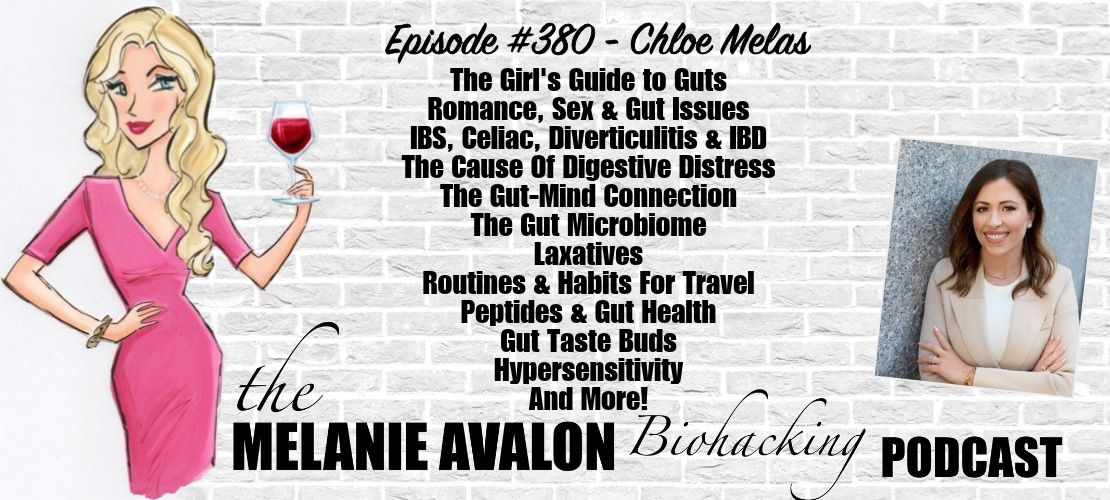
The Melanie Avalon Biohacking Podcast Episode - #380 - Chloe Melas
For peptide researchers:
Veratis Peptides: Get 15% off with code melanieavalon at MelanieAvalon.com/Veratis.
Axis Peptides: Get 15% off at with code Melanie at melanieavalon.com/axis. (And free shipping over $100!)
Biolongevity: Get 15% off with code melanieavalon at biolongevitylabs.com.
Reserve Research: Get 10% off with code MELANIE10 at melanieavalon.com/reserveresearch.
Chloe Melas is an award-winning journalist and NBC News correspondent who has appeared on TODAY, NBC Nightly News, and NBC News Now. Throughout her 17-year career, she has covered major entertainment and cultural stories and interviewed some of the world's most influential figures, including Oprah, Jeff Bezos, Tom Hanks, Sting, and Jane Goodall. At NBC News, Chloe led coverage of the Sean Combs criminal trial, reported on the Harvey Weinstein trial, and covered major stories spanning Hollywood, media, and breaking news.
Beyond journalism, Chloe is an advocate for women's and family health, openly sharing her experience with IVF and raising awareness around infertility. She is also a New York Times bestselling author and serves on the boards of organizations dedicated to preserving World War II history. Chloe's debut book, The Girl's Guide to Guts, explores life with IBD, IBS, and other digestive health issues. Published by Penguin Random House, the book hits shelves November 10.
LEARN MORE:
Book: https://link.amazon/B04ClQgqe
SHOW NOTES
SPONSORS & DISCOUNTS
LMNT:
LMNT is a zero-sugar electrolyte drink that supports hydration, energy, brain function, and muscle performance with a science-backed blend of sodium, potassium, and magnesium. Hydration is easy to overlook in the summer heat—especially with travel, workouts, long days in the sun, fasting, or lower-carb and whole-food diets. With clean ingredients and refreshing seasonal flavors, LMNT makes staying hydrated feel effortless and actually enjoyable.
Get your free Sample Pack with any LMNT purchase at drinklmnt.com/melanieavalon.
FACEBOOK: Join Melanie's Facebook group for a weekly episode giveaway and to discuss and learn about all things biohacking. All conversations are welcome! IF Biohackers: Intermittent Fasting + Real Foods + Life
INSTAGRAM: Follow Melanie on Instagram to see the latest moments, products, and #allthethings! @melanieavalon
AVALONX: AvalonX Spirulina is out now! AvalonX supplements are free of toxic fillers and common allergens (including wheat, rice, gluten, dairy, shellfish, nuts, soy, eggs, and yeast). They are tested to be free of heavy metals and mold and are triple-tested for purity and potency. Get on the email list to stay up to date with all the special offers and news about Melanie's new supplements at avalonx.us/emaillist! Get 10% off at avalonx.us and mdlogichealth.com with the code MELANIEAVALON. Plus, text AVALONX to 877-861-8318 for a one-time 20% off code for avalonx.us.
FOOD SENSE GUIDE: Get Melanie's app to tackle your food sensitivities. Food Sense includes a searchable catalog of 300+ foods, revealing their gluten, FODMAP, lectin, histamine, amine, glutamate, oxalate, salicylate, sulfite, and thiol status. It also includes compound overviews, reactions to look for, lists of foods high and low in these compounds, the ability to create your own personal lists, and more.
EMF: Stay up to date on all the news on Melanie's EMF collaboration with R Blank, and get the launch specials exclusively at melanieavalon.com/emfemaillist.
TRANSCRIPT
Chloe Melas
45 million Americans suffer from IBS, which is irritable bowel syndrome. That's a heck of a lot of people, and predominantly women.
And, you know, it's a syndrome, so it's not a disease, but it doesn't make it any less painful or uncomfortable. For people that think that these are modern issues due to just our foods alone, definitely not the case. You know, genetics and family history are a big thing, and I worry about, like, my two boys that are they gonna inherit any sort of bowel disease?
Melanie Avalon
Welcome to the Melonie Avalon Biohacking Podcast, where we meet the world's top experts to explore the secrets of health, mindset, longevity, and so much more. Are you ready to take charge of your existence and biohack your life? This show is for you. Please keep in mind we're not dispensing medical advice and are not responsible for any outcomes you may experience from implementing the tactics lying herein. So friends, are you ready to join me? Let's do this.
Welcome back to the Melonie Avalon Biohacking Podcast. Oh my goodness, friends, I am so honored and mind blown that I got to have this incredible conversation today with Chloe Melas. She is an award-winning journalist and on-air correspondent for NBC News Today, NBC News Nightly, and NBC News Now. She's covered so many high-profile people in her career, including some of the hottest things happening in the world now, and I was thrilled to find out that her new book is called The Girl's Guide to Guts, and is all about living with and dealing with digestive distress. Chloe has been incredible in speaking out about and advocating for people living their best, fullest life, even while navigating very unpleasant symptoms. And friends, not only is this book inspirational, educational, and overwhelmingly valuable, it's also hysterical.
I was laughing out loud so much. And if you have digestive issues and/or are just looking for the best prebiotic fiber to support your health, definitely check out Chloe's BioMe. You can get 20% off with the coupon code MELONIEPOD20 at bio.me. That's 20% off Chloe's incredible daily prebiotic fiber that Chloe made for herself because she found it was the right type of fiber to actually manage her IBD. So again, I cannot recommend it enough. Check it out at bio.me and use the coupon code MELONIEPOD20 for 20% off. We talk about so many incredible things in today's episode. Of course, I talk about my own history with IBS and digestive distress and fear of constipation. We talk about the stats and the prevalence of the various conditions, including IBS, celiac, diverticulitis, and IBD, how some of these conditions appear more in women, their potential various causes and whether or not it's your fault, the role of the gut microbiome, whether or not you should take laxatives, how to travel when you have gut issues, and super fun, how to still have a sexy, fun, romantic life with GI issues. The show notes for today's episode will be at melonieavalon.com/girlsguideguts. Those show notes will have a full transcript as well as links to everything that we talked about, so definitely check that out.
I can't wait to hear what you guys think. Definitely let me know in my Facebook group, IF Biohackers: Intermittent Fasting + Real Foods + Life. Comment something you learned or something that resonated with you on the pinned post to enter to win something that I love, and then check out my Instagram Find Me Friday announcement post, and again, comment there to enter to win something that I love. All right. I think that's all the things.
Melanie Avalon
As a brief reminder, you can get 20% off Chloe's incredible fiber created for those with sensitive digestive systems to help manage your symptoms and benefit your health at bio.me with the coupon code MELONIEPOD20.
That's M-E-L-A-N-I-E-P-O-D two zero. And now, without further ado, please enjoy this fabulous conversation with my new friend, Chloe Melas. Hi, friends. Welcome back to the show. I am so incredibly excited about the conversation I'm about to have. So the backstory on today's conversation, a few months ago now, one of the most popular guests on this show, Dr. Gabrielle Lyon, who is a dear friend, reached out and said that I simply had to have her friend on the show for their upcoming book, and I was of course an immediate yes just based on Gabrielle's introduction. Like I didn't even, even need any more details. And then it got so much better from there because this beautiful guest was Chloe Melas, who is a award-winning journalist and on-air correspondent for NBC News, so that again, was very exciting. And then all of that said, I didn't even know the topic of the book. And so when I learned what it was, friends, guess what? It is her upcoming book, The Girl's Guide to Guts: Everything Your Doc Didn't Tell You but Your Bestie Would. Okay, you guys have been listening to me for years now, and you know that I am a little bit overwhelmingly obsessed with not only gut health, but in addition, gut health issues. So I've had my own journey with SIBO and IBS, and honestly, honestly, part of the reason I have this show is because I got so fixated on my bowel habits, and the reason I have a therapist is because I needed to see a therapist originally for my constipation fears. And so all of this has just been, you know, really big on my radar and I've been talking about it for so long. And then it gets even better because I actually read the book, The Girl's Guide to Guts, and friends, oh my goodness, it is beyond ... Okay, first of all, it is hysterical. I was laughing out loud so many times during this book. Like, who would've thought a topic like this could become something so approachable and funny and inspirational all at the same time? And Chloe does write it with her co-author Judy, and they both tell their personal stories about what they go through, which again, that actually made me really grateful because I, I, I just have IBS. I don't have what they have, which we're gonna talk about. But this book, friends, I cannot recommend it enough. If you have any sort of gut health issues at all, it is an immediate yes. If you know anybody with gut health issues, it is an immediate yes AKA it's an immediate yes for everybody. It goes into so many things.
Melanie Avalon
The four most common types of gut issues, so we're gonna talk about that, so IBS, uh, celiac, diverticulitis, and IBD, the potential causes of these things, whether or not it's your fault, the role of stress in this, the role of how stress becomes like PTSD, like I said, literally in therapy for constipation fears for myself, the role of surgeries and medications and what you can do and how to talk to your doctor, and then even things like your daily life experience and how to date and how to have sex.
And it's just, it's mind-blowing. I loved this book so much. It's gonna change so many lives. And Chloe, thank you so much for, first of all, for being so vulnerable, telling your story, and helping so many women out there, and thank you so much for being here.
Chloe Melas
Thank you so much for having me, my fellow Georgia Peach.
Melanie Avalon
I know, I left that out. And we're both from we're both from Atlanta, which is absolutely, well, I guess amazing. I, I if you like Atlanta. Oh my goodness, though. But seriously, I'm so, so excited to talk to you, and you had so many references.
I was just, like, laughing. And I will say just really quickly, your story about your ex Chad, I think I dated Chad too, or at least a type like him. I was like-
Chloe Melas
I had to include this ridiculous relationship that I had before I met my now husband, Brian. His name is not really Chad, and no offense to any of the Chads out there, but I was thinking, "What is, like, the name that fits him?" And it was Chad. You know, we, I delve into whether or not all the stress of him being a total loser cheater and all the dates he stood me up on, including on New Year's Eve, if that wreaked havoc on my gut. And you know what? I truly believe after all this research into the mind-gut connection that yeah, there is total science behind stress wreaking havoc on your gut.
Melanie Avalon
I agree so much. And no, seriously, I read that and I was like, "Oh my goodness, I know this man." For me, it was being stood up on Valentine's Day, but very similar situations. So oh my goodness.
And, and to that point, yeah, the stress, we can, we'll definitely come full circle talking about that because there's, like, all the worries about the stress, like did it cause it? And then there's the stress on the, the opposite side where you get, like, you know, like I said, honestly it's like PTSD from the experience of going through this. And then I will say probably the thing I have worked on the most in therapy is my, my insane stress and concern about my bowel movements.
Chloe Melas
I'm obsessed with my bowel movements.
Melanie Avalon
I am too. I could talk about it all day. We could talk, we could talk about it now.
Chloe Melas
Yeah. Well, I, I literally... It's, so I didn't poop normally for over 10 years. I didn't have a normal bowel movement, which is insane.
Melanie Avalon
To this day, how are you, like, how are you now?
Chloe Melas
I'm good. I mean, like, some days are not great, but I went 10 years basically being constipated and addicted to laxatives.
You know, looking back, I definitely had, like, slow motility, probably, like, high levels of methane, which I've now discovered through stool testing, and I thought I had SIBO. Allegedly I don't have SIBO after going to my GI and doing an actual breath test, but I know that th- those results can be wonky and inaccurate. But I definitely have a whole regimen as to what keeps me regular now, and if I deviate from the plan, then I get constipated. And so for me, having one good bowel movement every day is all I need, and that's all I can ask for. I, my husband and other people who go multiple times a day, God bless you, but I went years with only mucus and blood. And honestly, I would only be able to empty my bowels if I took laxatives like Dulcolax, and that's really harsh. So I'm really glad that I have discovered a few other things that have really helped me.
Melanie Avalon
Oh my goodness, so much similarity. On the laxative front, so like I'm, I take a lot, I, a lot of magnesium. Like, a lot of magnesium, and that, and that keeps me regular.
Chloe Melas
What kind do you take?
Melanie Avalon
Uh, well, it's funny, it's ironic.
I take a lot of different types because I have a supplement line, so I take my own, which is like a blend, and then I take Natural Calm, like the, the drink form of it.
Chloe Melas
Like magnesium citrate?
Melanie Avalon
Mm-hmm. And oh, and then I also take I also take the magnesium oxide, the Mag 007. I don't know if you've had that one. That one's, like, purely just for bowel movements only.
Chloe Melas
So you'll have to send me this. I take the Ollie, Oly, is that how you say it? The, the brand. I take these magnesium citrate gummies, and then I a few times a week take psyllium husk. And I'm the co-founder of a fiber brand called BioMe, so that's the brand I take.
And it was inspired by my journey with IBD. So I mean, between psyllium husk and magnesium citrate, I am thrilled, but I have to obviously stay on top of it.
Melanie Avalon
And it, you know what's so funny, so I, so I've had three, I mean, not as many as you, but I have had three colonoscopies. And with the last one, the GI doc was asking me, she was like, "You know, what do you do to keep things moving?" 'Cause every time I get one, they're like, "Oh, you're fine. You just have constipation." I'm like, "Oh great, awesome." So she's like, "What do you do to keep things moving?" And I was like, "Well, I ha- I have a lot of magnesium that, that, you know, pretty much works for me." And she's like, "You know, you really shouldn't-" ... do that, 'cause that's not really studied in trials. You should really take like..." And then sh- she was like, "You should take like MiraLAX," or, "You should take like a pharmaceutical." I was like, "Why? Like the magnesium is working for me." It, it was really frustrating, honestly, trying to take away my magnesium from me.
Chloe Melas
I know. I mean, I think that like obviously in a perfect world I could just snap my fingers and be regular without any supplements, and just like have the perfect, perfect plate.
But while researching the book, I learned a lot about stool testing, and it's incredible that there are these really amazing over-the-counter stool tests that can give you so much information about what's going on inside your body, and really analyze like whether you're eating enough of the right foods, and polyphenols, and getting enough fiber, and your microbiome diversity and, you know, whether you might have parasites or all sorts of things. And so that was really eye-opening to me, and also super weird that no doctor in my 15 years had ever said, "Go get a stool test. I demand you get a stool test." It's so strange to me that all they did were colonoscopies.
Melanie Avalon
Yeah, the system's definitely really interesting and, and that's something I really appreciated in the book was you guys have like, you know, a laundry list of what to ask your doctor like, you know, before the visit, during the visit, after the visit, and then, you know, you give permission to fire your doctor. I, I actually ha- Have you ever been fired by your doctor?
I have. A GI doc once like let me go.
Chloe Melas
Oh my God. So I haven't, but I have switched doctors. And so that's the other thing that I write about. It's like, dude, call it advocating or just honestly if you just don't vibe with your doctor, I joke that there should be like a dating app to find your doctor. Like, if you think that your doctor is kind of a you-know-what, and they're not listening to you, or they think you have too many questions or whatever, like sorry if you can't deal with all my questions and me telling you what ChatGPT diagnosed me with, then I don't even wanna talk to you.
Like, you know, if you're just a factory and just moving me along, and I did it, I've done it all throughout my life. I've been really good at like just being like, "All right. Enough. I'm moving on." And so I, when I was having my kids and I was going through in- in vitro fertilization, AKA IVF, we ended up having to tell our doctor, "Hey, you need to be like a little more friendly, because this is a really dark and tough time in our life," and he actually like lightened up and was more amenable. So I was really grateful, but you can't always like tell your doctor like, "Hey, I think you're like a real jerk." And again, like doctors are there to like be cerebral, and diagnose you and, you know, help you find a path forward. They're not necessarily there to be like your therapist, and I get that, and you might need somebody else to hold your hand through those things. And so I love that you have though a therapist that helps you with your GI issues. That's something that I wish I had done a really long time ago.
Melanie Avalon
Well, it's funny. So when you're f- when you're interviewing therapists to find one and the issue you're coming in for is your fear of constipation, I had a lot of really bad first dates with therapists like, like where it was not a match. I m- I remember it kind of like scarred me. One, I remember one was like, and this is something that you talk about in the book too, like things not to say to people who have GI issues. I remember one of the therapists was like, "Well, well have you just tried drinking more water?" I was like, "Okay, this is not the therapist for me." And then another therapist I like, you know, I'm vulnerable. I'm telling her all of my fears about constipation, and then she literally said to me, I'll never forget it, she goes, "You know what, Melanie? Maybe sometimes people are just full of shit." And I was like, "Whoa. You're not my therapist either." So yes, it can be, it can be hard to be, you know, vulnerable and like talk about these things. And then it g- and then, you know, the response from people, bringing it back to you, because when you first, 'cause a, and a large part of the book what you talk about is, you know, you didn't talk about this. You know, you were hiding it for a very long time, both from other people and then, you know, definitely publicly, and you share a lot of stories about being at, you know, like high profile entertainment industry things and having things happen. Oh, by the way, I did see like two weeks ago Chelsea Handler who I know you love.
Chloe Melas
I love her.
Melanie Avalon
She was amazing. I thought about you, 'cause I had read that part of the book prior to that.
But in any case, you, you, you tell a story about how, was it Women's Health that was, that did the first news article where it mentioned your story? What, what was that like, the journey? Uh, and ob- obviously we obviously need to get to your actual journey, but, um, what was it like deciding to actually talk about this publicly and then, you know, actually doing that going forward?
Chloe Melas
So it was the craziest thing. One of my really good girlfriends, Abigail, works at Women's Health, and she's like totally risen the ranks like a badass, and she now runs the entire magazine. And a couple years ago she was like, "Dude, I think it's really cool that you co-founded a fiber brand, and we're doing an article about fiber supplements, and we'd love to interview you and Shannon Race, your co-founder." I'm like, "Cool. Let's do it." And so when I jumped on the phone with the journalist, you know, obviously super weird for me to be interviewed, 'cause like I'm usually the one doing the interviewing, and she was like, "Well, what made you guys start BioMe?" And I'm like, "Because I have IBD, inflammatory bowel disease. Specifically, I have ulcerative colitis." So IBD encompasses Crohn's and ulcerative colitis. And so I told her kinda like the journey, and years of colonoscopies, and all sorts of medications, and, you know, I would go through months of remission, and then I would go through a flare again, and I noticed that psyllium husk that my husband told me to take was really, really helpful in bulking up my stools. She ended up using just a couple of my quotes, and the ones that she used were about IBD, which is fine, but to see it in print was like kinda wild when the article came out, and I decided when it came out to just post a picture on Instagram, and I got so many messages.
... including The Today Show. And The Today Show said, "Hey, we wanna do an article about your journey with IBD." So I was like, "Oh, geez. Okay, this is, this is the moment. Do I do it or do I not?" And I said, "Okay, let's do it." And that's when the rest is history, really. I did a phone interview, and we did a whole article about my journey with IBD, and next thing you know, that article came out, like, a week later, and then I got a Google alert on my phone that People Magazine did a story on me. And I'm like, "Oh, my Lord." And my Instagram DMs were just popping off, and people were like, "I have IBD," or, "My cousin has this," and, "I have IBS," or, "I have celiac," and, "Thank you so much for talking about this." It was in that moment that I was like, "Okay. Okay, I'm on the right track. I gotta keep talking about this." And that was sort of the beginning of me being more comfortable with sharing something I'd kept a secret for 15 years.
Melanie Avalon
That's amazing. Incredible. I love how it was kind of, the universe kind of just thrust it upon you, you know? It's like, you're gonna talk about it now.
Chloe Melas
Yeah, it came about super organically, which I think is, like, the best part, right? Like, you hear about people who say, "Oh, my dream was always to write a book," or my... You know, "I wanna do this," and that's great to have a vision board and goals and, and all of that.
But I never planned to use my chronic illness as a platform or to be an advocate or to go out there and overshare, and here we are, and I'm checking all those boxes, which it might be cringe to some people, but for me, these messages from patients and caregivers who are telling me how they can't wait to read the book is honestly all I need to keep going.
Melanie Avalon
It's amazing. What percent of people, and I guess we sh- we can go through, like, the most common forms, but what percent of people actually struggle with some sort of digestive distress issue?
Chloe Melas
You know, it's hard to say, but the data that I have for you is that 45 million Americans suffer from IBS, which is irritable bowel syndrome. That's a heck of a lot of people, and predominantly women. And, you know, it's a syndrome, so it's not a disease, but it doesn't make it any less painful or uncomfortable.
It could be bloating, cramping, diarrhea, food sensitivity. And experts really believe that it is an issue with how your nervous system communicates with your digestive system, so your brain and your gut are constantly communicating in this two-way track through something called the vagus nerve. And it's believed that it is an imbalance, an issue with that communication that causes these symptoms. So it's super fascinating, and no, it's not your fault, but the only way you can know if you really have IBS is to do an elimination diet and also rule out you have IBD by getting a colonoscopy because some of the symptoms present the same. IBD, which is what I have, inflammatory bowel disease, over three million Americans have it. I believe that number is on the low end because people are self-diagnosing, they're not going to the doctor, they're not going and getting colonoscopies because you have to be 45 for insurance to cover it, and I think a lot of people in their 20s and 30s have undiagnosed Crohn's and ulcerative colitis. Absolutely. And that, again, can present with all sorts of digestive issues, whether it's chronic constipation, whether it's loose stools, blood in your stool, which is what I had. That's how I knew. A sense of urgency, like you always have to run to the bathroom. And the only way to know if you have it, and it's an actual disease, is under a microscope, and you gotta go in through a colonoscopy, which is really not that big of a deal. I know people freak out over the idea of a colonoscopy. You guys, it's not bad. I've had, like, dozens of them.
Melanie Avalon
I was gonna ask how many you've had.
Chloe Melas
I've definitely had 20, for sure.
Melanie Avalon
Does it get easier every time?
Chloe Melas
Nope, doesn't. I had one, like, a year ago, and I vomited while doing something called the prep, this, like, gross stuff that you have to drink, and I write about it in the book, and I hate to just say, like, "You just gotta find a way to drink it." And I will put it in the, put it in a pitcher. I mix it. Looks like lemonade. It's like yellow Gatorade and stuff, and it's really salty. And you put it in the fridge to make it super cold, but you really just gotta, like, chug it. It's gross. Some people do the pills now, but I've actually heard horror stories from people who've taken the pills, and they said that they, like, it, like, didn't fully empty their bowels, and that's awful. You go to the hospital the next morning or to your doctor's office, and they're like, "Sorry, we can't do it. That was a waste of a night, of you being up all night. We can't do it because you're, you're not empty." And then if you're not empty, then they can't see clearly with the camera, and then they can't do it.
Melanie Avalon
It's so funny. So on my other show, my co-host, he was getting a colonoscopy, and I didn't even know about the pills 'cause I've always done, like, the liquid, and he said it was the pills. And I was like, "Are you sure that pills can, like, really empty everything out?" I was suspicious, so I, I can see that happening, like, it not, not fully working.
Have you ever had to do one... I had to do one once when I was admitted to the hospital 'cause I was anemic, so they- I had to do it, like, while in the hospital, which was horrible 'cause then you have to, like, ring the bell every time you have to go to the bathroom. That was really bad, like, doing the prep when chained to a bed.
Chloe Melas
It's honestly been, like, the most crazy different experiences. I've had times where I was gonna completely call off the colonoscopy because I just couldn't finish, but so far, all of mine have been successful.
And it's kinda crazy how, like, I'll have symptoms and go in and be told that things don't look so bad, and I'll have times where my- I don't have any symptoms, and they're like, "Wow, you have a lot of inflammation," which is also wild because you can actually have, like, silent inflammation.
Melanie Avalon
Yes. Actually, to that point, there were a few things, um, that relates to a few things I wanted to talk about. One was this, like, very haunting phrase which is so true, but I'd never really thought about it, and I'm paraphrasing. I probably have the exact phrase somewhere. But you, but basically you guys go through the, the GI system set up, and you say that tech- technically the, the normal state of the gut is a state of controlled inflammation, and I was like, "Whoa." That's, like, so interesting to think about.
On the IBS front, so, 'cause you were, you were mentioning at the beginning about the, like, the hypersensitive nerves, and I remember when I first read, and I think you reference the study in the book, but I remember when I first either read or heard about the study where they would compare patients with IBS to patients without IBS, and basically the patients with IBS could be in the exact same stage of, like, quote, "bloating" as, like, a normal person, but for the IBS patient, they, it bothers them. Like, they feel it. And then the person without IBS doesn't feel it the same. And so the takeaway is, like, "Oh, you're just hypersensitive." But when I remember when I read that and I was like, "I feel like that's being gaslit because, like, like, technically if nerves are relating information, and if they're- ... relating more information than I am experiencing that. You know? It's not like it's not real.
Chloe Melas
So I think it's like this is where I know things are not so cut and dry. So with what I have, right? I got diagnosed after having a colonoscopy. They said, "You have inflammation. We can see it here. Here's a photo that we took during your colonoscopy. You can see the inflammation. You can see the little ulcers. Here's some medication, and this will calm your symptoms down, and you might have to be on the medication for a really long time. We might ba able to wean you down, taper you off, switch it up." And I've done all of the above.
But when it comes to IBS, you know, you can have severe bloating without IBS. So, you know, bloating can be caused by things like food sensitivities, lactose intolerance, constipation, which you and I have talked about, but also like swallowed air or hormonal changes or celiac disease. So you have to go get tested to see if you have celiac disease. And of course, you can do an elimination diet, which I highly suggest for anybody out there who's listening who thinks that they have IBS. It's kind of a pain, but you gotta do it. You can Google how to do an elimination diet or ask ChatGPT. For anybody out there who's wondering, like, "Okay, well, so what do I do?" Well, if you go to a GI, a gastroenterologist, or if you go to your general doctor who can refer you to, to a GI, IBS is typically diagnosed when somebody has reoccurring abdominal pain, changes in your bowel movements, and you're racing to the bathroom a lot. So it's not just bloating alone.
You know, I mean, I remember there were times where I looked several months pregnant. I mean, I think I have IBS on top of IBD, 'cause you can have both too, by the way.
Melanie Avalon
No, it's interesting because I remember, I think it was probably when interviewing, 'cause I've done a few different, like, shows on here dedicated to, like, IBS and constipation and things, and I realized, 'cause I think they changed the definition of IBS a few years ago, where, like, before it didn't have pain as a criteria in it, and then they added in pain. And I was thinking about it, and this actually relates to another question I have, 'cause I don't actually have pain really ever, so maybe I actually don't have IBS.
But I perceive that I have IBS because I feel like my bowels are irritable. I stress about constipation. I feel like I have to keep things moving. So ha- sometimes I just wonder, I'm like, "Maybe I'm just keeping myself in this state."
Chloe Melas
Well, I mean, I think that, like, to your point, like, the criteria has changed. You know, more recently they say that, like, just discomfort can be the main identifier in having IBS, but for years it was really GIs said, you know, "Do you have pain associated with your symptoms?" And again, like, in terms of, like, your frequency or, you know, your bloating or your bowel changes, you know, it's, it's a little complicated to figure out if you have IBS. And remember, it's a syndrome, it's not a disease.
So if you have IBD, you have a higher risk of developing colon cancer, sadly, because it's actual inflammation. When you have IBS, luckily you don't have inflammation that you can visibly see in the lining of your intestines or your colon, which is great, although the symptoms can royally suck. But you don't have a higher risk of developing something like colon cancer, which is your silver lining. So if you had to pick between the two, you definitely would rather have IBS. But both terrible if you wind up with them on your life bingo card, for sure.
Melanie Avalon
The discomfort, the potential pain with any of these things. You also talk in the book about how the gut itself doesn't actually sense pain or temperature. So when people are experiencing pain or feelings down there, like, where is that coming from?
Chloe Melas
Well, I think that what's really interesting is that you're right, like, your gut doesn't feel, like, cuts or temperature the way that your skin does, but you're very sensitive to pressure and stretching. And so basically, like, your, the inflammation in your gut activates those, like, nerves from my understanding. Remember, I'm not a doctor.
But basically your brain, like I said, and your gut are connected through things like the vagus nerve. So it's like a two-way street. Imagine, like, a highway, and it's sending signals constantly. So I think that my understanding is that, like, this inflammation can activate these nerves inside your gut, which can then result in abdominal pain, and your brain interprets those types of signals, if that makes sense.
Melanie Avalon
Also, a little fun fact I learned about that there are taste buds in the in the digestive tract, but they don't, I mean, we don't taste with them, but they taste. They taste things for themselves, I guess.
Chloe Melas
So this is actually crazy because my co-author Judy Battalian is obsessed with this. So, like, your tongue can, like, taste food consciously, right? So, like, you can taste something if it's sweet or it's salty or it's bitter or, like, whatever, right? And so your gut has these taste buds, like taste receptors similar to what is on your tongue, and it, like, identifies the nutrients that are moving through your system. So it helps regulate your digestion.
It can, like, help trigger the release of certain hormones, and all of this is communicating with your brain. So it's truly fascinating, and we interview Dr. William Lee, who wrote Eat to Beat Disease, who talks about all of this and also talks about our microbiomes, which are totally fascinating, and I wish that I had the time to now write a whole second book on the microbiome, 'cause I feel like this is the key and the foundation for our health is our microbiome.
Melanie Avalon
That might be the topic that comes up the most, like, on everything. And actually, I first became obsessed with the microbiome because of my digestive issues, like, way back in the day, and I did something very similar to you because I remember you said in the book that, was it that you really wanted to get a f- a fecal transplant, so you, like, sought out- That doctor
Chloe Melas
Yes. So I went to go find somebody who would do, like, an under-the-table fecal transplant for me because I was convinced that somebody else's healthy stool could, like, make my gut healthy. And I tr- still truly believe that that could be something that'd be, would be really helpful to patients with IBD, but unfortunately it's just not FDA approved for IBD.
It is for other things.
Melanie Avalon
I, I know. I, I've been really intrigued by fecal transplants and whether or not it would, you know, if it, if it will expand to other conditions.
I was gonna ask, 'cause I, I couldn't, I don't think you actu- so you, you did not, you did not... Well, I guess you couldn't say if you did, but-
Chloe Melas
No, I, I didn't do it, but basically, like, doctors, they take healthy stool, they screen it, they clean it, and then they introduce the bacteria, the microorganisms into someone's digestive system, and there's a lot of different ways that you can do it. We write about it in the book.
It can be done, like, through a colonoscopy or orally through an enema, and, you know, there isn't just, there's just not enough research out there to show whether or not it can help somebody with IBS or ulcerative colitis. There have been some clinical trials, which I think is really great. There is a lot of scientific evidence that shows that it can be helpful with something called C. diff, so that's really great. And I don't know, I think that this is something that hopefully one day we'll see. I ask all my doctors about fecal transplants, and they all sort of smile and they're like, "Yeah, you know, maybe one day. Not yet." But it can be dangerous, obviously, too-
Melanie Avalon
Yeah
Chloe Melas
... 'cause if somebody's carrying, like, a certain disease or whatnot, I mean, you gotta be really, really careful before doing something like that.
Melanie Avalon
I'm just thinking about all the, like, TikTok content we could create. Like, our Christmas wish list, like, fecal transplant or, like...
Chloe Melas
Oh my gosh, can we do that? I need to be creating more social content. It's, like, keeping me up at night.
Let's do a TikTok. Let's do a reel. Let's do, like, a Zoom and then my team will, like, cut it up and make it look cool, 'cause I'm still, like, I'm 40 years old, y'all, so I'm still trying to, like, act young and make myself seem cool, and I don't know. So y'all leave me a DM, shoot me a comment, let me know if you guys like my content on social because I'm really trying. I'm trying to be hip with my Girl's Guide to Guts content these days.
Melanie Avalon
Well, I think you're doing it. And, I mean, you're like the OG, like, and the stuff that you were writing about back in the day, like, w- when you started with your writing, you know, you said in the book you were writing about, like, you know, Selena Gomez or, like, Justin Bieber.
Chloe Melas
I know. I used to write for a website called HollywoodLife.com, and I have the most cringe bylines and cringe YouTube videos out there when I hosted our YouTube channel. So it's wild the many lives that I've lived and the reality stars I've interviewed and all the things that I was doing in my 20s, and then in my 30s I pivoted to more, like, serious news at CNN.
I did, like, legit, legit reporting in Hollywood, and it was really cool. But then after eight years at CNN, I was ready to, like, peace out and pursue my dream job and come to NBC, and so that's been really amazing. I've been here three years, and I do a little bit of everything, like lighter fare, medium fare, serious stuff. I just did a huge story on Diddy, which was, like, crazy, that got him, like, sent to solitary confinement. You guys can see that on my Instagram. So I have range, girl. I go from guts to prison, like, you know? In terms of what I do.
Melanie Avalon
No, you've got it. And now you're, like, popping up on my Instagram feed all the time. Like, you popped up the other day for the Kelly Clarkson thing.
Chloe Melas
Oh, good. I'm glad. I, I gotta get on that explore page, baby.
Melanie Avalon
You're there. You're there.
So, um, actually to that point, so I'm, I'm in awe... Okay, I am really in awe hearing that because for me, again, I don't, I'm just, you know, I guess IBS adjacent or IBS. You have, you know, this much more, you know, intense case with IBD, and the thing that's... I get very intimidated by, like, travel because of my whole, like, digestive stuff, and, like, I need to have my right food and I need to, like, have my magnesium and my bowel movements and my colonics and all the things and, and so I'm good when I have my routine and when I can set my own hours. A schedule like you're describing right now, which involves a lot of travel, involves a lot of, like, random times, how did you navigate that, or how do you? How did you and how do you navigate that with, with everything that you're going through with IBD?
Chloe Melas
I think that my husband always says, like... Well, it's a cooler phrase than practice makes perfect, which if it comes to me, I will, I will tell you. But basically, like, you gotta plan, you know? Like, if you're going on a trip, why would you pack your medications? No matter what sort of issue that you have, even if it's not any bowel issues. Like, it's just like if you're on your period, you're gonna, like, pack your tampons and your pads in your purse or your backpack. You're not gonna, like, put them under the plane. That just makes absolutely no sense.
So you wouldn't wanna be in, like, the Bahamas and have to find a local GI, which I'm sure there's great ones there, but you don't wanna have to deal with that, like insurance and all the things. So definitely bring your medications with you. If you're worried and it's international travel, get a doctor's note. If you're worried that you're gonna be, like, stopped somewhere, make sure that you bring some extra medication, 'cause you wouldn't wanna run out. You know, I love, like, the oh shit kit that some people, like, talk about making, but if that's, like, whatever that is, sanitary wipes, suppositories, your magnesium, your fiber, your psyllium husk, your, you know, electrolyte packets or whatever it is that you need, you should also have your little go bag, change of underwear. You know, even if you're on a plane or on a bus or, you know, where will you stop to go to the bathroom? What cabin are you sitting in? Should you sit in an aisle seat if you're not traveling with somebody that you know so that you can get up when you need to go to the bathroom? I don't deviate from the plan, like I've said. So I eat the same thing every single morning. If I have coffee and nothing else, then why would I have french toast? Right? Like, I'm not gonna go hit up the entire buffet. And I think you just really gotta be consistent, 'cause then that can lead to, like, traveler's constipation and all sorts of issues that can set off a chain reaction.
So that's a long-winded answer of, like, we have so many tips in the book for travel, what to wear, what to do on a first date, even, like, how to talk to your loved one about your issues with, like, sample conversations, which sounds ridiculous, but it's the truth. And so those are just some of, some of my, some of my tips. I mean, like, some... Honestly, like, if you're really, really worried, then, like, you should kinda limit how much you're eating and drinking that day in a place that's still safe and healthy for you. But when I know I have a really, really, really big day of events, or, like, when I'm gonna go interview somebody, I am very careful about not eating too much or drinking too much so that I don't trigger some sort of an issue later.
Melanie Avalon
It's so true, the, like, sticking to the plan, the routine. The saving grace for me is I do daily intermittent fasting, and I have done for, oh gosh, since 2010.
Chloe Melas
What do you do exactly?
Melanie Avalon
So I only eat right before bed.
Chloe Melas
What are those? So you don't eat all day?
Melanie Avalon
One meal a day, mm-hmm. Yeah, so I, I, I wake up and i- it's, I didn't start it for... It, I was doing that before I had the GI issues, and it, it pairs so well because when you're not eating, like you just said, you're not tempting fate with anything.
And then I can adapt it to anywhere I go. So yeah, I just do, I just do fasting every day and then I... I, I know they say don't eat right before bed. I do, and it works really well for me, so.
Chloe Melas
What time do you eat before bed?
Melanie Avalon
Yeah, really late. Really late. Like around midnight. I go to bed really late.
Chloe Melas
Okay, so you eat around midnight, like a full meal?
Melanie Avalon
Mm-hmm.
Chloe Melas
And then, and then you're able to fall asleep after?
Melanie Avalon
Yeah, I sleep so well. I sleep... I love sleeping on a full stomach.
Yeah, so basically the reason I love it so... And this is why I can literally have an, an entire other podcast called the Intermittent Fasting Podcast and talk about it for, like, a decade. Yeah, it works so well because, again, like, during the day I'm not... I get more energy, I get more time back, I don't have to worry about, like, eating and bathroom breaks or anything like that. And then at night I eat, I get to have a luscious feast and eat all I want, and then go to bed happy, and then wake up and start over again the next day.
Chloe Melas
Right, and then the magnesium helps you go to the bathroom in the morning.
Melanie Avalon
The magne- yes. Mm-hmm.
Yeah, so a, a few different thoughts here, um, 'cause you're talking about, like, traveling and l- what, what to bring. My favorite thing, I'm curious if you have one of these. Well, do you, do you get colonics ever?
Chloe Melas
I have had them, yes, but I don't get them regularly. Do you?
Melanie Avalon
I, I used to when I was in more of, like, a fear state. Now I'm pretty good.
Like, I don't identify as being constipated anymore, but I do have the perpetual fear that it might come back. So I have, like, an at home board that you can, like, create a whole colonic system at home, and that is, like, my saving... Know- just knowing it's there is like just knowing, like, "Okay, if I ever get, like, super constipated, I can literally, like, physically flush this out with, like, a, a colonic." And then when I travel I bring, I bring, like, the actual, like, enema bucket and, like, pack it in my suitcase, and I wonder if TSA, like, opens my suitcase and is seeing, like, vibrators and enema buckets.
Chloe Melas
Like a Fleet enema or something more serious?
Melanie Avalon
No, like a bucket bucket. So you like... It's, like, a metal bucket that's like a pail, like, like the nursery rhyme.
You hold above you, and then it has, like, a tube, and so it basically creates, like, a re- like, a whole water system enema thing.
Chloe Melas
And does it work?
Melanie Avalon
Mm-hmm. Yeah.
Chloe Melas
Oh wow, that's amazing. Well, there's so many things that you can teach me. I feel like s- like such a simpleton right now with the, with the way that I do it. So I'm so excited for you to, like, text me all these, all these secrets.
That's great.
Melanie Avalon
I will, I will text it to you. The thing, the nice thing about the enema bucket, I actually, I think I've only used it while traveling, like, once, but just knowing it's there.
It, you know, and that, that goes to something we were talking about which is, like, the role of stress and the mindset and, and do people cause these diseases or not? In the book you talk about, like, six different, you know, potential factors that can be causes, and they can overlap, and you're very clear that this is not people's fault. So what should people know about why these things happen, and, like, the role of, like, genetics versus yourself and, like, lifestyle? What's happening?
Chloe Melas
So first of all, we have some sample conversations in the book and, like, things that you should never say to somebody, and one of them has been said to me more than once by a family member, of course, is like, "Well, what did you do?" Like, "Well, what did you take?" Like, "What did you eat? What did you not do? Like, we don't have a family history of this, so must be your fault." First of all, I don't know that I don't have family history, but nobody on either side claims to know anybody with bowel issues or bowel disease. But again-
Melanie Avalon
Yeah
Chloe Melas
... people are afraid to talk about these things, taboo, and everybody's basically dead, so I don't know if, like, great-great-grandma had maybe celiac disease or somebody had undiagnosed Crohn's or colitis. But you know, genetics and family history are a big thing, and I worry about, like, my two boys that, are they gonna inherit a- any sort of bowel disease? And so there are a bunch of, uh, different genetic variants associated with IBD, so genetics can play a role. In my situation, I don't think genetics played a role. Could be wrong.
I believe it was changes in my gut microbiome, which I think was thrown off by years of antibiotics. I took Ciprofloxin, Azithromycin, and all sorts of things 'cause I was always running to urgent care in my 20s. So again, like, changes in your gut microbiome is the second thing. You know, environmental exposures. I mean, it could be really pollution, just things in our daily life. You know, I- Noticed that my microbiome was totally thrown off kilter when I moved to New York City. Very different sort of situation than the sunny plains of Auburn, Alabama.
Your diet, ultra-processed f- foods. I grew up on frozen meals and McDonald's and Chick-fil-A and all types of fast food, and I'm not faulting anybody, but when your diet is high in ultra-processed foods, that is... That has been associated with a higher risk in IBD in certain studies. So we can't sit and say that any specific food causes IBD, but I believe, like, my gut microbiome, the environment, my processed foods, you know, I was smoking cigarettes in college and in my early 20s.
I write in the book that youth is really wasted on the young. Maybe I had issues with my immune system, which would be a fifth thing is maybe an overactive or dysregulated immune system. Hard to say.
Having IBD is a autoimmune issue where your body is literally attacking your colon, attacking itself. You know, there have been a lot of thoughts that we are, like, it's our hygiene. It's that, like, we have been using all sorts of hand sanitizers, and this kind of theory that we've been, like, so sterile that it's affected our immune systems. And so that's also really interesting, like, coming out of the pandemic, right?
Where we were wearing masks and social distancing, and we were using hand sanitizer and wiping everything down with Clorox wipes. So hard to say if there's been, like, a rise in the wake of COVID, and that's all connected. Maybe too soon to tell. But those are some of the things that we explore in the book, and I'm very open about my doctor saying, like, "Oh, we don't know what causes IBD.
We have theories," and me being like, "Well, these are, like, my theories." But we aren't prescriptive in the book. We're not, like, definitive and say, "This is what causes this, and this is what you need to do." I mean, with something like celiac disease, you can literally say, like, your body is attacking gluten as a foreign invader, right? And so you know that celiac disease, you have a gluten allergy, you eliminate gluten, you- your symptoms go away. I don't know what to eliminate.
Chloe Melas
I don't know what I'm doing wrong or what's going on, and I think that's what's really hard is, like, I don't ever know when a flare is gonna come.
Melanie Avalon
Yeah, and with the flares, so how does that work? So, like, you- you'll be in, like, a, a remission state and fine, and then-
Chloe Melas
I'll have blood in my stool. I'll have blood in my stool, or I'll all of a sudden feel like I have to go to the bathroom, like, 10 times a day, and maybe I go a little bit, but, like, it's blood, but I feel like I have to go, and it's because my rectum is inflamed.
And you can... You... I use suppositories that are medicated. There's one called Canasa. It's prescription, and that, like, calms down the inflammation, but if it's really bad, I take steroids, both oral and rectally, which sucks. All sorts of side effects taking s- taking steroids. And then there's other types of medications I'll take, like mesalamine and other things like that, but of course I, I look at my diet. I eliminate caffeine. I eliminate alcohol. I eat super clean protein, make sure I'm getting fiber, drinking water, trying to sleep more. Definitely when I'm run down and I'm overworked and I'm overtired, I definitely, like, notice the flare come.
Melanie Avalon
Are there any peptides out there, do you know, that are being looked at?
Chloe Melas
BP 157 is supposedly really, really great for people with IBD and ulcerative colitis. I have never taken it.
I know that Dr. Gabrielle Lyon and my husband, Brian Mazza, who has a big following in the health and wellness space, they've all told me to take it. I actually started a GLP-1. I'm on a low dose of Mounjaro that's really helped with my inflammation. I think it's really helping, and I'm actually due to go get my blood work tested again. And so I do think that perhaps the Mounjaro has helped, and my endocrinologist at Cornell, well, Cornell prescribed me. I've been on it for, like, five months.
Melanie Avalon
It's ironic because I've been talking about peptides for so long because they... I pr- I swear, like, so many of the guests that I have on this show, and it's not, obviously not books about peptides, but it's people, you know, renowned researchers in their respective fields, and it seems like more and more they're talking about even, like, GLP-1s, like, low doses for whatever condition they're talking about. Like, I, I just had, like, Dr. David Perlmutter, and it- he was talking about it for, like, you know, neuroprotection, and I feel like there- there's just so many metabolic benefits.
So the irony is I've been talking about it for so long, and I just recently started, you know, experimenting with them myself, and I'm obsessed. I'm obsessed with, like, all of them. I'm doing the BPC.
Chloe Melas
My plan is to start taking some. I just don't know whe- which ones.
I've just... I'm a slow adopter. I finally started the Mounjaro, and so I think I have a few more months of that before I taper off, but I'm open to trying all sorts of things. I'm, you know... I'm not, like, woo woo over here, but I'm, I'm down to, to try stuff, and my husband is super, super into functional medicine.
Melanie Avalon
Oh, yay. Okay, I'll text you 'cause I'm, like, obsessed now, especially with, like, the newest GLP, um, the newest GLP-1, the Ret- Retra, Re- Retta, because it, it has a third component to it.
Chloe Melas
Yeah, my husband's on Retatrutide, or, well, he wants to be. Maybe he hasn't started it yet, so I should take that back, but he wants to be on Retatrutide, and a lot of his friends are on it.
Melanie Avalon
I actually just made an app. I made it for myself because I was like, "I gotta keep track of all of this." So I made an app to, like... It's... I'll send it to you. It... And it's all, like, girly and, like, pink, but it's really helpful for, like, monitoring everything.
Okay, so yes, peptide tangents. Really quickly on the, like, the history of this, and you were talking about, you know, you don't know if, like, you know, people in your past family had these conditions and things like that. I'm really fascinated by, like, the evolution of humanity and, you know, how long have we been experiencing different things. And one of the things that actually has brought me - I don't know if you've heard this before, but this actually brought me peace because, like I said, I tend to - I have a tendency to, like, freak out about the concept of bloating and am I gonna be constipated, and have you heard about the Hadza tribe and their fiber intake and what happens?
Chloe Melas
No, tell me.
Melanie Avalon
So they are basically... I'm not sure if it's, like, all the time or if it depends on, like, what eating season they're in, but they kind of exist in a state of, like, and you can see pictures of them, very extensive bloating, and it's because they eat a really high fiber diet, and then, like, their microbiome is, like, turning that into energy. And so you'll see pictures of these, like, tribe people looking intensely b- bloated, but it's, like, on purpose.
Like, that's the way it's, like, set up. Like, that's how they're supposed to live. And so that brings me a little bit of peace, like, knowing that.
Chloe Melas
I mean, that's amazing. I- I... We get into, like, the history of a lot of these different issues when Crohn's got its name in 1932, and, you know, an early description of ulcerative colitis in the late, you know, 1800s, and I'm sure IBD existed long before that. I mean, I think what's also interesting is we talk about, like, the history of celiac disease, and I think that, like, that's really interesting to know that it dates back, like, hundreds and hundreds of years. So I think that for people that think that these are modern issues due to just our foods alone, definitely not the case, but I think that that's- that's really, really interesting.
I mean, I'm half Greek, so it's interesting, right? Like celiac, its, like, root word is Greek, and there are descriptions of celiac disease dating back, like, 2,000 years or something like that. So I think that, you know, perhaps these digestive diseases and issues were just not understood, obviously, and dismissed until, like, there was more medical research around them, and then obviously I do think that it has grown, and the statistics back that up. And so whether that is, uh, the different potential six areas that we explore as to the rise in these different syndromes and diseases, or are people finally getting the right care and finally being diagnosed? Maybe it's a combination of both.
Melanie Avalon
It's definitely beneficial, I think, that especially including people like you, that it's becoming more approachable to talk about because it's, like, the one category of diseases where I think people can be inherently embarrassed about it, which is... makes it hard for, you know, education to spread, inspiration to spread when you're just embarrassed about even talking about it.
Chloe Melas
Well, it's, like, taboo, right? I mean, to talk about your bo- bowels is like, ew, gross, not sexy. Don't say the word poop or diarrhea. Like, you know, that's why I never talked about it. It wasn't something that came up over cocktails with any guy I was dating, and definitely not coming up over appetizers with my girlfriends.
And so, you know, other than maybe someone saying, like, they're constipated, and recently TikTok with hot girls have IBS trending, it's just people aren't talking about it in a more serious way, and I think that's why Judy and I try to bring hu- humor to the, to the arena here, and, like, we look back with humor. And, you know, things that were causing us a lot of sadness and dark clouds along the way, we have found a way to sort of laugh at these situations to foster community and to hopefully shed some stigma because, you know, the first thing that we can all do is we might not know how to, like, cure all of this, but we sure as heck can talk about it. And if we can talk about it, maybe some people will be urged to go to the doctor, get the right diagnosis, get the help they need, provide them some sort of relief. I think a lot of this is, like, plays such a emotional toll, and when you have community and you find people that are similar to you, and if somebody can look at Judy and I and say, "Oh, gosh, well, they travel the world and they pursued their dream jobs, and they have kids and pets and all the things," then maybe my issue is not a death sentence, you know? Because I think, like, when you get hit with a diagnosis, it can really feel like a ton of bricks, and I also write about that in the book, that, like, when I was diagnosed with UC, I was so in denial, and it hit me like a freight train.
Melanie Avalon
How long did it take you to... Yeah, 'cause you talked about, like, the stages of, you know, of grief when you get your diagnosis. How long did that take you to go through?
Chloe Melas
It took about a year before I realized that I needed to get serious about this or else it was just gonna get so much worse. And then, and then once I was diagnosed with ulcerative colitis, when I went to my second GI, that's when I had no choice but to get on medicine and really start being more serious.
But there weren't books like this, and there weren't people like me on podcasts talking about it. Certainly celebrities weren't talking about it. So I think that at the time I was just reading, like, really dated message boards, and there was no, like, Instagram and TikTok out there helping me, so I was really treading water lonely, lonely, lonely. So I'm really inspired, like, that the girls of today have a lot more resources and a way to find connectivity.
Melanie Avalon
Yeah, I'm just thinking about that, like, and I know there's pros and cons to, to social media and all the things, but if we didn't have it, yeah, you would have no, like, nobody really to talk to 'cause like you said, it's not gonna come up normally in casual conversation.
Chloe Melas
I had no one. I mean, I had heard about the Crohn's & Colitis Foundation, but I was, like, not in a place where I would ever go to a walk or an event or wanna go, like, commiserate with people in public. I would've bought a book. I would've followed somebody on Instagram or, like, tried things, but I knew nobody, so I wasn't gonna... I didn't know anybody that had it, so I wasn't, I wasn't talking about it, right?
And also if I talked about it, people were like, "Oh-" "Gosh, you know, you're sick. Wow, okay." I don't want people to pity me, so I was just like, "Well, if I ignore it, then maybe it'll go away." It d- it didn't, but now here we are. I never, ever thought that I would be talking about this. It was not on my life bingo card, and now I have, like, legit Kris Jenner and Paige DeSorbo and Lo Bosworth and all these awesome women blurbing the book. I mean, women I've, like, grown up with, respected, Kendra Scott, Rebecca Minkoff, Katie Sturino, Hoda. I mean, I could cry, the women that provided blurbs for the book. It's so, so, so touching because they all realize that this is a conversation that's long overdue.
Melanie Avalon
And to that point, it is interesting, I, that I'm assuming it's more women that have all... Is it more women for all of the different, the ones that you talk about?
Chloe Melas
Yes, it is. It is, which was primarily why we decided to call it The Girl's Guide to Guts because I think women's health definitely deserves more attention anyway.
Melanie Avalon
Oh, 100%. It's still, it's still shocking how women are not, you know, appropriately represented in so much of the medical literature, especially with, like, their cycles and, and things like that.
Yeah, was that, was there ever a question... So when you and Judy decided to write the book, I, 'cause I absolutely am obsessed with, like, creation processes and, like, what leads to what, so when you guys decided to write the book, did you know right from the beginning that you wanted to, you know, market it towards women?
Chloe Melas
No. No, I mean, I think it was just, like, a general book that was gonna be written by two women, and definitely you don't have to be a woman to enjoy the book, and, like, the tips are pretty gender-neutral, and I think the stories will make anybody laugh.
But when it comes to IBS, you know, women predominantly are, have it at a higher rate. IBD, it's a little bit more equal. I think that, you know, with ulcerative colitis specifically, it sort of affects men and women around, you know, at, at approximately, like, the same rate. But what I did realize when writing the book is that you really need, like, a hook, you know? And the publisher felt really strong about sort of making this geared towards women, and then we just kinda went with it, so we're not, like, looking to leave our guys behind. I just did a video with this awesome guy who's the president of the local Crohn's and colitis chapter named Steven Kalish. He's been hospitalized over 100 times. He has Crohn's disease, and he's amazing, and I just did a video with him for the book, so then some of our experts that we interview, several of them are men.
Melanie Avalon
Yeah, I think it's, I think it's a, a really smart decision, and l- yeah, it is gonna help so many women.
And Judy, so we didn't mention this yet, so she had surgery for a pouch, which, by the way, when I started reading the book, I, it took me a while to... I didn't know what that was. So, like, for the, for the longest time, I was thinking, I was like, wait, does she... I, I really thought she had, like, a external pouch outside of herself.
Chloe Melas
An ostomy bag, right. So a J, a J-pouch is an internal pouch, and it's made from the small intestine, so it's for somebody that's had their colon and rectum removed, or your colon removed.
And so it's a lot of times prim- primarily for people who have ulcerative colitis, and Judy was a teenager when she had her colon removed after a terrible, terrible virus that she came down with. And ultimately it wasn't until after they removed her colon that they were able to do some tests and, and reveal that she did have ulcerative colitis, but she had, like, immediate relief, but she's had a lot of complications living with a J-pouch.
Melanie Avalon
Wow. Did you ever consider getting surgery?
Chloe Melas
So it was only brought up once or twice by my second doctor, who said that if my inflammation continued to not calm down and continued to spread, that I could consider having a portion of my most inflamed section of my colon removed, but I ended up finding another doctor. We adjusted my medication, and I really started looking at my functional medicine side of things, my holistic side of things, and I was able to go into remission for five years.
It doesn't mean that I'll be able to stay this way, but same with biologic medication intravenously. You know, I had a doctor that really wanted me to jump there, and instead of jumping, I was like, "I need a second opinion." So again, I'm glad I trusted my gut because I, that's a whole other path to go down, and I have mad respect for the people out there, many of them, who are having to take all of those types of medications like Humira and Remicade, but I haven't had to do that.
Melanie Avalon
It's such a scary question to think about be- uh, 'cause I know for me, at one point they said I have, I had, like, twisty colon. I don't know if you've heard of that.
And then I remember I talked about it on my podcast, and, like, a listener reached out and, and said that she actually got surgery for that and it was, like, the best thing she'd ever done, and I was like, "Oh, that's interesting to think about." And now I'm remembering that I, I interviewed, I don't know who know- if you know Dr. Carmen Fong. She wrote a book called Constipation Nation.
Chloe Melas
Yes.
Melanie Avalon
Oh, do you know her?
Chloe Melas
I think I do, but I, I think I know the book.
Melanie Avalon
She's in Atlanta, actually.
Chloe Melas
Love my Georgia peaches.
Melanie Avalon
I know, I know, and I'm just now remembering that we talked about that, too, and I was supposed to, like, set up a appointment. But it's just so interesting, like, all of the different, you know, potential things out there, and, and a lot of them are, like, you know, really big commitments, something like that, like surgery.
So, and again, friends, this is all in the book. So I loved, loved, loved that you h- you guys have a whole chapter on, like, sex and intimacy with these things because I think that's, that's the most I've ever seen dedicated to that topic, and again, I've been obsessed with this topic for quite a while. So with your husband, 'cause you tell a story about, you know, trying to, like, kinda keep it a secret from him for as long as possible. What was that experience like, and, and what advice do you have for people who are navigating romantic relationships?
Chloe Melas
Yeah, I mean, it's embarrassing, but if you find someone that truly loves you for you, then, you know, they're gonna Want to support you and be there for you. And, you know, it never affected our intimacy luckily, but of course, I was insecure and running to the bathroom a lot and pretending to go to the gyms, that I could go to the bathroom, not in his house.
And I think even if you don't have bowel disease, you want to, like, not poop at your new boyfriend's house. And so it was before the days of Poo-Pourri and all those things that we have now. You know, gosh, living in the early 2000s, it was like the Wild West. Basically, you know, I moved in after four months, and then he actually proposed to me on the day of a colonoscopy. I was... I write about it in the book, and, uh, we'd been together eight months. And so it's always just was present in the relationship from the very beginning. So you know, they, "In sickness and in health" is part of your vows. And, um, we write in the book, like, tips for sex and intimacy and starting a family and things to ask your fertility doctor and all those sorts of things, which is really, really helpful. And I think that, like, people of all ages and different stages, I think that there will be things in this book that you can definitely apply to you or maybe you're like, "Oh, I wish I'd known that, but now I'll do that," you know? Or, "Oh, I'll ask my doctor that. That's a really great one," you know? Or, "Hey, when we get freaky on Friday, I'm gonna try this," you know? So don't worry. It's not like positions or anything like that.
Melanie Avalon
No, it was amazing. I felt so seen.
Some of the tips, I was like, "That is exactly what I do." Like, one of the things was, like, saying how, you know, either non-eating related events for, like, get-togethers or, like, eating afterwards, which again, that's what I do every night, uh, which works really well for me. Do you ever... Sorry, I j- I just thought about this. Do you use bidets ever?
Chloe Melas
So no, but I'm, I'm half Greek. I'm a Greek citizen, so I'm a European, European woman.
But when I had a hemorrhoidectomy several months ago, I ended up having to take a lot of sitz baths. Every time I went to the bathroom, I would, like, basically be in, like, a giant bidet. I'd get in my bathtub, and I would, like, fill up the water, like, you know, four or five inches, and I would just, like, soak my butt. So I think bidets are probably amazing, and I wish I had one.
But I would just, like, sit in the bathtub to not clean myself, but to provide relief, you know, because I was in so much pain after this hemorrhoidectomy for months. It's like the worst surgery ever, and I have so many friends that have had hemorrhoidectomies, and their husbands, and they all were like, "Dude, this is way... Like, why didn't anybody warn me?" I write a little bit in the book about it, and it triggered a flare, which sucks, my first flare in years and years.
Melanie Avalon
And with your... Uh, wait, you have two kids? Two kids?
Chloe Melas
Two kids, two little boys.
Melanie Avalon
And did tho- oh, and again, listeners, there's a whole section in the book on pregnancy and, like, how that, you know, how that may, may or may not affect things. Like you said, that some, some women, their symptoms get worse, some get better, some are the same.
For you, what was it like?
Chloe Melas
I had flares in both of my pregnancies, but they weren't so bad. I stopped m- my medication during both, and you don't have to do that, but I... It's just what I felt comfortable with. So I think you have to do what you think is best for you, you know?
When we write about parenting and parenting with a chronic illness, and so I think there's a lot of things in here that if you don't have one of these five issues, whether it's colon cancer, diverticulitis, celiac, IBD, or IBS, if you had, like, lupus or you had another autoimmune disorder, you might read this book and see yourself in it.
Melanie Avalon
Yes, it's, it's so, so applicable. Amazing.
So where are you at now? 'Cause I was thinking about this at the beginning 'cause I was, you know, reflecting on, and we talked about it throughout this, throughout this, um, episode about, you know, we, we have our habits and our routine and we know what works and that works. And so, like, where I'm at now is I know what works and I do what works, and I'm not normally, like, stressed about it. However, if I were to think, like, oh, if I, if somebody were to take away my ability to follow my routine and do my things, like, that, that idea actually gives me, like, slight panic. So, so it's this weird place where I feel, like, really good and in control and hopeful, and yet at the same time, I'm like, "Well, as long as I can keep doing the things, it's gonna be okay, but don't tempt me," or like, don't, you know, don't take anything away from me with that. So where are you at now with your journey and, you know, doing what works for you and then just the overall, like, mindset and stress surrounding it?
Chloe Melas
So, well, you know, I have been in a mild flare, and it was more moderate, but now it's more mild for probably, like, six months. I am due for another colonoscopy. I am managing with my diet and my lifestyle and just being very, very careful about just the way I'm living my life, so what I'm eating, what I'm drinking, looking at my diet, my fiber, my sleep. But, you know, I'm, like, going to so many events for work, and I'm up so early for my job in the mornings that, like, I can't always get, like, adequate, adequate sleep, and I have two cats and two dogs that keep me up at night, and so, like, it's, it's, it's like a farm.
It's like a zoo. Mentally, I'm in a great place. You know, I'm really excited for my book to come out, and I've really great doctors. I've met a lot of really incredible experts along the way, and so I feel really hopeful. No matter what happens with me and my disease, I am... I believe I'm gonna be okay, and I'm glad that I have the resolve and the strength and the courage to share my story and for you giving me a platform to hopefully help a lot of people. And I just want people to spread the word, you know? I need all the help I can get, Judy, and I really want to make an impact.
Melanie Avalon
Well, you are definitely, definitely doing that. Thank you so, so much.
So, so friends, the... And we're gonna air this episode, I believe, like- I think the week it's coming out, so yeah, we're, like, timing it for that. So it- when you listen to this, it should be out or, like, right about to be out. So the book is The Girl's Guide to Guts: Everything Your Doc Didn't Tell You But Your Bestie Would. And you can actually use the coupon code, and thank you guy- thank you for setting this up, so MELANIEPOD20. That will get you 20% off. I'm guessing will that work, do you know if that works on, like, Amazon and everywhere, or, like, direct from the publisher?
Chloe Melas
I think that it's for 20% off of BioMe-
Melanie Avalon
Okay
Chloe Melas
... is what that's for, so if anybody out there wants to try the daily prebiotic fiber or psyllium husk, that, if you wanna repeat the code, that's for BioMe, which I think you can use on our website, bio.me.
Melanie Avalon
Okay. So the website bio.me, and then use the coupon code MELANIEPOD20, so M-E-L-A-N-I-E-P-O-D 2-0, and that will get you 20% off.
And that sounds amazing that you developed... It- so it's like a fiber blend, essentially, that was what you needed for yourself to feel better.
Chloe Melas
Absolutely, and it's, it's really, really helped me, and it's really Katie Cody and Kurt Seidensticker and Shannon Race who are the brains behind the formulation, so I really can't take credit for that, but it's been incredible to, to be a part of it. And, I mean, in terms of the book, we have a website, thegirlsguidetoguts.com, and we're really proud of it. Still a work in progress, but it has all the little buttons where you can order on Amazon, Target, Walmart, Barnes & Noble, Books-A-Million, you name it. So please spread the word.
We need to reach as many people as we can.
Melanie Avalon
Amazing. Well, this has been absolutely amazing, and sometime after the book comes out, we must hang out in real life and talk about all the things.
The last question I ask every single guest on this show, it's really short, really quick, and it's just because I am super appreciative of mindset. So what is something that you are grateful for?
Chloe Melas
My kids. I'm so grateful for my kids. I always wanted to be a mom.
Melanie Avalon
Well, that's absolutely amazing. Well, Chloe, thank you so much. This has been incredible. Congrats in advance on the book, and just thank you for everything that you're doing. It's amazing.
Chloe Melas
I can't wait to come down to the ATL and hang out with you.
Melanie Avalon
Yes. Do you like theater, by the way?
Chloe Melas
I do. We gotta go.
Melanie Avalon
Okay, I have tickets to, like, so many things, like, later in the year, so we should talk.
Chloe Melas
I'm gonna text you.
Melanie Avalon
Awesome. Have a good rest of your day.
Chloe Melas
Thank you so much.
Melanie Avalon
Bye. Thank you so much for listening to the Melonie Avalon Biohacking Podcast.
For more information and resources, you can check out my book, What, When, Why, as well as my supplement line, Avalon X. Please visit melonieavalon.com to learn more about today's guest, and always feel free to contact me at contact@melonieavalon.com. And always remember, you got this.