

The Melanie Avalon Biohacking Podcast Episode - #379 - Jeff Zwiefel
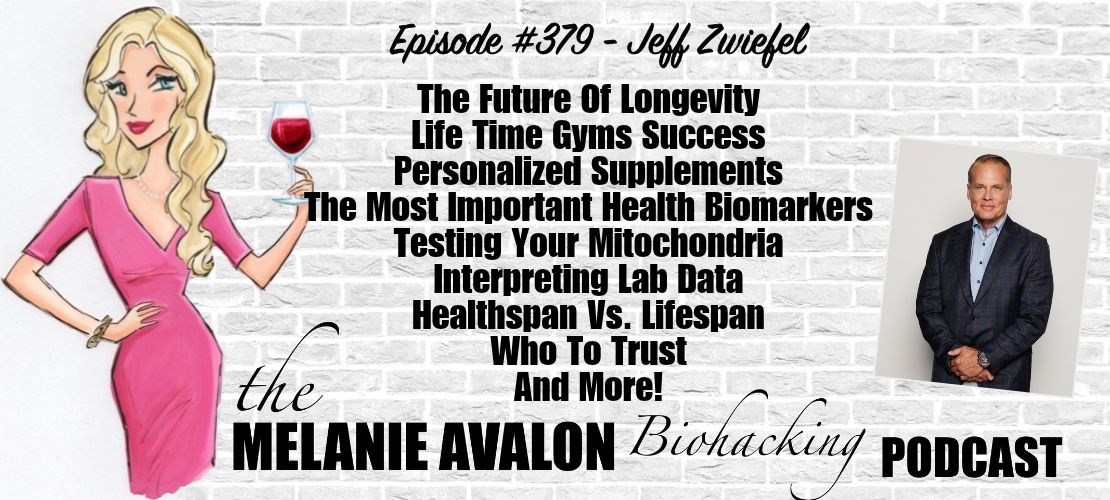
Jeff Zwiefel is the former President and Chief Operating Officer of
Life Time, where he played a pivotal role in shaping the company’s evolution over more than two decades. A nearly 40-year veteran in the fitness and wellness industry, Jeff has led large-scale operations and strategic growth initiatives
that have helped redefine how health clubs deliver value to their members.
Now, Jeff is channeling his deep expertise and personal passion into the rapidly emerging field of longevity and healthy aging. He is currently partnering with
Life Time to lead the development of MIORA — Longevity and Performance, a groundbreaking, science-backed program designed to optimize healthy aging through personalized, clinical-grade interventions.
LEARN MORE:
SHOW NOTES
FACEBOOK: Join Melanie's Facebook group for a weekly episode giveaway and to discuss and learn about all things biohacking. All conversations are welcome! IF Biohackers: Intermittent Fasting + Real Foods + Life
INSTAGRAM: Follow Melanie on Instagram to see the latest moments, products, and #allthethings! @melanieavalon
AVALONX: AvalonX Spirulina is out now! AvalonX supplements are free of toxic fillers and common allergens (including wheat, rice, gluten, dairy, shellfish, nuts, soy, eggs, and yeast). They are tested to be free of heavy metals and mold and are triple-tested for purity and potency. Get on the email list to stay up to date with all the special offers and news about Melanie's new supplements at avalonx.us/emaillist! Get 10% off at avalonx.us and mdlogichealth.com with the code MELANIEAVALON. Plus, text AVALONX to 877-861-8318 for a one-time 20% off code for avalonx.us.
FOOD SENSE GUIDE: Get Melanie's app to tackle your food sensitivities. Food Sense includes a searchable catalog of 300+ foods, revealing their gluten, FODMAP, lectin, histamine, amine, glutamate, oxalate, salicylate, sulfite, and thiol status. It also includes compound overviews, reactions to look for, lists of foods high and low in these compounds, the ability to create your own personal lists, and more.
EMF: Stay up to date on all the news on Melanie's EMF collaboration with R Blank, and get the launch specials exclusively at melanieavalon.com/emfemaillist.
TRANSCRIPT
Jeff Zwiefel
Longevity now, it's a mega trend that is positioned to be massively disruptive in my ... Healthcare happens in the homes, the studios, the clubs, the schools, at work. You know, in that break/fix paradigm to catch people after they've slid into decline and bring them back to neutral, you know, that's just not the way it needs to be.
Consumers have been left attempting to try to, you know, engage in the peptide category as the wild, wild west, right? With these research-only peptides
Melanie Avalon
Welcome to the Melanie Avalon Biohacking Podcast, where we meet the world's top experts to explore the secrets of health, mindset, longevity, and so much more. Are you ready to take charge of your existence and biohack your life? This show is for you. Please keep in mind we're not dispensing medical advice and are not responsible for any outcomes you may experience from implementing the tactics lying herein. So friends, are you ready to join me? Let's do this.
Welcome back to the Melanie Avalon Biohacking Podcast. Oh my goodness, friends, what an honor to sit down with today's legend. Yes, Jeff Zwiefel was the COO and president of Life Time. I know you guys know these gems, and it was such an honor to connect with somebody who has done so much for and knows so much about longevity, business, and the business of longevity. In today's episode, we talk about so many things, including why Life Time became so successful, what blood markers you need to be testing to support your health span and how to interpret them, whether or not you can have a personalized supplement where you get all of your supplements in one, the importance of your mitochondria, how to know who to trust, the future of healthcare, and so much more.
The show notes for today's episode will be at Melanieavalon.com/jeffzwiefel. That's J-E-F-F-Z-W-I-E-F-E-L. Those show notes will have a full transcript as well as links to everything that we talked about, so definitely check that out. I can't wait to hear what you guys think. Definitely let me know in my Facebook group, IF Biohackers: Intermittent Fasting + Real Foods + Life. Comment something you learned or something that resonated with you on the pinned post to enter to win something that I love. And then check out my Instagram Find Me Friday announcement post, and again, comment there to enter to win something that I love. All right. I think that's all the things. Without further ado, please enjoy this fabulous conversation with Jeff Zwiefel. Hi, friends. Welcome back to the show. I am so incredibly excited about the conversation I'm about to have. It is on all of the topics that I love brought together with an incredibly epic and accomplished human being. So we are gonna talk about all things longevity, the history of it, the future of it, the business of it, and who better to have that conversation with than Jeff Zwiefel? So he is the, wait for it, former president and COO of Life Time. I know you guys know Life Time. I feel like everybody knows Life Time. So he's a nearly 40-year veteran in the fitness and wellness industry. And after Life Time, or I guess maybe a little bit during Life Time, the transition, he was with a company called MIORA, which is a longevity and performance science-backed program that also does a lot ... I was looking all into them, and they do a lot with testing your biomarkers and prescribing, you know, different therapies and treatments and even medications for longevity.
Melanie Avalon
And now I just learned that he has been working 90 days now leading 10X Health, which also works with biomarkers and testing, and it's direct to consumer, and there's just a lot that we can talk about there. But, um, yeah, I've been looking forward to this conversation for so, so long.
So Jeff, thank you so much for all that you do, and thank you so much for being here.
Jeff Zwiefel
Thank you, Melanie. I appreciate that kind introduction.
Exciting discussion that we're gonna have on longevity, which I believe is one of the most transformative trends that are shaping our world today. So I'm tremendously excited about what we're talking about.
Melanie Avalon
So you already actually used a keyword that leads into a good opening question because, like, the word trend. So question about longevity and your personal connection to it and whether or not it is a trend because I feel like there are a lo- so longevity, obviously it's a passion of mine. That's what this show is about.
Obviously, it's a passion of yours. And yet I feel like it's not one of those things that, at least for me, when you're really young, like, you're not like, like, "What do you wanna do when you grow up?" Like, "I wanna be a longevity person," you know? Like, when ... Like, it's not a passion that I think something people would think of automatically. So my, my question is your personal story. When did you get interested in this concept of longevity? Is it a trend? Like, what is it, the future of it? Just what, like, what got you to, to what you're doing today? 'Cause working, you know, for, like, 40 years and being president of Life Time, I mean, that, that's a whole journey in and of itself, so ...
Jeff Zwiefel
Yeah. Really puts it in great context, Melanie, because as I've been studying the health and wellness and, you know, fitness industry for four decades and, you know, we've been doing amazing things undeniably around improving people's overall health and the quality of their life. And, you know, I'm just so remarkably blessed and have amazing gratitude to, you know, the, the lives that we've changed through the 1.5 million members that we had at Life Time.
You know, the stories that, as you can appreciate, are so captivating and, you know, really, you know, are the most meaningful things you can do in your life. But as I looked at it and I continued to assess the marketplace as a whole, it became much more clear to me That, you know, as a, as a health club or a lifestyle kind of operation that we were attempting to be at Lifetime, even as much as we were, you know, strategically and the broader vision of not just being a gym or a fitness facility, we wanted to be a, you know, a lifestyle destination. Even with that, we were only able to take customers so far on their journey. And when you begin to reflect on, you know, the, the current realities of where the consumer mindset is in being massively inundated with so much information, primarily through social media and other mechanisms about their overall health, and a lot of it being misinformation and conflicting information. While at the same time, I believe the consumer, regardless of their age, wants to have and is demanding control over their own health like never before. And then coupled with the convergence of, you know, the consumer just rejecting and no longer accepting traditional healthcare generally being, being programmed of treating disease and sickness and illness and being a, you know, a, a break-fix model and being shuffled around in that system once you are ill versus thinking about how people can optimize their health.
I, I had the vision while at Lifetime with our founder to build a personalized wellness and preventative health all under one roof. We at Lifetime always had the idea of proactive care and not waiting again till you're sick, but, but thinking about preventative health. And when you, when you think about the dimensions of the consumer today, six out of 10 Americans with chronic disease, right? We know these stats, 50% either diabetic or pre-diabetic, 43% living with obesity and 74% overweight, 93% are dealing with this metabolic health dysfunction that we talk about, and one in three Americans reporting issues with their concentration and, and mental focus. I mean, so longevity now, it's a mega trend that is positioned to be massively disruptive in my view. And that's what I think, you know, is so exciting about it because it's a gold rush. And the challenge, as I say, with so many gold rushes, Melanie, it brings a ton of bad actors in it as well, right? And it has many pitfalls of people trying to capitalize on the excitement and this prospect of cutting corners and subpar products and exaggerated claims and the fool's gold scenario, right?
Jeff Zwiefel
But it has brought in scientists and entrepreneurs and investors and health professionals all looking for a way to, you know, navigate the, the rugged and unpredictable territory of the gold rush, if we will, and how we can work through the dry wells and the false leads in making sure that we focus the consumer on promising theories and products that are real, right? That are legitimate.
And so for me, this, this walk, if you will, and the journey that I've been under is not just that I'm, you know, in my early 60s and certainly looking to try to live like I'm... and function and perform like I'm 38 or 42 years old. That's my objective personally. I want to live in an optimized state. I don't want to be compared to age-related norms, and I don't think the average person that is, you know, very health conscious and very informed... I mean, I interviewed 400,000 Lifetime members when I embarked on this journey at, at Lifetime of Miora, the longevity and anti-aging performance business. You know, I found that 93% of them were already engaging in some sort of nutritional supplement, red light therapy, colder contrast therapy. You know, they were, they were so already seeking these services somewhere else. And so why not create that one-stop shop for them within the Lifetime ecosystem? And then, you know, embarking on my newest journey at 10X Health as the president and CEO, COO of this business, I think it's an opportunistic time with our precision health optimization model to really provide the solutions to consumers that they're looking for. That, that's a long way of answering your question.
Melanie Avalon
So I am not admittedly... I feel like there are-- Actually, I'd be curious your thoughts on this. I feel like there are gym people and there are not gym people, and it, it doesn't necessarily even relate to, you know, the desire or the joy of physical movement and things like that.
Like, I f- feel like ... 'cause I'm having flashbacks to-- I used to go to a Lifetime. Um, so I, I was raised in Memphis. I went to one there in my... like, I guess when I was in middle school or high school. So I'm thinking back to my experience of walking in there and what, like, what was available at the time and who I was as a consumer at the time and what was I interested in. And the memories I'm having, I'm-- hopefully these are correct memories. Like, I went in and-- but they also had, like, juices or supplements or, l- or, um, like, stuff like that. Like, that's my memory that they were, like, educating me on that at that time. But going back to, like, the gym people and the not gym people. So I I am all about physical activity and movement and all the things, and I have tried multiple times to, like, go to the gym and, like, have a membership and keep going, and it's just, it's not my personal place. I don't, I just don't I don't know. I'd rather... I'm just better at being, like, active
Jeff Zwiefel
I think that's exactly right. I think, you know, that environment and, you know, sort of way of being physically active is, is, you know, certainly not for everybody, and by any means. And as much as, uh, you know, Life Time attempted to have a really broad and wide aperture of attraction and retention of, of consumers because, you know, we pack so many things all conveniently under one roof, as you say, from swimming to, you know, sports, pickleball and basketball and tennis, and to, you know, fitness and, and programming for kids, right? So it attracted the entire family unit and, you know, our sweet spot was the kids and cul-de-sacs, of course, in suburbia. But we also tried to do the healthy eating and, and nutritional products and things. It still, you know, is gonna miss a large segment of the customer that are very health-conscious, that care about their own fitness, understand and value the importance of movement and physical activity, and still is doing differently.
I love to mountain bike, as an example. I mountain biked, you know, at 5:30 this morning in the desert here in Arizona, and that, I think, is, it's just a tremendous change and alternative and reinvigoration for so many reasons to gain your physical activity with something that's also engaging and entertaining at the same time, you know? And so I think the, the idea of getting on a piece of cardio equipment in a, in a fixed kinda room with a stagnant environment is, is really difficult for a lot of people. And, you know, one modality of, of fitness is really also difficult for retention and, as we know as a physiology, the really difficult kinda great adaptation that you need to have, right? And so I think there's a lot of reasons why, you know, the gym's not for everybody, and that's the other reason why I would say that part of my journey has taken me to a company like 10X Health is because we can serve anyone, anywhere, all over the world, and it doesn't matter, you know, where they're at. Our objective is to meet them where they're at. And what I'm so enthusiastic about with, you know, this industry is we're finally progressing to the point, Melanie, where we have these diagnostics and these tests that can really create true personalization for the first time ever. I mean, everybody's got their own unique DNA and genetics and biology, and the healthcare system has traditionally done this one size fits all for people. You know, and it's a, it's not uncommon, of course, that 70% of consumers are dissatisfied with the healthcare system. 76 tell us that they report they don't care if they have to switch physicians, and it takes 26 days on average to see a physician. And over 100 million Americans report, like me, not even having a primary care physician, right? So, and then you fast-forward to 2040, where Deloitte re- research will tell us that 80% of healthcare will be preventative in the US, and I believe that's absolutely gonna be happening because of the factors that I talked about earlier. This healthcare happens in the homes, the studios, the clubs, the schools, at work.
Jeff Zwiefel
You know, and that break/fix paradigm to catch people after they've slid into decline and bring them back to neutral, you know, that's just not the way it needs to be. And, you know, health and fitness industry had this, has this opportunity to change that, but, you know, that's a difficult thing for them to change the model.
So I just think this excitement that we're under, Melanie, now is this forefront discussion about measuring life in two ways, right? Lifespan and healthspan. Lifespan, how long you live, and healthspan, how long you live healthy, disease-free life. The average American is living 14 years in chronic poor health. So we're, we're getting through our medical system and the great science and the best healthcare system in the world at treating disease in the US at extending life, but we're really doing a poor job extending the life in our years, right? And that's what's exciting to me about, about what we're doing in this area of longevity.
Melanie Avalon
I'm just envisioning the future of all of this, and I have a question about the, I guess, the expansion potential, the community potential, because just going back again and like I said, I'm getting all my Life Time memories hitting me, and I, I realize that I, I'm having an in real time epiphany that I th- when I first started going, like I said, I was, I was quite young. I was probably in middle school.
I think I thought, 'cause I, I was raised in a Bible Belt Christian South area
Jeff Zwiefel
I opened that club in Memphis. I remember it.
Melanie Avalon
You... Okay. Yeah, yeah, yeah, in Collierville if... I don't know if you... At that one, if that looks-
Jeff Zwiefel
Collierville is where it was, yes.
Melanie Avalon
Yes. And I think, I'm pretty sure, this could be a false memory, but I'm pretty sure I thought it was, like, a ... a Christian-affiliated gym.
Jeff Zwiefel
Really?
Melanie Avalon
Yeah, because of the community I was in, and, like, all my friends went there. And, like, the word Lifetime, I think I got- would get it confused with LifeWay, which is the bookstore. So I think I made... Which is a Christian bookstore. I think, like, in my head, when I'm like, "Lifetime," I'm like, "Oh, the Christian gym that I went to when I was little." Which isn't even, you know, the case.
But where I'm, where I'm going with this is community is, is so powerful for, well, health and fitness in general, longevity in general, and also creating movements and actually making change. And so, you know, the incredible thing about a massive business like Lifetime is that even if people don't go there initially, I'm, I'm assuming, even if they don't initially go with a goal of, quote, "healthspan" per se, you know, just getting into a community of like-minded individuals is just, I think, what creates momentum. So with something like what you're doing with 10X Health, do you have a vision of there being... 'Cause, like, you were talking earlier about information overload and, like, so much, you know, what is the consumer supposed to know what to do? Do you have a vision of having, like, one go-to, you know, testing place where it's, like, the thing and everybody goes? Or do you like a model of lot of different type of options that people can go to for pursuing healthspan?
Jeff Zwiefel
Yeah, that's a great question. I think it's part of the challenge I think the consumer's been faced with as well, is the access to so much data that is also fragmented like, you know, our current healthcare system. You know, and you're, there's a reason why we're also seeing, to your point, Melanie, the massive growth in some of these concepts like longevity clinics and social wellness concepts like Othership and Bathhouse and things like this because... And, and the growth of HYDRX as a competitive event, right? Because of, one, the accessibility to it. You don't have to be, you know, a CrossFit competitor and go through rhabdomyalgia of training to engage in it. You can find a friend or a partner and go ahead and participate in a HYDRX event, and you don't have to be in elite shape to do it. So I think Lifetime's success was predicated, to your point, on this social wellness concept of creating community, a club in a club. A club in a club of like-minded people that, you know, in the s- in the Group X cycle studio, the Pilates club, we created an Aurora club, which was, you know, the, the aging, uh, consumer club. And of course, that was one of the most popular ones, because they would come down after doing some activity and meet in the Caf- Life Cafe and have shakes and smoothies and coffees. And that social time, as we know from, you know, the, the longevity work that's done in the, by the, the author of "The Blue Zones," who's from Minnesota, may be the most important ingredient of a long, healthy life than anything else we could do.
And so that connective tissue, as I'm rambling about it, you know, for the consumer, how do they take this disparate data from my Eight Sleep mattress that I have and my Au- Oura Ring and, you know, my WHOOP or my Ultrahuman or my Fitbit and, or my Apple Watch, and how do I make sense of all of it? How do I integrate it into a program and a routine that I can do something about, right? I mean, we're seeing the advent of these improved testing and diagnostics ranging from, like, we do genetic testing, epigenetic testing, biological age, gut microbiomes, NAD testing, brain taps, food allergies, capillary function assessments, and obviously we're seeing the advent of blood biomarkers coming very much to the forefront. But at the end of the day, how do we take this information and, and roll it up into a consumer way where it's integrated, it's personalized, it's customized to their dashboard, if you will?
And then the program design is created, like what we're doing at 10X, taking that data that we are able to curate for the customer and then creating a relationship with a practitioner tele- through a telehealth mechanism or one of our clinics that we have around the country. And then combine that with, you know, first and foremost, what elements of your lifestyle are the most concerning, right? Problem, solution. Am I not sleeping at night, right? Am I, you know, is... Do I have, you know, issues with digestion? Is it, is it brain fog? You know, is it recovery from working out and training? Am I just gaining body fat, right?
Jeff Zwiefel
I mean, we're finally seeing a massive movement and an awakening around women's health optimization, given the fact that we've taken the lid off the black box hormone stuff and... But when we're looking now, you can't even get an estrogen patch for women because they're in such huge demand right now with perimenopausal and menopausal women finally not tolerating the answers to our traditional healthcare system that, "Oh, you just gotta accept it. It's a normal part of aging." And it's not, right? It's just flat out not.
And so for, for us at 10X Health, the opportunity to bring these complicated elements together, simplify it, distill it down into a program that people can use and activate, and then progress down their journey in time, addressing the most important thing first, and not trying to boil the ocean, Melanie, right? And making sure that we are... Because you also can't budget for that in the way that you want to. So looking at symptomology, comparing that to assessments like your genetic test and your blood work, and then making sure that it's built just for you. I mean, that's what's so exciting to me about what we're doing here with the genetic test, because the genetic test become this baseline understanding of how you can take ownership with your health and how you can look at these genes and ultimately develop a more comprehensive program that optimizes their, your biological pathways, and that's what's cool about it.
We're doing 27 genes with six biochemical pathways, and that really allows us to look at things like your folic acid activation. I- in other words, how does your body convert and activate folate, right? This is a foundation of the methylation cycle, energy production, and detox. You know, how does homocysteine metabolism work? How efficiently does your body, in other word, clear homocysteine, and which really can in- influence your cardiovascular and cognitive aging. Example, how we look at vitamin D metabolism and how the body produces and activates and uses vitamin D, and how it influences things like bone health and immune function and mood and inflammation. I mean, I could go on and on, right, about what these 27 genes actually do and why they're so more important now to inform how you eat, what you eat, and w- and, and what you supplement with. People are blindly going out and taking peptides and supplements and other things and stacking them without understanding first the baseline biology of their own human body.
And that's the real challenge that we're gonna get into with what I started with, with the gold rush, right, Melanie? And how we need to make sure we're thinking about setting up the rou- right foundational framework, you know, of a program for consumers. Does that make sense?
Melanie Avalon
It completely does. And, and speaking to that, because, I mean, it can really be, it can be like the Wild West out there, like, like you said, with everything, and people wanting to try all the things all the time.
So that actually, that's a big question I have about how you're doing this, because you mentioned, you know, that there's a lot of different tests, like genetic tests, you know, gut tests, blood tests. How do you decide... So, so for each, each arm, 'cause, like, for me on this show, I've, in all of those categories, I've tried, I've worked with a lot of different companies, tried a lot of different things. So how do you decide who to work with for each, each one?
Jeff Zwiefel
Yeah. Obviously, you know, we have a clinical-- I have a chief science officer here, and, you know, having the right level of scientific vigor and validation with any strategic partner, whether it be, you know, our blood testing company, whether it be, you know, our manufacturer of our genetic testing, it's just, it's, it's gotta be table stakes in this category. 'Cause as you can appreciate, it's people's health that's at risk here. And so you've got to make sure that you really do your due diligence and that there's the right level of, you know, not just common sense, but rigor and, and scientific validation, quality controls, and standards from end to end. So without that, I think it can be really challenging, right?
And a, a example of that right now is how consumers have been left attempting to try to, you know, engage in the peptide category as the Wild, Wild West, right? With these research-only peptides. I mean, we don't really know where the hell they're coming from and what's in these products right now because they're not from, you know, a compounding pharmacy that is validating, has, you know, CVAs and everything else on the products and goes through the quality manufacturing standards that we would require at a company like 10X Health. So, you know, the buyer has to be extremely aware of the risk in this right now, and it's really a concerning part of the business. And that's why you've got to go to organizations that have, you know, the good track record and the background for this kind of stuff because it can really be a scary, scary s- situation if not done right. That's what I would guard against.
Melanie Avalon
And, and also to that point, 'cause I think, I think trust is huge with this, and for analyzing and personalizing everything to the individual who comes to 10X, did you guys develop your own, like, AI algorithm to do that? Or how did you, how'd you determine that?
Jeff Zwiefel
Yeah, that's a great question. You know, we partnered with a company out of Austria, believe it or not, called Novogenia.
And Novogenia has this proprietary capability. They have their unique AI algorithm. Their... That's where our lab is. They have a gene SNP that's a custom built. It does 72 million gene SNPs, and it does this genetic mapping. That's the, um ... What we've created and how we deliver it is through, you know, this unique micro bead absorption method, and that's an oral method. So what we do is take people through the genetic test, a methylation test, and we understand their own body's biology and how it responds to f- you know, different types of foods and supplements. And then from there, we can design for them a personalized, uh, supplement, and those are manufactured by our lab in Austria, uh, Novogenia. And so I know that I can eliminate all my other supplements because this becomes my one-stop shop in optimizing my overall nutritional supplement based on all the factors of my lifestyle and, you know, how my body processes and utilizes nutrients.
Melanie Avalon
Whoa, okay. Um, this is so interesting. So how, how many potential supplements can go into that personalized supplement?
Jeff Zwiefel
Oh, it's endless, right? It's these little, these little micro beads that we use that are covered with cellulose to help with absorption. And so it is an endless composition that we can manufacture in someone's personalized supplement routine, and that's what's so super exciting a- about it, and taking out all the guesswork from this, this process, and that's the super cool part about that. And then from, at that stage, then you can determine, you know, what the next steps in your journey are.
We also make, you know, a methylated version of a multivitamin called Optimize that's the best in the market if you're looking for more affordable option and not the full Cadillac or personalized version of your own supplements. Our personalized supplements are about $300 a month or, you know, $10 a day. But when I combine all my different supplements into this one-stop shop, I'm actually coming out on a more favorable basis from a budgetary standpoint. So it's really a cool and ingenious way of, you know, taking all the guesswork out of this thing. And you think about it as a comparison to your blood work, for example. You look at your blood work, and our goal is always to try to think about what biomarker is farthest off optimal, yes? Same thing here, uh, with your genetic testing. All of our genetics obvious- are, is, are unique, and that's why it's called your own genetics. And it's remarkable to find, for example, we all have been told in this industry that essential fatty acids, omega-3 are, are tremendously important, and you should supplement with them, right? Well, unless you find out how your body processes and absorbs omega-3s, you may not be maximizing or oppos- optimizing your omega-3 fatty acids. And so same thing with vitamin D and folate and, you know, various other products on the market, and that's what's so cool about starting, like I said, is testing first, not guessing. And I think the consumer right now is left with this guessing and this kind of being lost at sea with misinformation, too much information, pseudoscience all around them, trying to conclude what the heck they should be taking to be healthy. Consumers have this amazing desire to be healthy and take control of their health, like I said earlier, but they really need to have the right direction on how to go through this and get it done the right way. I mean, at ... What I had developed in concert with Jim LaValle at Lifetime that we're, uh, gonna be partnering at 10X Health is taking your blood work, for example, Melanie, and breaking it into five triads called the metabolic code. You know, measure 100 biomarkers, let's just start there, in your diagnostic blood draw. And then we put it into this unique algorithm to generate a personalized wellness plan. We break it into five triads. One triad is your adrenal, thyroid, and pancreas. The second triad is your gut, immune, brain. The third is cardiopulmonary and neurovascular. Fourth is liver, lymph, and kidney. And the fifth triad is the estrogen, progesterone, testosterone, your hormones. So then we can create the right lifestyle plan.
Jeff Zwiefel
We look at the red, yellow, green on your dashboard around that, and then we decide what lifestyle behaviors you need to change. Obviously, we're employing health coaching.
And then we can decide what we wanna stack up relative to nutrition, supplementation- IV therapies, hormones, peptides, and so on that might be appropriate for you. That's the way you need to create the right foundation and continue to progress the right way. I mean, it's just an exciting space right now, and we're learning and seeing so much more on the categories like GLP-1s, as you know, that it is really shifting things as a whole in a significant way.
Melanie Avalon
It's interesting because I got approached by a brand probably a few months ago, and not the same thing at all, but the idea of it was, it was to combine all of your different supplements into one, and it made it into like a... It was like a juice machine, and it would like give you a drink. And I was like, "Well, in theory, I love the idea of, you know, having everything in one at some point, and also I have no idea what this company is. How do they know what I need? Like, I also don't know what's in this drink." So I was like, "No." What you're doing, I am... Yeah, I'm so fascinated by this. So how do you account for... So you, you mentioned the, the beads and, like, the cellulose coating for absorption. Does that get around certain things needing to be taken with food or without food or, like, time of day?
Jeff Zwiefel
You still really wanna take it with food because it'll maximize absor- absorption. These are all methylated products, which can dramatically improve absorption and utilization in a significant way because so many of the supplement products on the market today aren't methylated, and that is a real shortcoming for them. But we still highly encourage them, given the, the purity and the potency, to improve the absorption with, uh, some sort of food. So still, still encourage that.
You can take them any time of day, but ideally around, uh, uh, a small meal or a large meal. Yep.
Melanie Avalon
Gotcha. Yeah, it's funny.
The methyl thing, I feel like that's my, that's my test if I ever, you know, am looking and evaluating a supplement line, if they have any sort of vitamin-related thing that could be methylated, I, I check. That's my first thing, and if it's like me- not methylated, I'm like, "Okay, bye." Like, they're not, they're not getting it here.
Jeff Zwiefel
Consumers, you know, it's totally gamed on many times, right? They don't know, they don't know what to look for on... And it, the other scary part is we know in this industry that is finally starting to come to the forefront is, you know, the bad actors that even Amazon is starting to require independent testing on their supplement lines to validate, believe it or not, that what's on the label claim is truly in the bottle. There's no regulation in the industry for this today, and that is what's truly scary.
We do independent testing on all our products at 10X Health. That means we take them from the supplier or manufacturer that we've contracted with to a third-party lab to validate the ingredients. And we do this on our, on our personalized supplements from NovaGenia as well. So, you know, you've gotta really look at this. So the cool thing about this genetic test that we do is we're looking at methylation pathways, we're looking at detoxification, neurotransmitter production, energy metabolism, cardiovascular health, and inflammation management. Think about it, Melanie. You've got consumers, 93% have metabolic dysfunction. This metaflammation, where does that come from? Right? Some inflammation is good when you're healing something, right? But the chronic inflammation, the constant, you know, issues here come from the really poor processed, ultra-processed food in our diet. It comes from the environment that we live in. It comes from stress and anxiety. It comes from the lack of sleep that we're getting, right? It comes from the lack of great nutrients that we, we don't get, right? And, you know, it affects everything from our energy level, to our homocysteine metabolism, to our cognitive function, to mood, and our recovery and overall wellness. So I think that's, that's what, um, you know, we really need to try to guard against.
Melanie Avalon
I could not agree more. Inflammation, it's funny, I've I've talked about this before on my show, but I've had a, not a fear of inflammation, but a concern about inflammation for so long, and it's to the point that I've had therapy sessions where my therapist is like, "Melanie, everything is not inflammation." And I'm like, "But it is. Must a- address the inflammation."
Jeff Zwiefel
Well, it's usually, it's usually, Melanie, the sad part is how we can look at it in blood biomarkers, for example, in homocysteine levels, cortisol levels, and these become upstream predictors of major age-related diseases like cardiovascular disease, type 2 diabetes, cancer, you know, Alzheimer's disease, and you name it. The idea is with this, things we're doing at 10X Health and what I was doing at Life Time are designed to predict eight to 10 years upstream the likelihood if you don't do something about it, what the probability of some of these issues will be. You know, our CRP levels, right, our creatinine, uh, levels, our homocysteine levels, our LP-PLA2s, these become really important numbers for people to understand and to be able to act on early on and prevent some of these nasty age-related diseases that, that can happen.
Melanie Avalon
I'm super curious, has there been... So in, in working, you know, developing this company, working with this company, has there been any internal debate about what direction to go on any topic? Like, has there been anything that's, that you guys have been torn?
Jeff Zwiefel
Oh, yeah. Yeah, there are always, as you can appreciate, that constant critical dialogue about, you know, where the consumer market is going, where the most significant opportunities are in terms of problems that we're looking to try to solve, right? But when you look at the market, you know, obesity's such a s- large segment of the US population, you know, coupled with insulin resistance, you know, poor sleep, brain health. Gut is becoming such a well-known category now.
We've recently launched a new, relatively new product called MitoScreen, Me s- MeScreen, that is a mitochondria assessment. Mitochondria is the powerhouse of the cell. One of the most significant predictors of age-related decline is the health of your mitochondria, right? Mitochondrial dysfunction is ultimately the determination of how rapidly you're gonna age and potentially encounter some of these age-related diseases. So, you know, and then get into this really poor cycle of chronic inflammation, and then your body can't fight infections, it can't repair tissue, it doesn't build muscle, it doesn't adapt to stress the right way. And so we're excited. We're doing the genetic testing, we do blood testing, of course, we do gut health testing, and we're also doing mitochondrial testing right now, and we're one of the few companies out in front doing those kind of things. But yes, we always have healthy, constructive debate with our scientific advisory board, as well as our internal medical chief science officer and innovation officers around what should be next and why. That's a difficult area to predict.
Melanie Avalon
On the mitochondrial front, one of-- This is a tangent question, and I don't even know if we know the answer. But what I think about a lot with mitochondria is because they are inherited from... Like, you get it from your mom, not your, not your dad.
So I've always wondered if, like, people's energy levels and, yeah, I guess mostly, like, their energy levels and how their mitochondria are functioning, is that largely determined by your mom, like, your mother's mitochondrial health or is it not related? Like, I don't-
Jeff Zwiefel
I think your lifestyle has a really dramatic effect on it as well. You know, as we say in, you know, epigenetics versus genetics, 80% still of, you know, your lifestyle, your, your outcome of your health is a function of lifestyle.
And, you know, how you train, you know, really will dictate your energy production of those engines inside your cells. So again, mitochondria at the basic level is how we're converting oxygen and nutrients into ATP. You know, ATP is the energy that we use for our muscles to contract and our brain to function. You know, so it's a really valuable marker, you know. But we, you know, love looking at other things like, you know, VO2 max and, you know, the other great measures. It's a really interesting area. We're still dialing in sort of what we call the Me Score. I just had mine done a couple weeks ago. And, you know, most importantly, what we wanna be able to provide is what the consumer can do, right, take action to improve the health of their mitochondria and change the outcome of their mitochondria. I think that's, that's the most exciting world that I think we can, we can focus on. Yes.
Melanie Avalon
I'm just thinking about, 'cause you were talking about, you know, where to focus, which direction to go, the future of all of this. The... or a nice thing about this, dare I say, like, business model compared to conventional, you know, conventional medicine, is that conventional medicine really benefits on people staying sick because, you know, then they're still on the m- the medications and the pharmaceuticals and all the things.
But with this, you can address people's health issues, be preventative so you can address a solution, and yet people still remain customers because the end goal is now health span, and which you can, you know, perpetually work on. So you don't lose a customer by healing them, presumably.
Jeff Zwiefel
Yeah. The TAM, or the total addressable market, of this industry is massive, right? Because it isn't just the silver tsunami of, you know, the growth of the 60 plus that's happening after 2030. That's a massive change, sure.
But I'm finding, you know, 26, 27, 28-year-old men and women that are having anxiety because of social media, you know, addictions and dead scrolling, having trouble with sleep and REM and, and recovery, and hormone levels at such a younger age that are deficient than ever before. So I think your point is right. I mean, our, you know, lifetime value or the LTV, when you can provide a customer with this baseline or foundational information like we're doing at- to 10X Health and then provide them with a program and a protocol that is personalized and, and effective at starting to make the positive changes that they're seeking, you got a customer for life. You have a customer that is, you know, in your ecosystem and won't leave you because like you said, the opportunistic word in this category, Melanie, you said it earlier, it's trust. It's all about trust.
Melanie Avalon
What do you think is going to be the effect... So with the government and politically e- and everything, I think we've seen more and more of a, you know, a move towards this world that, that we're in, like an acceptance of it. Uh, we're seeing that for sure.
Where, where do you predict that's going? Do you think that's gonna continue and be good?
Jeff Zwiefel
No, I think it's a great question. I, I really hope and believe optimistically that, you know, making America healthy again is a bipartisan issue.
There's no political group that shouldn't be excited about getting behind how consumers, physicians, wellness advocates, parents, policymakers are dealing with the chronic health and the traditional healthcare that's largely failed to solve the problems. You know, so I think it's great that we flipped over the pyramid, right? I mean, I think it's great that we're actually talking about how ugly the ultra-processed foods are and how sadly the food industry and big pharma has owned so much of the narrative and controlled the mainst- mainstream scientific positions in the past. You know, I- we don't need to get into vaccines good and bad or whatever, but we do need to take control and allow consumers to have great information about their own health and what's good and what's bad out there for them, and do a better job educating them about it. So I certainly hope that this is the start of something that continues, uh, in a meaningful way to take shape. And we see it as a way with 10X Health that, again, is something that will continue to create great tailwind for us as an organization in bringing this to the forefront in the consumer mindset and the rigor of clinical science.
Melanie Avalon
Yeah. I, I could not agree more. I, I hope it continues in that direction.
I, I always get nervous. I'm like, "What if, you know, what if they come in and try to actually regulate these things to, to take them over for big pharma?" For example, like when, you know, NMN was, like, in a gray area, or, like, NAC was poten- you know, for a while, was not... You couldn't get it and it's... Yeah. It's, it's just fascinating.
Jeff Zwiefel
Yeah, like peptides. I mean, like what has happened with the shortage of GLP-1s with Novo Nordisk and, and Eli Lilly, right? I mean, yes, and fortunately, the compounding pharmacies were around to continue to provide an alternative solution with the, the short- shortages that happened.
But, you know, you know, we need to bring more double-blind, you know, peer review research to the forefront on some of these really strong-looking peptides, like, and better understand their application, their use, like BPC 157 and TB 500, right? And, you know, Semorin and things like this. And we need to better educate the consumer on how they work and why they work and how these cell signul- signaling, you know, transmitters actually do what they do, right? And I think that's gonna be a massive market and industry for us, for sure. I mean, we've seen the progression, Melanie, of the rapid evolution of semaglutide to tirzepatide, now to retaglutide. I mean, this is continuing to evolve and will continue to evolve, fortunately, as a way of transforming the obesity epidemic and treatment. Because, you know, now we've just got to make sure that we're advising our, our clients, our customers how to do it the right way, you know, with titrating dosages, with gradual and slow weight loss, one to three pounds a week at most, with body composition assessment along the way, with, you know, high-protein food intake and resistance training to avoid the loss of lean body mass. I mean, that's why a partner like 10X Health is so crucial, where people aren't going out and blindly using these products without the right guidance and support.
Melanie Avalon
I've personally been really fascinated by the consumer perception evolution of GLP-1 agonists because I feel like, I feel like when they first, quote, "exploded on the scene," and I'm aware they were around before that, but when they became culturally a thing for people losing weight, people were really skeptical or, like, kind of shaming it, like saying it was, like, an easy way out.
Jeff Zwiefel
So many quick-fix diets, right? And I was there too, candidly, Melanie, right?
Being in the fitness industry for four decades, I was very reticent about it until I started to digging into the research. And, you know, the fact that this drug has been around, you know, obviously since 2007 and started with the treatment of diabetes, but now, you know, being Attributed to the potential for health complications, but not just diabetes and obesity, but 200 chronic diseases related to heart failure, kidney disease, hypertension, and as well as the downstream complications of things like sleep apnea, osteoarthritis, and potentially even correlated to Alzheimer's. So I think we're gonna continue to see how it progresses. And you're right, consumers were skeptical. Health professionals were extremely skeptical. Two years ago, two and a half years ago, I wrote a position statement on GLP-1s for Lifetime because we needed to establish our position.
Melanie Avalon
What was it?
Jeff Zwiefel
I'm happy to send it to you. It was that this product works, and, and we need to be out there with it, prescribing it to people that have tried everything and failed, and this is the catalyst that can finally work for them. I've got, you know, we've got millions of members that were at Lifetime that were doing all the things right. They were trying to eat healthy, they were trying to be physically active, and they still couldn't drop the unwanted pounds.
We have found that this has been amazing tailwind for the health club industry. I mean, the research that I did early on with the Harris Company showed that there was a $6.7 billion TAM with people using GLP-1s were twice as likely to start exercising, thir- 71% versus 36%. And our member traffic never was higher. You know? So people were worried that it was gonna kill health clubs and kill fitness. That's not the case, right? I- my, my position statement was simply framing how do we do this right? What I was worried about early on, I'm still worried about it, is the horrific misinformation of an American consumer of the quick fix, immediate gratification, you know, fast food drive-through me- mentality of I can take this injection or this pill, and that's all I have to do. Our methodology was how you need to do this as a comprehensive lifestyle approach. Or we could be shifting a society of overweight and obese people that are dying of cardiovascular disease, cancers, you know, and diabetes to a society as frail, no function, not being able to get off the toilet, right, and ostro product, uh, people, because they're not doing this right. I mean, we've seen the horrific people with body dysmorphia that are obviously taking this thing too far and, you know, it's, it's really, that's a really sad reality that needs to be managed, but the growth of it is undeniable. It's a massive mega trend again, Melanie, that, you know, companies like 10X are gonna make sure that we provide the right wraparound solutions to make sure people do it right.
Melanie Avalon
Yeah. Well, I'm, I'm personally, I'm thrilled to see it because yeah, when, when they first, when they first became a, you know, like a trend, I was like, I feel like people are against this because they, they think people are just taking the easy way out.
But then, but then we saw people finally, like so many people who like could not lose weight, seemingly no matter what they did, like now something was working.
Jeff Zwiefel
Now when Oprah comes out and talk about it, and she's got access to, you know, private chefs and personal trainers anytime she wants at her house, and she's, and we all know the stories of her trying and failing, uh, the weight yo-yo diet so many times, and then disassociating herself with Weight Watchers as an investor, right? Yes.
Melanie Avalon
Yeah. It's, it's wild. So I'm glad. I was like, you gotta... I was like, "I'm gonna wait this out," and eventually, hopefully there will be, you know, there'll be like education and-
Jeff Zwiefel
Yeah. And I got criticized, I got criticized early on, Melanie, by my peers in the health club industry thinking that, you know, I was selling out to pharma and, and, you know, medicine and a pill, and that wasn't, of course, the message, but it gets misconstrued. But, you know, it's a tool in the toolbox. Like so many of the tools that we're talking about within the longevity segment, you can't use them as a one-off. If I think I'm gonna live longer, healthier by using a PEMF mat alone and not worried about, uh, what I eat and smoking and you know, how my sleep is and you know, oh, it's not gonna happen, right? So we've gotta really be thoughtful about this foundational hierarchy.
I use an analogy much less Maslow's hierarchy of need, right? You're familiar with it, you know, right? Foundation one, we need, we need oxygen and we need water, right? Then we need food. Then we need, you know, something. We need housing. We need cover. And the, and the fifth is self-actualization. I can put the same methodology to this foundational build of longevity. You know, we need to be active and moving and eat decent, right? And we need to get good sleep, and we need to manage our stress. That's the foundational layer. And then we will start laddering up from there. We need to do diagnostics. We've gotta do some assessments. We gotta have some baseline understanding of your own biology, right? With things like our, the 10X Health genetic testing, the blood work- The gut microbiome testing. And then we've gotta determine what's appropriate for you and your individual needs.
Melanie Avalon
It's so true. I was literally thinking with the Maslow's hierarchy of needs that when it comes to all of this stuff, I feel like it's so individual.
S- especially like you mentioned, like the PEMF mats, and the supplements, and like sauna or cryotherapy or whatever it may be. Like I know for me, I have my own hierarchy of things that work really well, and other things that would work but they're not like higher, but that could be completely flipped for somebody else.
Jeff Zwiefel
That's right. I mean, you think about that, Melanie, and you've got... Your body is like a house. You know, your house may have a time of day where the kids are running around, and you're cooking, and alarms are going off, and the phone's ringing, and your body doesn't hear any of these signals that you're sending to it, right? You know, you- we've gotta get our bodies in a place where they're able to respond to these signals and go through the proper adaptation and improvements and enhancements that are making, you know, significant changes in, you know, how the quality and quantity of our lives. I mean, I don't think there's anything in my view, right, that can leave a better legacy in, you know, my life and anyone's life than improving people's quality and quantity of life.
Living longer, better. They wanna look better, they wanna feel better, they wanna perform better. No matter who they are, people wake up with that desire. The challenge we know in the consumer's mentality is they don't concern themselves about it till it's too late, till something goes wrong, and then they cherish what their great health was, and they wish they could get it back, right? And then they're caught in the traditional healthcare system cycle, and that revolving door, right, of go get another X-ray, go get a CT scan, do some other tests. Let's try this drug. This drug created four or five different side effects to you. Oh, let's stack a different drug on that to mitigate those side effects, right? It's doesn't get to the core or root cause of the issue, hardly ever, right? My dad is 92. He's been through cancer, open heart surgery. He's had, uh, many different situations that he lived through. He's independent. He's lived on his own. He still farms and drives tractors and things like that. Well, he had, you know, fluid on his heart recently, uh, got put in the hospital, and what do they do, of course? He sits, he lays sedentary, doesn't move. You know, lymphatic drainage is the number one thing for this fluid retention and pooling, right, of blood and fluids in different parts of your body. But, but we don't, and that nasty cycle is what would likely cause the end of his life, and then the stacking of medications that happens without finding what the root cause is.
That's the troubling part that I have. I mean, there are great, you know, practitioners and doctors all across the USA and abroad, but... And they save lives every single day, undeniably, and treat disease like no, nobody else in the world, but they're not great at extending health span today.
Melanie Avalon
Yeah. I am, I am so sorry about your dad, by the way.
Jeff Zwiefel
Yeah. Thank you. Thank you. I hope, uh, I, I gotta get home this weekend to see how he's doing. Yeah.
Melanie Avalon
Oh, man. S- I'm sending all the good vibes his way.
Jeff Zwiefel
Thank you, Melanie, I appreciate it.
Melanie Avalon
Yeah, and it's, this is just kind of an esoteric thought about all of it, but if the way the, the current sick care system, it... Like, all of the modern chronic diseases that we experience, they're not bad enough that they, you know, kill us outright, which if that happened, I, w- I feel like we would evolve out of them in a way, but they're just bad enough to keep us sick our whole life. So there's like no escape.
We can't, evolution can't save us. Like, we're just, it, stuck.
Jeff Zwiefel
Ugly cycle, isn't it? It's an ugly cycle that we're caught in, and you're right, and you know, it's obviously extremely expensive.
I read a statistic the other day that the economic value or improvement if we had one year of extended healthy life is worth $38 trillion glo- globally. 38 trillion. 10 years was worth $387 trillion for a decade of improved healthy life. So if you wanna do the ROI on this, right, it becomes pretty clear our system is so horrifically broken. It's fragmented, it's reactive, and it's gonna go on, right, because there's too many cooks in the kitchen and people with a handout at various stages that are getting paid. So I believe companies like 10X will run alongside this in parallel and naturally attract consumers that are frustrated and will no longer tolerate that existing broken system, and they're looking for an alternative to take control of their own health once and for all.
Melanie Avalon
Well, to that point, so how can people... Like, can anybody-- Are you, are you nationwide, or how does 10X work?
Jeff Zwiefel
Yeah, we're nationwide. You know, we're nationwide.
They can go to 10X Health Systems Our website is the best place to learn about us. We've got free wellness assessments that people can go online and take, and we can then begin to customize programs very early on to their needs. We have wellness and health concierge and coordinators that follow up with those customers, uh, after they've taken that really brief 10-point wellness assessment, and then we begin to figure out where to meet them where they're at in their current journey, what the best roadmap will, for them will be, and what that might look like, and we'll customize that for them. It might be, you know, lifestyle things. It might be, you know, nutrition. It might be supplementation, a nutritional supplement, or it might be some clinical pharmacological product like a hormone or a peptide, and that would require you then engaging with one of our 50 state medical practitioners because we don't prescribe products on the pharmacological side, of course, without physician oversight. And so that would be the track that we would take them in at that time. Does that make sense to you, Melanie?
Melanie Avalon
Yes. Amazing. And for listeners, so it's 10, it's like one zero X Health.
Jeff Zwiefel
Yes. That's right.
Melanie Avalon
Awesome. Awesome.
Well, we will put links to all of that in the show notes, and, um, thank you. Yeah, thank you so much for all that you're doing for our world.
I mean, it's, it's incred- it's insane. It's incredible.
Jeff Zwiefel
Thank you for your passion on the category and having me today, Melanie. I, I believe that just we need to spread the word about the opportunities and the, and the, and the challenges and the realities of, you know, how to make longevity truly something that everyone can be a part of democratizing longevity as part of our rally cry and making it not just for the uber rich, but for everyone.
Melanie Avalon
I love that. Yeah, we didn't even talk about that, and I, I love that because I think it's, it's been, there's definitely been a ceiling of sorts where, you know, people above a certain income have had more access to this before, and so I think that's really, really important.
Well, thank you. So the last question that I ask every single guest on this show, and it's just because I realize more and more each day how important mindset is, so what is something that you're grateful for?
Jeff Zwiefel
Well, it wouldn't be appropriate if I didn't say that I wasn't first grateful for my health, my strength, my perseverance that, you know, my genetics and my mother and father provided me. I'm thankful for my family, I'm thankful for my faith, and I'm thankful for the social connection that I have with my friends. I mean, those things are the, you know, very fabric of, of me and give me the purpose day in and day out to do what I do, and, uh, without them, it, it would be nothing.
So, you know, life is about nouns and verbs. It's not about... It's about action and about people doing, and I believe in that. Yes.
Melanie Avalon
I love it so much, and I could not agree more. So thank you so much.
I will eagerly watch the evolution of everything that you're doing, and it is so, so appreciated and changing so many lives. So thank you, Jeff. This was absolutely amazing. I'm so grateful.
Jeff Zwiefel
Thank you very much for the time.
Melanie Avalon
Thank you. Thank you so much for listening to the Melanie Avalon Biohacking Podcast.
For more information and resources, you can check out my book, What, When, Why, as well as my supplement line, Avalon X. Please visit melanieavalon.com to learn more about today's guest, and always feel free to contact me at contact@melanieavalon.com. And always remember, you got this.