

The Melanie Avalon Biohacking Podcast Episode - #365 - Shalin Shah
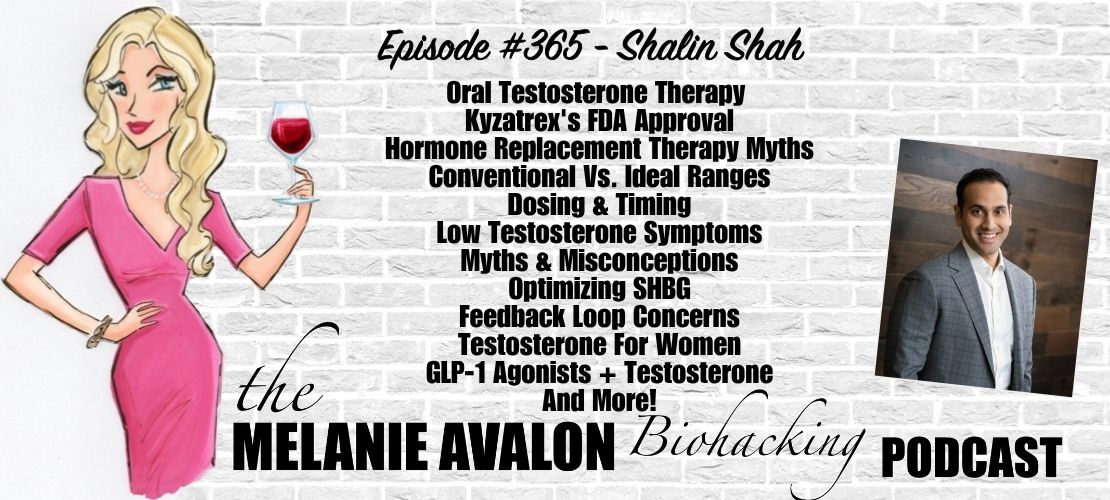
Shalin Shah is CEO of Marius Pharmaceuticals and a leading voice in metabolic health and testosterone therapy. He led the development and FDA approval of KYZATREX®, an oral testosterone treatment for men with low levels due to medical conditions. With a background in global investing, he entered healthcare to drive innovation and improve access. Under his leadership, KYZATREX launched through major medical networks and telemedicine platforms. A proponent of longevity medicine, Shalin advocates for rethinking testosterone regulations and believes oral TRT is key to reversing declining testosterone levels and life expectancy, aiming to add both years and vitality to life.
LEARN MORE:
SHOW NOTES
FACEBOOK: Join Melanie's Facebook group for a weekly episode giveaway and to discuss and learn about all things biohacking. All conversations are welcome! IF Biohackers: Intermittent Fasting + Real Foods + Life
INSTAGRAM: Follow Melanie on Instagram to see the latest moments, products, and #allthethings! @melanieavalon
AVALONX: AvalonX Spirulina is out now! AvalonX supplements are free of toxic fillers and common allergens (including wheat, rice, gluten, dairy, shellfish, nuts, soy, eggs, and yeast). They are tested to be free of heavy metals and mold and are triple-tested for purity and potency. Get on the email list to stay up to date with all the special offers and news about Melanie's new supplements at avalonx.us/emaillist! Get 10% off at avalonx.us and mdlogichealth.com with the code MELANIEAVALON. Plus, text AVALONX to 877-861-8318 for a one-time 20% off code for avalonx.us.
FOOD SENSE GUIDE: Get Melanie's app to tackle your food sensitivities. Food Sense includes a searchable catalog of 300+ foods, revealing their gluten, FODMAP, lectin, histamine, amine, glutamate, oxalate, salicylate, sulfite, and thiol status. It also includes compound overviews, reactions to look for, lists of foods high and low in these compounds, the ability to create your own personal lists, and more.
EMF: Stay up to date on all the news on Melanie's EMF collaboration with R Blank, and get the launch specials exclusively at melanieavalon.com/emfemaillist.
TRANSCRIPT
Shalin Shah
There's an androgen receptor on nearly every organ in the body, and testosterone, obviously, yes, is the male dominant hormone, but men have estrogen in their bodies, too. And, you know, females have testosterone. Actually, they have-- Generally pre-menopause, they have four times the amount of testosterone than they do estrogen. So you might see enhanced libido there, or you might, you know, sort of notate, like, better mental clarity, right?
So I don't think it's, it's... You know, people should not think, "Oh, I only need this if I want to go exercise."
Melanie Avalon
Welcome to the Melanie Avalon Biohacking Podcast, where we meet the world's top experts to explore the secrets of health, mindset, longevity, and so much more. Are you ready to take charge of your existence and biohack your life? This show is for you. Please keep in mind, we're not dispensing medical advice and are not responsible for any outcomes you may experience from implementing the tactics lying herein.
So friends, are you ready to join me? Let's do this. Welcome back to the Melanie Avalon Biohacking Podcast. Oh my goodness, friends, I have been dying to do an episode dedicated to all things testosterone, and what better person to do it with than with Shalin Shah, who I had the pleasure of meeting at Dave Asprey's Biohacking Conference for his FDA-approved oral testosterone therapy pharmaceutical, yes, pharmaceutical, Kyzatrex. In this episode, you are going to learn all about testosterone, what it does in the body, what ranges you should be looking for, and whether or not you should engage in hormone replacement therapy when it comes to testosterone. And while Kyzatrex is approved for use in males, we do talk about testosterone levels and supplementation in women. Shalin breaks down a lot of the myths and misconceptions out there when it comes to testosterone supplementation, including its history of having a black box warning, concerns about downregulating your natural testosterone production if you go on supplementation, the difference between injections versus the oral form, including the fascinating effects of the oral form with its circadian rhythm and its therapeutic effect, especially when it comes to the pituitary and effects on SHBG. We talk about the potential benefit of combining GLP-1s with testosterone supplementation, and so much more. The show notes for today's episode will be at melanieavalon.com/testosterone. Those show notes will have a full transcript, as well as links to everything that we talked about, so definitely check that out. I can't wait to hear what you guys think. Definitely let me know in my Facebook group, IF Biohackers: Intermittent Fasting + Real Foods + Life. Comment something you learned or something that resonated with you on the pinned post to enter to win something that I love, and then check out my Instagram Find Me Friday announcement post, and again, comment there to enter to win something that I love. All right, I think that's all the things. Without further ado, please enjoy this fabulous conversation with Shalin Shah. Hi, friends. Welcome back to the show. I am so incredibly excited about the conversation I am about to have. It is a long time coming, and it's also on a topic that I know you guys are really, really interested in, I got so many questions about, and we've talked about it in different episodes as-- never as, like, the central focus topic. And so it needs its own episode, and we are here to talk all things testosterone, and I have the perfect guest for it. So I met Shalin Shah at Dave Asprey's Biohacking Conference about a year ago.
Melanie Avalon
He was at his booth for his FDA-approved oral testosterone treatment called Kyzatrex. And I was so excited to meet him and really fascinated for so many reasons. Number one, testosterone is such, and I'm sure we're gonna talk all about it, but such an important hormone. I think people often think about it in terms of men, but it's also very important for women as well, and I know I got a lot of questions from women about it.
I feel like there's a lot of misunderstandings out there. There's a lot of confusion. There's a lot of questions about how to best test and support testosterone levels, and should you supplement? You know, and if so, which route should you go, and all the things. On top of that, I was really intrigued because, like I said, Kyzatrex is an FDA-approved medication, and we were just talking offline before this, but it's an interesting blend of waters, the, the biohacking supplement world and then the pharmaceutical world. So there's definitely a lot of questions to be talked about there.
But yeah, I've, I just have so many questions. Shalin is the CEO of Marius Pharmaceuticals, and they are-- and he led the development, like I said, of Kyzatrex. So, so many questions, and thank you so much for being here.
Shalin Shah
Absolutely.Pleasure to be here.Thanks for having me.
Melanie Avalon
And I just realized I, I didn't ask to actually how to pronounce your name.Is it Shalin or Sha-
Shalin Shah
Shalin.
Melanie Avalon
Shalin. Okay, I said it all wrong.
So Shalin. I nor- Normally I, like, ask beforehand. Okay, Shalin. So okay, yes. So many questions for you. I think-- Okay, so when did you... And I have more questions for you personally, but just really quickly, when did this approval happen? Had it recently happened when, like a year ago?
Shalin Shah
So no, we got approved-- Kyzatrex got approved in July of twenty twenty-two, which, you know, again, was a long research and development path.That was about thirteen years before that approval.
Melanie Avalon
So your personal story, what was your background? So your background was in global investing.
Um, did you personally have a testosterone crisis, or, or did you-- Like, what led you into the, the pharmaceutical world?
Shalin Shah
So it wasn't-- I wouldn't necessarily call it a crisis, but it was certainly an awakening, right? So this was about a decade ago. I did go and, you know, you know, generally into health and wellness. So, uh, you know, we have our up-- like, like a lot of people, have our ups and downs. But, you know, generally, that is something that I do spend a fair amount of time on.
And I went to my doctor, asked for a testosterone test, which was a bit of an uphill battle To begin with, right? You know, I was 30 years old at the time, and he just was, you know, wondering why I wanted this. So I just said, "Yeah, look, I'm kind of tired, so please, you know, write it so it'll go through insurance." And I came back-- You know, my levels came back, and, and lo and behold, they were-- they weren't below what is considered, you know, normal, quote unquote, but they were certainly at the lower end of the normal range, and that, that raised a lot of questions for me. And, you know, that's when I started digging a lot deeper into testosterone, understanding its role, and this was again... So it was kind of like a perfect storm of all things because not too long ago, the FDA-- from that p- time point, the FDA had basically put black boxes on these products and raised alarm bells around cardiovascular risk, and that was actually on the back of a couple faulty studies which they themselves acknowledged had defaults, but still went ahead and did this anyway. And then the third part that came together at the same time was, yeah, I'm based here in Raleigh, there was a drug-- there was a drug being developed, an oral testosterone, and it fell on my desk from an investment perspective. So all of those things came together, and again, I've-- I started doing a deep dive into testosterone and basically came to the conclusion that if testosterone had a dif-- the molecule had a different name and was not called testosterone because of its checkered past and its baggage, stigma, et cetera, it would be the most valuable molecule in the world. And that's kind of the point when I, I, I dove headfirst in and, and got into Kyzatrex.
Melanie Avalon
Wow, amazing. Yeah, it's wild what a name can do.
Like, once things get attached to a name, you really-- you can't escape it. Is it similar-- You're mentioning the, the studies and problems with how they were conducted. Is it similar to what happened with the Women's Health Initiative and women going on different types of, like, estrogen?
Shalin Shah
Yeah, I think the outcome was, uh, effectively the same, right? Like, obviously, there's nuance between WHI in, in the sense of what the data actually was and then in terms of the products that they used and, you know, synthetic hormones versus natural or bioidenticals. But again, effectively the same thing happened with testosterone because faulty studies headline was massive, right? New England Journal of Medicine. And they wouldn't retract it, even though, again, these, these studies had multiple aspects that were shown to be faulty. The, the, the headline and the damage was done.
So yeah, there are a lot of similarities in terms of what it could do or what it did and how long it's taken to come back from there, right? We're still not fully resolved of what happened despite the black box warnings, the cardiovascular risk warnings coming off in-- They came off in February of twenty twenty-five. So, you know, again, decade or so later. But, you know, the education piece is-- it-- the lift is so heavy. There's so many doctors that if you walked into their office today, or patients alike, and asked them about cardiovascular risk and testosterone th-therapy, it was like, "Yeah, testosterone probably does cause heart at-heart attacks."
Melanie Avalon
Wow.They were redacted, the, the warnings, because the studies were faulty?
Shalin Shah
Studies were faulty, and then not-- they also mandated the industry, the pharmaceutical industry, run the largest randomized placebo-controlled trial in testosterone history, and that was called the Traverse trial. Over five thousand patients, hundreds of millions of dollars that went into it, and that study did read out in June twenty twenty-three, also New England Journal of Medicine.
And clear as day, you know, the conclusion was testosterone therapy does not cause heart attacks.
Melanie Avalon
Wow.Okay.So if that was twenty twenty-three, when you released Kyzatrex, did it have a black box on it?
Shalin Shah
It did initially, and then it came off.
Melanie Avalon
Wow.Okay.Did that information make its way to the public or not?
Shalin Shah
Still making its way, honestly, right? Like, it's-- Again, that's why I, I feel that we've been... You know, this has been a long journey, but it's really been an education and advocacy journey rather than a product or a marketing journey.
We've really just been out there talk-- you know, through venues like this, sharing around what... you know, what is testosterone's role, and kind of clearing up some of this, some of this past.
Melanie Avalon
Yeah. And to that point, so I have so many testosterone questions.
I will ask a listener question really quickly because you just mentioned, like, you know, the-- with the Women's Health Initiative, like the synthetic version of progestins and estrogen and such that they use. With testosterone, Nydia, Nadia, said, "Is there only synthetic testosterone for men and women?"
Shalin Shah
So there's, uh, it's-- And this is a little more nuanced, but there's, there's different versions of testosterone. Say, like testosterone cypionate is a very common injection, injection. There's also testosterone enanthate. Testos-testosterone in Kyzatrex is called testosterone undecanoate, which is a different chain. So these are all different chains and esters that kind of affect short-acting or long-acting versions effectively.
But what happens-- What's different about testosterone versus some of the synthetic progestins and whatnot is once-- when you take the testosterone, different versions, once the body cleaves these different esters, the testosterone is identical to what you see in its bo- in, in your body. So they all act in a natural form, if you will. I think actually what drives the most-- the, the natural bits is in how do you mimic physiology is really the dosing schedules because that's where you wanna mimic your natural circadian rhythm. So I think that is actually more important to focus on than sort of in, at least in testosterone's case, the type of ester that is used in the product. 'Cause even, again, I'll be honest, like, you know, if you think about bioidentical hormones, a lot of people-- This has become a, a pretty big marketing term, right? Bioidentical hormones are also made in a lab Right? Like, everything is synthetically made. Nothing is pulled from nature and put into your body in terms of hormones. So again, I- what we focus on a lot more is how do we replicate the natural physiology in terms of the ups and downs and circadian rhythm of your body?
Melanie Avalon
Okay. Awesome.
Yeah, well, I'll definitely have more questions about all of that dosing and everything. Before that, just to get a foundational picture of testosterone, first of all, a question. So when we're talking about testosterone in general, how much of it equally apply... Like, so wh- and I guess it depends on a case by case basis, but with what you're saying, but in general, when we're talking about testosterone, how much of it equally applies to w- men and women?
Shalin Shah
It's equal. I, I would say it's, like, 50/50, right?
I mean, again, like, there's an androgen receptor on nearly every organ in the body, and testosterone, obviously, yes, is the male dominant hormone, but men have estrogen in their bodies, too, and, you know, females have testosterone. Actually, they have-- generally premenopause, they have four times the amount of testosterone than they do estrogen. So I mean, again, obviously throughout history, testosterone has been associated with masculinity and masculine hormone, et cetera, but no, these are... It's equally important for both a male and female.
Melanie Avalon
Yeah, that's always-- I remember when I first learned that, that, you know, we, women have much more testosterone than estrogen, which is crazy, 'cause we, we think... Yeah, we think it's, like, all the estrogen and all the progesterone. So okay, as a hormone, so what is its primary role?
You just mentioned that there's, you know, receptors everywhere. What is its primary role in the body?
Shalin Shah
So actually, again, it has a very diverse role across the body. So, you know, these are, these are mainly, you know, gene transcribers that are gonna go on and turn effectively genes on in different parts of the body, but they play different roles, right? Like, whether that is in your brain, your heart, your bones, right? Obviously, it controls libido.
It controls muscle, fat metabolism. So i- there's really no one specific thing or most important thing that you can say that it relates to testosterone, but it, it, it truly plays a role across your entire body.
Melanie Avalon
Is it true, you m- you mentioned the male stereotype around it, that it leads to aggression? Or like, what, what is it actually from a personality standpoint?
Is that testosterone, like, the super aggressive human?
Shalin Shah
No, that's not. I think that's just been a, again, like, a toxic masculinity cultural thing that's been created, right?
There are certainly docile men with high testosterone. There are aggressive men with low testosterone. Testosterone does affect mood. I think that is a f- an accurate statement, but I don't think it's, it's-- you cannot-- there's no data that draws testosterone levels, a linear line with testosterone levels and aggression.
Melanie Avalon
It's interesting, and I'm trying to remember. I listened to a really long conversation, a podcast about it. They were saying that people think testosterone creates aggression, but really it creates, ah... It was something similar that-- and, and not-- it wasn't the same thing at all, but it was-- that was what led to the idea that people thought it was aggression, but it wasn't aggression.
Shalin Shah
Honestly, like, anecdotally from what we hear from patients, it's almost the opposite because once, you know, under a low testosterone scenario, a male, you know, can often be depressed. That, that is very common, right? You know, lack of motivation and, and mood, as I said, right?
Versus a man with adequate testosterone may not have the same level of depression, will have more motivation, have the energy, often h- you know, reduce, you know, if their brain fog is an issue, then, then you might see a reduction in brain fog. So that man is actually a lot more clear and, and potentially level-headed than the man who has low testosterone and is facing all of these challenges, right, mentally. It's just very difficult to be a, a sort of, let's call it a strong human, if you will, when you're facing challenges like that. So I think adequate testosterone, not too much testosterone in that sense, adequate to levels of testosterone, I think can lead to a more balanced person.
Melanie Avalon
Yeah, that completely makes sense. So to that point, the levels.
So the conventional ranges when people are testing, first of all, what are those? Second of all, how applicable are they to different people? Like, do people have their own personal level that they feel best at? How do we even determine what an ideal level is in general?
Shalin Shah
Yeah, absolutely. So there are normal ranges. It's extremely wide. You know, currently, the normal-- the accepted normal range is, is about three hundred nanograms per deciliter to a thousand nanograms. However, that number is actually trending lower on the lower end to say, like, normal may be two sixty-eight with a lot of reference labs, right?
If you go to your Quest where you are, your LabCorp versus mine, yours may be lower, right? 'Cause this is a function of the, the po- the, the population that the lab is driving from. But over the last number of decades, that lower end has continued to shi- to, to go down, right? Because we have a generational decline in testosterone levels. Now, in terms of what is right for you, this is a personal number in that sense, so that's why we advocate a lot for earlier testing. So when you're younger and your numbers are, again, quote unquote "normal" or you feel your best, you should absolutely understand what your testosterone level is, so this way, as you move through life, you understand what your baseline was. And again, if you're on, say, testosterone later, twenty years later when you're forty or fifty, it's, it's not that you're chasing that number of when you were younger, but at least you understand where I did feel good at and, and, you know, when I'm going through replacement, where I, I might need to tend to closer to that number than my peer or my, you know, my colleague in that sense. So- You really do wanna test early at the bare minimum, you know, every man over 40 should be tested on their annual physical because there's, you know, testosterone in, in a lot of ways is the single best biomarker that you can test for because you're getting an insight into your cardiovascular health, into your inflammatory state, into your glucose metabolism, right? Into your cellular health. So again, if you're gonna test anything, you should test that, but that's not happening today.
Melanie Avalon
Okay.So, so many questions there.The 300 to 1,000 nanograms per deciliter, was that for men only?
Shalin Shah
Correct.That is for men.
Melanie Avalon
Are there ranges for women?
Shalin Shah
So there aren't as good established ranges for, for women, and, you know, so it, it, it could trend from anywhere from, like, 30 to 40 nanograms per deciliter up to about 75, 80. It's, like, a much tighter range.
But the problem with that is that they haven't really tied this to whether it's symptoms or outcomes, so that's... it's, it's really not the best, let's call it, yardstick when you're thinking about female health. We know a lot of females when they're on testosterone are probably trending a bit higher, I mean, especially on products like pellets. But yeah, again, I think, like, that, you know, 75, 80 nanograms per deciliter is often considered a sweet spot, but I think there are a lot of people that feel better at higher levels.
Melanie Avalon
Okay, gotcha. Wow, that's, that's a, yeah, that's a big difference.
And then has there been-- 'cause you mentioned that the trending lower, so two questions there. One-- and you can choose which one you want-- which direction you wanna go first. What do you think are the primary causes of the dropping testosterone levels in general in the population? And then two, has there been any manipulation of the ranges in order to support pharmaceuticals, or is that less likely since it was a black box warning pharmaceutical for a long time anyways?
Shalin Shah
So I'll answer the second one first. I, I think the manipulation-- the changes of the ranges have hurt testosterone makers, right? Because it actually makes it that much more difficult for a patient to qualify. So say it was 300, right? Now it's 268. You just cut off more people from getting included 'cause now I might have a 298 patient, right? Now he doesn't qualify for therapy.
So I think the, the lowering of the ranges have made it harder for pa- and ul- ultimately, honestly, like, most of testosterone therapy is generic anyway, if you think about generic injections which dominate the market, gels are, you know, generic and so are a handful of other products. It's the orals which are newer that are branded. But I think what's-- well again, what's happened is this demonization of hormones and, and frankly keeping people off has been more of the sort of MO it seems like versus actually helping patients and getting patients on. If they were-- you know, again, you look at-- think about a 301 patient. Patient is just above that normal range, so that means everything's fine? Like, these things are not binary, right? Like, just like if you think about A1C or any disease, honestly, if you think about it. Disease is not binary. Disease is like progression, and they start much earlier than, than when they finally man- manifest, and you wanna be thinking about these things way earlier in the spectrum rather, rather than later. So I don't think testosterone's any different. So, like, what's caused this, this generational drop in levels? It's twofold. One is we have a number of things from an environmental perspective that have frankly disrupted our entire hormone systems, and a lot of this you can link to things like microplastics, our food system, right? We have a lot of processed foods, a lot of hormones in the foods themselves, right? That have thrown our bodies off, and that-- those are things-- water, things in our water system. A lot of these things you can't really solve for. They're just too mass scale, too prevalent in our lives that, that even if you can do a decent job, you're, you're really not gonna be avoi- avoiding everything. So that's one part of it.
And then the second part is, is a bit on the lifestyle side, right? I mean, we have seen where obesity rates have gone over the last couple decades, and testosterone and obesity are bi-directional. It's not one necessarily causes the other, but they both cause each other. Think about things like sleep too, right? Our sleep cycles have been massively disrupted. We're on devices, screens late at night. A lot of people are doom scrolling. That messes up your circadian rhythms, right? And if you're not getting that sleep that your, your body really needs, that REM and deep sleep, you're not regenerating your hormones appropriately when you're going to bed. So there is a number of lifestyle things, but all in, like, these declines-- say even if you went and got healthier and you started exercising every day and you started eating really well and you dropped 10% of your body weight 'cause you were overweight, usually those changes lead to about 50-point changes in testosterone levels.
Shalin Shah
So even if you are just below normal, say you were 250, right? And you got up to 300 through diet and exercise, you're still quite low and, you know, far from optimal.
So I think we're just living in a time where supplementation will become much more normal.
Melanie Avalon
That's also pretty ironic 'cause now I'm thinking-- I don't know how often this actually realistically happens, but I'm thinking of a situation where if there was a person who was borderline low and would s- and would benefit from supplementation and then made, like, a little bit of a lifestyle change and, and then now, you know, that, now that bumps them up, so now they're no longer qualifying as being low, but they are still low. Like, they could have, like, shot themselves in the foot by making beneficial changes?
Shalin Shah
Correct. By even-- Yeah, exactly. Ge- just getting above that normal range slightly And yeah, you're right, disqualifying them from therapy, and their insurance is not covering it, and, you know, sort of cascades from there.
You know, that's why, again, the norm- you know, you talk to a lot of urologists. Urologists are one of the primary prescribers of testosterone i- you know, in the country today. Most of the data that they'll cite actually says anywhere up to 450 nanograms per deciliter could show some therapy benefit. Above that, it's less likely, but almost up to 450 nanograms per deciliter could you see therapeutic benefit from testosterone.
Melanie Avalon
Just so I get an idea, so people who are really, like, pumped up on steroids and testosterone, like the, the stereotypical-
Shalin Shah
Gym bro
Melanie Avalon
...gym yeah, like, what are those levels?
Shalin Shah
Those-- I mean, if you're talking about real, like, steroid abuse and bodybu-builder, you're probably, you know, three times that upper normal limit. You could probably be anywhere between 2,500 nanograms per deciliter and, like, 4,000.
So you're way up there. No normal guy replacing their testosterone is gonna be there.
Melanie Avalon
Okay.Are you going to the Enhance Games?
Shalin Shah
We-- It's an inter-- I mean, fair question. Haven't really figured out our, our, our position there.
Just given, like, a lot of this, the, the historic stigma around this, what best solves for the future of men. Still debating.
Melanie Avalon
Yeah, they, they invited me to come, and I was like, "Whoa, I need to..." I'm going. I'm just really intrigued and curious. S-so for listeners... And I think by the time this comes out, they will have already happened, but essentially they are allowing performance-enhancing drugs in athletic competition, trying to break, you know, various world records, and they have a lot of former record holders and s- and such, and Olympians. So should be interesting.
I've, I've never even been-- Like, this is not my sphere. I've never been to anything like this, even on the legal side of things. So yeah, we'll see.
Shalin Shah
Yeah, it should be... I mean, again, it is an interesting experiment, right? I think what's important for, like, general listeners to know too, right?
And this is what, what caused-- Like, testosterone is a controlled substance today, right? And this is because Congress did it in 1990 as a result of the Olympics, doping in the Olympics. It was actually Ben Johnson, a Canadian sprinter that was caught doping, and that caused all this outrage, and then Congress scheduled testosterone. It's the only hormone to be scheduled. So estrogen's not a scheduled hormone, progesterone, insulin. Obviously, the, the... Actually, even HGH is not even a, a controlled substance, which is kind of wild when you think about it. But what's also important to know, too, because, like, again, testosterone gets wrapped up in this, but, like, performance-enhancing drugs extend so far beyond testosterone. Like, nobody is getting jacked by taking testosterone and sitting on their couch, right? Like, it's a totally different sort of set of drugs that people are on in order to, you know, achieve these ridiculous sporting accomplishments or physiques that I think it's important to, like, understand that, like, testosterone is the most basic, like, innocent of anything in that world.
Melanie Avalon
Actually, to that point, 'cause that was a question I had, 'cause you, you just gave the picture of somebody, you know, sitting on the couch taking testosterone. So if you do take it and you don't, you don't add any additional physical activity, you have a sedentary lifestyle, what are the effects of it?
Shalin Shah
So well, you can still see positive effects, right? Because again, it could be working on your brain. So you might see enhanced libido there, or you might, you know, sort of notate, like, better mental clarity, right? So I don't think it's, it's... You know, people should not think, "Oh, I only need this if I want to go exercise," right?
And, and there are also effects that you won't necessarily feel in the sense that you would potentially lower your inflammation that's going on in your body, right? Testosterone is anti-inflammatory. There would be some, you know, anabolic activity that's going on, so you could see so-some more muscle synthesis happening, even if you're not stimulating it the way that you should be through training. So you know, that said, there are a lot of positive things that can occur while being, let's just call it a regular person on testosterone.
Melanie Avalon
So okay, and that completely makes sense, especially what you were saying at the beginning with, you know, all the different receptors for it. For the effects that it does have on muscle, for example, and fat loss, does that require additional stimulus, or can it still-- Like, would people put on weight-- or sorry, like, put on muscle without adding additional, like, weightlifting?
Shalin Shah
Yeah, no, good question. So there's two, two points I would make there, right? One is, I mean, testosterone is used in certain, like, hospital conditions, so to preserve lean mass, right? Say you have a bedridden patient. There has been data that's shown that, that lean mass is preserved via testosterone in a, like, fairly inactive patient, right? So there, there, there is definitely that, that benefit there.
I, I think there, there will be, there will be anabolic activity, right? And that's why actually, interestingly enough, what we're gonna be studying is, as we talk about lean mass, we're gonna be studying Kyzatrex and GLP-1s, because GLP-1s, you know, obviously, yes, they're leading to weight loss, but up to 40% of this is lean mass. So that's a big... You know, one of the biggest issues with GLP-1s that people are trying to solve for is this, this loss of muscle, and effectively we're trading obesity for sarcopenia. And so yeah, we are gonna study this as well. I mean, anecdotally, we have good data that shows this preservation, but we're gonna do it in a proper clinical trial.
Melanie Avalon
Oh, that's interesting.Okay.That's exciting.Have they studied it at all, do you know, for, like, the astronauts?
Shalin Shah
Not that I know of, but I think the same premise exists, right? Like, if you're not using, if you're not using your muscles And you're in some sort of, you know, sedentary or f- floating position, if you will.
Yeah, there is a case to definitely be on, on, on an anabolic like testosterone.
Melanie Avalon
Okay. And so some questions I am dying to ask and very curious about.
First of all, we've talked about, you know, the ranges and, and testing and then potentially supplementing. Is there a window of opportunity for when you should start on this? Kind of like with, I know for women in hormone replacement therapy, they... there's like a certain window of opportunity where they say that's the early window that you need to start on to see the best effects.
Shalin Shah
Right. So yeah, so there, there has been good, good data that shows on the female side, right?
Yeah, HRT should start, be started within 10 years of menopause. That, that doesn't exist the same on the, on the male side. What I would say is this, if you know you are low testosterone or testosterone deficient, you really have no benefit in waiting, right? Would you get the, you know, the same benefits or same changes could you experience if you started five years later, seven years later, 10 years later? Sure. But it's not just what, what I would advocate for is n- it's not just the symptomatic differences that you may feel, but there are the underlying bits that you want to be conscious of. So again, I talk about inflammation, or if you talk about insulin sensitivity, right? Or even fasting insulin, right? Fasting insulin can be reduced on testosterone, so we know that's a number that we wanna get down, not talked about nearly as, as much as it should be today, but that is a number most people are gonna need to get down. So if I have to think about my, you know, timeline of life, I'd rather make that intervention earlier, have better numbers so I could likely have a better lifespan.
Melanie Avalon
Okay, so you just hit on two, two big topics. So one, the, the lifespan.
A person who's optimized on their testosterone levels, quote, "naturally" versus supplementing for it in whatever form it may be, do you think those lead to the same effects on lifespan and then also health span? Like, and are those two correlated?
Shalin Shah
So it's hard to say exact- if, if a guy has na- you know, natural T levels, would he have a better lifespan than the guy that has to supplement his T levels, right? All things equal, they should be the same, right?
As long as that low T supplementer, right, doesn't have other issues that are making him worse, and same with the other, like the other patient, right? The guy that might have normal T, who knows? He might have plaque buildup in his arteries because of, you know, a, a poor diet, but somehow he's main normal... maintained normal testosterone levels, right? Like, ideally those, those two should be the same sort of outcome generally. But I think what's easier to kind of look at is that, and there's tremendous data on this, uh, there was a massive study on VA patients, I think it was like 300 odd thousand if not more patients out of the VA, that basically just simply said, "Look, low testosterone leads to higher all-cause mortality." Right? So if you, you know, if you take that statement at face value, then if you have low T, you are likely to die earlier.
Melanie Avalon
Wow. Yeah.
And I guess in the example of somebody who's on hormones versus not, y- like you said, the reason that they're on it, if it's like a environmental lifestyle factor that's creating the low hormones, then just supplementing the hormones is not gonna remove that other lifestyle factor that could be, you know, having negative health effects as well.
Shalin Shah
Exactly. I mean, like you want to... I mean, we always advocate it for, I always advocate for like you do wanna do the fundamentals, right? Like diet, sleep, stress, exercise, those are non-negotiables. You should be doing them no matter what.
But, you know, if you're doing all that, there's, there's nothing wrong with then supplementing if, if you need to.
Melanie Avalon
And to this point, so here's a huge question I have. So once you go, and I guess we can talk about the different routes, so Kyzatrex, like we said, is an oral testosterone treatment, so we can definitely... I would love to hear about the different forms and the, you know, cost benefits of them.
Once you go on, does your body stop naturally producing testosterone, and can that be permanent? Like, what are the... Like, is this like you're committing like you're like committing?
Shalin Shah
No, it's a good question, and it, it does come up. So, and like again, I just wanna preface, right? Kyzatrex is indicated for men with low or no testosterone due to certain medical conditions. That is our indication, right? So that's just, you know, fair disclaimer for that.
But in terms of do you stop producing it and then do you have to stay on for life, one, it depends. So and this, this, this does vary by modality. So often when people are taking injections, because you're taking them for a one-week or two-week basis, you are getting super physiologic levels, meaning they're quite high for the first half of that treatment regimen, and then they are subtherapeutic for the second half, right? Because it goes up, and then obviously comes crashing down, and, and then you stay down there till your next injection. Because of that super physiologic high, the body often does shut down its production, and you generally kind of view this through the lens of the pituitary signaling, LH and FSH. So most often, again, when guys are on injections, those levels are zero, undetectable. Now you switch the modality and you look at short-acting oral testosterone And what's interesting is what we've seen in the data is that LH and FSH, while they do come down, they stay actually in the normal range. So the pituitary is still active. And what's interesting is because, you know, again, it goes back to that daily physiologic, you know, dosing that I mentioned. So at the end of the day, your body is really flushing out that testosterone. Basically, it's used what it's had to for the day, and you're back to baseline at the end of the day, rather than maintaining some sort of super physiologic level. So at the end of the day, if you have no external testosterone in your body, then your brain is saying, when it's time to make hormones, saying, "Hey guys, we gotta get back to work." Right? So it signals to the testes to make testosterone. So that's why I think it's really interesting with short-acting oral that the LH and FSH stay on to a certain degree. Is it, is it, is it down or, you know, a little bit? Yeah, but again, still in the normal range. And then to your question around, like, do you stay on this forever? It, it's kind of a-- It's funny when I get asked this question, right? I kind of look at it from the other lens. Like, you can get off, but then you're gonna feel how you used to feel, and is that what you want, right? If you got on for a certain reason because you were symptomatic or because you wanted to make sure you're optimal for better health or whatever it may be, like, are you more concerned with returning to that state? Are you more concerned with having to stay, you know, quote, unquote, "Stay on forever"? And that's really the way I frame it to guys. You can get off. That's totally fine, but you're gonna feel like, likely feel like shit again, and then you're gonna wanna get back on.
Melanie Avalon
Wow, okay. I'm really... Okay, so I'm really fascinated by the, the LSH, FSH pituitary response to the different dosing.
So the-- or the different methods of dosing. So when they inject it, that big bolus dose, what's the half-life of it? D- where, like, where does it live? Does it just, like, hang out for a little bit and, like, slowly get used up?
Shalin Shah
Yeah, exactly.So yeah, it's f- like and that's why if you're, if you're measuring a guy kind of even like a few days post-injection, right?Those levels could still be super physiologic.
Melanie Avalon
And where, where is it living?
Shalin Shah
It's in your serum.It's in your blood.
Melanie Avalon
It's just... Okay. It's interesting.
It's kinda similar 'cause, like, I'm on thyroid medication for hyperthyroidism, and so there's always this ongoing debate about the TSH and whether or not the TSH should be, like, suppressed if you're on supplemental T3 as well. It's not the same thing, but that, that's why I'm so fascinated by it because I feel like I'm always fighting my doctors with this because of the communication between the two and them trying to, like, reduce my medic- like, reduce my hormones because my TSH is suppressed, but I'm like, "It's suppressed because I'm on the hormones, so don't reduce the hormones."
Shalin Shah
Correct. Yeah.
And it's, it's... You know, so it has like the, the effect here is like... And which is why you see this with long-term, like, let's call it steroid use, like, or whatnot. Like, let's call it abuse, right? Like, androgens g- uh, the androgen receptors get blunted. So that's why you often see guys increase their doses over time because the receptors are not working as well as they were originally, right? So an even more reason why you want... Like, again, you want the most physiologic dose and, like, match that circadian rhythm so you don't have to oversaturate your receptors.
Melanie Avalon
This is...Okay, and so when you take it orally, does it go through the liver and get processed?
Shalin Shah
No. So what's unique here is that's old oral testosterone, methyltestosterone did go through the liver, and that's why it was effectively thrown out, right? And that's why a lot of doctors, if you talk to them today, just because that's what they are aware of, like, they're like, "No, oral testosterone is bad." What we've created is lymphatically absorbed oral testosterone.So this actually gets absorbed in your small intestine, and it bypasses the liver.
Melanie Avalon
So does it, for all intents and purposes, end up at the same pathway and location as injections?
Shalin Shah
Uh, yeah, it would be in your blood, right?Eventually, it'll make it in your bloodstream, but it's just it doesn't, it doesn't hit the liver.
Melanie Avalon
Men take it once a day?
Shalin Shah
So it's actually taken twice a day.It's BID.
Melanie Avalon
Okay, and then the dosing is just based on...What is the dosing based on?Like, who picks what level you're aiming for, especially with such a wide range?
Shalin Shah
Yeah, so a- again, it's, it's kind of, you know, individual each pa- patient. What we, we started at-- Well, I think it's better to, to, to mention it this way. So in our phase three trial, most of the patients ended up on either three hundred milligrams BID or four hundred milligrams BID. Those were the largest co- cohorts of patients.
Since then, what we've seen is, and, and we, we have, we have data that's been presented on this, is a lot of clinicians, knowing that this is where they end up, start at, at those starting doses because it, it saves a titration potentially. You know, again, guys are a little fickle. Often they wanna see results fast. So what a, what a, what a number of cl- clinicians have seen is, "Okay, if this is where they're gonna end up, let's just start 'em there," and that seems to work out pretty well.
Melanie Avalon
And, and to that point, how long does it take to get there?Like, when do you retest once you start?
Shalin Shah
So you can recheck levels within seven days if you want to see your... If, again, if you want to see your levels, right? It, it, again, it depends on the clinician and their protocol, right? Whether they're gonna actually check at thirty days. Often a lot of clinicians don't see their patients for three months, so it might be three months till they see them.
What's interesting around our data is that From a hematocrit perspective, this is your red blood cells, only 2% of patients, sub-2% of patients in our phase III trials had hematocrit elevations above 54%, which is sort of the, the bar, right? If you go above 54, either people are donating blood or they're down trid- t- titrating their dose. And we only had sub-2% of patients do that, versus if you look at published data around injections, those papers will cite up to 66% of patients would have hematocrit levels that, that go above 54%.
Melanie Avalon
Do you think this will be available for women in the future?
Shalin Shah
We are actively working on a female development program. I mean, it is a, it is a company goal, it is a personal goal that we bring this.
Like, we want an FDA-approved option for females. I actually-- so again, I m- I mentioned I got into this, uh, about a decade ago. Even back then, some of the KOL conversations that I had were around female. So it couldn't be a better time for it. We are, we are completely dedicated to it, and I think there is a, there is a, you know... With, with the regulatory support from this administration, like there's a lot-- there's a, there's a good chance we can bring this out for females.
Melanie Avalon
Is there any FDA-approved testosterone supplementation for females?
Shalin Shah
Zero FDA-approved options for females.And there's no shortage of data.Like, there's plenty of data on why this is important for females.
Melanie Avalon
Wow. Okay, and to that point, 'cause I was really curious, like the, the process of getting it approved, like just in general, w- was this your first-- 'cause you said that the, the opportunity, you know, came across the table for you.
Was this your first foray into a medical thing?
Shalin Shah
Pharmaceutical? Yeah. So it-- yeah, it, it, it, it was, is. And I, honestly, that's why I think we've done, Marius has done things so differently, because we don't have that traditional pharma background.
We have varied, you know, experiences, whether it was time spent in, you know, consumer or energy or industrial. Like we've seen a number of businesses over the years and applied those learnings to now the pharma space, and that's why we've, we've taken a different pa- tact, right? Like we launched Kaisertrex as a cash-only model in 2022 and went straight to patients and providers that really deal in hormone therapy, whether that's concierge med, whether that's functional, whether it's hormone therapy clinics, longevity clinics, naturally, right? So we've done things very differently because we don't have, honestly, that baggage of a, of a traditional pharma background.
Melanie Avalon
Yeah. Again, this is another reason I was just so fascinated to meet you, 'cause I don't know that... I don't know if you guys are the only like FDA-approved pharmaceutical type booth, like at the biohacking conferences.
Shalin Shah
Oh yeah, 100%. I, there, there... Yeah, I think we were definitely the only FDA-approved product. Yeah. It's not common, right?
But we just, we again, we know patients. That's why I think we're, we're truly in a hormone renaissance here because this has been driven by patients. Why are there so many TRT clinics that are popping up or hormone clinics popping up, anti-aging clinics, whatever you wanna call them, right? They're only c- popping up because clearly there's a tremendous patient demand for these therapies, not the other way around.
Melanie Avalon
Yeah. And it's so fascinating to me, and again, like kind of going back to the enhanced games things, I really like having more... It, it's hard to like step out of your biases and mind and like look at something objectively.
And so it's really interesting to me why we get certain like almost morality clauses around the substances that we put in our body for whatever reason it is. Like we have these ideas that it's okay if you're doing it for longevity, but not okay if you're doing it for this reason or, or like with the, what you're doing, the oral testosterone with pharmaceuticals, we're like, "Oh, pharmaceuticals are okay if it's like this, but not if it's this." Like I, it's just really interesting to like step out of it as much as you can and be like, "Why is that?" Like why do we have these ideas?
Shalin Shah
Right, right. Yeah, they just get stigmatized into these buckets and, and again, like patients should have the choice. So you know, you talk about like, again, yeah, if it's hormones or even like, you know, we get testosterone and hormones are like really adjacent to sexual health, right? And, and because if it's deemed sexual health, then it's often, you know, quote unquote, "not covered" or it's not prioritized, right?
And, and this happens a lot in the o- for the female side too, right? And it's really worse-- I mean, I have a lot of our, our KOLs, if I, if I, you know, sort of brought them on, they would just, you know, they'll, they'll, they'll, you know, light firestorms because of how lopsided it is that, you know, again, it's easy for a guy to get Viagra, but it's really hard for a female to get a sexual health drug that may be FDA approved for them. And a lot of insurers don't cover it, which to me is akin to not covering mental health, right? Like imagine like, imagine the PR or the press if, if insurers stop covering SSRIs for depression, right? Because we said, "Okay, we don't, we don't, we don't think this is real," right? Like that would never fly, but how is, how is it so easy to dismiss sexual health, which has a clear correlation to mental health?
Melanie Avalon
Yeah.That's so fascinating.Okay.So when the actual approval process, how long was it for you?
Shalin Shah
So yeah, in terms of R&D was from 2009 to 2019, we finished the trial.
Melanie Avalon
Oh my gosh, so long.
Shalin Shah
Ten years of R&D there, and ten years and a lot of money that, that happens there. And then, you know, you basically kind of get your filing ready for the FDA. I think we submitted in, at the end of '20, if I'm not mistaken. So we were lucky we got through COVID. We didn't have any interruptions there.
And then, you know, the approval process was like a year and a half.
Melanie Avalon
Do you remember-- Is there like a moment where you get like a final, final approval?
Shalin Shah
Yeah, you get a n- like you basically, you get like a couple hints. They drop a couple hints along the way, you know, whether it's labeling. They might say, "Hey look, here are our comments on the label," and then you know you're getting close. But I-- so you get some of those, but you're not exactly sure, and I'm pretty sure You know, the email came.
I was-- I think I was already, uh, I was-- I must've been already at home. I must've been working from home and, you know, email just popped up and said, "Hey, you know, this is your approval letter." Right? Yeah. So pretty crazy in how it, how it unfolds, but, you know, it's an, it's a nerve-wracking process for sure because you're dealing with the agent, you know, the FDA, and, and they do wield obviously a lot of power. We, we-- It's very interesting 'cause again, not, not everything you agree with along the way, sometimes they come back with questions, and you gotta provide your answers and scientific justification. But again, we took a very, like, pragmatic, practical approach to this. So, you know, there were points where we certainly challenged the FDA too, and we said, "Hey, look, this doesn't make sense. Like, we're not gonna... This... You know, you're not looking at this right, right?" And, you know, whereas most people would not wanna do that. They would kind of just go along, spend more time. I mean, again, if it was a different company, it might, might have taken a few more years to get this approved.
Melanie Avalon
Wow.Yeah, that is, that is completely wild.And how long have you been working on a potential version for women?
Shalin Shah
So women is, is relatively recent. It's been about a year that we've been, been working on this.
We put together a, a pretty rockstar female advisory board together in, in late last year. I think what really changed is the opening, right? The FDA had that panel on female HRT in, I think it was June or July of '25. And again, credit to a lot of the KOL, you know, the people that were on that panel. I would call a lot of friends that I have that were on that panel. They just, they just stood up until they were heard. That changed the landscape. This administration has changed the landscape for patients and hormone therapy. Without that, I think we would be-- It would just, it would be an uphill battle.
Melanie Avalon
Are the changes that have been made, are they, quote, "permanent" or could they be reversed when administration changes?
Shalin Shah
I don't think there's gonna be... I mean, look, anything could happen in that sense, but I don't think it's something that a new admin-- you know, the next administration would just pick up and reverse. It's not-- I mean, these are scientifically grounded decisions. They're not whims. Again, I think scientifically grounded is the best way to describe it, so I don't see why somebody would pick up and change these things.
Frankly, I mean, hormone therapy is not, you know, a partisan issue, right? Like, it doesn't-- Your hormones don't care if you're de- Democratic or Republican, right? Like, uh, I mean, this is, this is the health of our population. And if we wanna think about, like, right, like we have an aging population, as do, as, as do- does much of the world, and we have ballooning healthcare costs. These healthcare costs must get under control sometime in the near future or our budgets will literally implode. So they have to start thinking about, okay, what does preventative health look like in this country? And I think hormones play a very central role in that preventative health equation.
Melanie Avalon
Yeah, I, I could not agree more, and I'm, I'm just so grateful for, for everything that you're doing. And so how-- Oh, wait. One-- I have one last, like, very random question.
With estrogen and... Actually, yeah, with estrogen, we know there's the whole, like, estrobolome. Do you know if there's any connection with the gut microbiome and testosterone? And especially if you're taking an oral form that's, you know, going through the small intestine, like, is there any microbiome stuff happening?
Shalin Shah
So we don't, we don't, we don't see, like, or report, like, any, you know, sort of changes happening to the microbiome, but it certainly plays a role in terms of how you absorb your oral testosterone. So again, one, one individual to the next, you may have someone that is a super responder, so needs a very low dose and could achieve, you know, let's call it high levels, versus the next person might need the average or the highest dose to achieve the same levels. So we do see that dictated by an individual gut, but we haven't seen anything from the data showing anything, you know, to the negative side.
I mean, testosterone even plays a role in, like, your beta pran- pancreas cells, your beta cells, and things like that. So ideally, you should see, you know, neutral or positive effects overall with the right amounts of testosterone in your body.
Melanie Avalon
Oh, and speaking to that, so the effects on other hormones and systems, so if you supplement testosterone, will that have an effect on, like, estrogen and progesterone? Like, do you need to be monitoring other things as well?
Shalin Shah
I guess it depends on male, male or female to a certain degree, right? On the male side, you still wanna monitor estrogen, but what's, what's-- Well, again, what we've seen uniquely in oral testosterone versus injections is because, again, you're not going super physiologic, you're not getting this excess conversion to estrogen. So even again, this is, this is a pre-fly some data. We had a clinician look at Kyzatrex and the amount of patients that were on estrogen blockers. Prior to Kyzatrex, they were on injectable testosterone. That number was 20 odd percent of patients were on estrogen blockers.
After switching those patients to Kyzatrex, that number dropped to, like, 10%. So because again, you just don't have these excess levels that are converting. But so you do wanna watch your estrogen levels for sure just to understand what is happening. But the, uh, again, for honestly, for what I, what, what we see with clinicians, like, you wanna watch out for a couple key hormones, but, like, the hormonal system is obviously, like, very complex, right? And there's a lot of substrates and so forth. It'd be very challenging to kind of keep your eye on every single downstream hormone from these kind of key ones. I think you wanna focus on, you know, the main ones and otherwise you'll go a little crazy.
Melanie Avalon
Yeah, I know. And then as far as like practically implementing this, so as far as like getting it in access, and also 'cause you've made it very clear that it's for, you know, men who are low.
Amy, for example, said, "Can middle-aged men with normal testosterone levels take it and have improvements like women do when they start HRT?" So I don't know if you can even speak to or with, you know, Kyzatrex specifically, but men-- if men are have like normal levels, but they feel like they're not optimized, can they get optimized?
Shalin Shah
So I think, again, it depends on really where they are, right? I think if you're at the lower end of normal, like I was citing that, like the urology data saying, you know, sub four 50, you could see some benefits on, on testosterone therapy. I think that there, there is a, there is a baseline number that does matter here, right? If the patient's at like 800, the, the likelihood of them seeing benefits on TRT is, is probably less likely. But then the other bit too is, is how symptomatic are they, right? Because you either have guys that are asymptomatic, they really don't feel anything. You have guys that don't realize that they have some of these symptoms, right? They kind of just chalk them up to aging or, you know, life, right? And then you have guys that like absolutely know something's wrong, right? So I think depending on where they are on that spectrum, that will dictate, you know, being on therapy and the results they see and sort of the satisfaction they see.
But, but what I would say is this, is like for guys, like you don't-- being symptomatic is not the only reason to go check your testosterone levels, right? Like you, you, you may be feeling this way, you may not know it. Again, like I really wasn't symptomatic in a lot of ways. I really couldn't say anything was wrong. But when you do normalize, you know, things get better and you're like, "Well, that was actually, you know... I, I, I didn't, I didn't realize." Right? So that's why it's so important that you just-- you do make this part of your routine blood work.
Melanie Avalon
And is that where-- So this is from a woman, 'cause Crystal said, "Oh, I so want to hear this one. I want to get mine checked, but I have no idea where to start." So again, women, so different population, so not eligible right now for Kyzatrex.But just for starting, is that where you start?You just ask your physician for a test?
Shalin Shah
Absolutely, yeah. Ask your physician for your, you know, testosterone test. Again, female, you, you can have, you know, testosterone, estrogen, progesterone levels checked. If they don't know, you just keep asking or you have to-- I mean, there's honestly a lot of like good at home blood tests today too, right?
So you, you know, these consumer lab tests are available. You can always do that and do an at home test and, and, you know, get your levels yourself if your physician-- if it-- if you find it challenging to get from your clinician.
Melanie Avalon
Can people-- So I know you have the website testosteroneproject.com.Does that have a lot of information for listeners?
Shalin Shah
So testa- so a couple things for listeners from, from a resource perspective. So testosteroneproject.com is actually our-- is actually an advocacy organization that I founded, and it's focused on descheduling testosterone, right? This should not be a controlled substance. It's focused on female testosterone, making an FDA-approved a- uh, you know, option available, and then standard testing, right? These are the things that it's focused on.
So it's more of a policy organization. But from a resource perspective, we have a disease website, a disease state website that's called rethinktestosterone.com, and that has a lot of the studies and data because there's no shortage, honestly, of, of studies that have been done over the last couple decades here, whether it's related to diabetes, depression, general testosterone, et cetera. So that's a good resource for, for patients to start.
Melanie Avalon
Awesome.And then for actually getting Kyzatrex, which by the way, what is-- how did you come up with the name?
Shalin Shah
So Kyzatrex is two things combined, Kyza meaning kites and like, so you're kind of flying, and then treks, like going on trails and treks.
The FDA naming process is extremely convoluted. I mean, rightfully so, for, you know, safety purposes and so forth. They don't want two drugs to sound the same. They wanna make sure different languages like have, you know, appropriate sort of connotations and so forth. But yeah, like you kind of just spend all this time coming up with like 10 different names and you pressure test them and then you rank them in terms of what's likelihood to make it or get rejected. So we did all that work and, and Kyzatrex was at, you know, at the top, close to the top and, and yeah, it got through.
Melanie Avalon
I'm just super curious.Is it like a thing-- 'cause it took me forever to get one of my trademarks.Is it a thing where you have to do like one at a time or can you give them like-
Shalin Shah
You do have to do one at a time.
Melanie Avalon
Oh gosh.So you have to really ...Oh man.
Shalin Shah
You have to make sure 'cause then again, that could push back your, your approval and you don't want that to happen by any means.So it's a, it's a crazy process.
Melanie Avalon
Wow. Oh my goodness, I'm so fascinated by it. Well, thank you. Thank you for going through it.
Wow, a decade, that's insane and thank you for what you're doing. Well, with the oral supplementation of Kyzatrex and thank you for what you're doing for hopefully the future with women.
Perfect. Was there anything else you wanted to share with listeners about, you know, everything that you're doing?
Shalin Shah
Well, one thing I would say is like, well, I mean just this is kind of just again, about the modalities in oral testosterone. I think something important that, that folks really wanna start to pay attention to is something called SHBG. So SHBG is sex hormone binding globulin, and that actually binds to testosterone and makes it unusable, right? So, you know, and a lot of people have high SHBG levels.
Men have higher SHBG levels as they age, could be from-- or it could be from lifestyle, drinking, those types of things. Women, actually a lot of women have elevated SHBG levels because of birth control. So actually you have a massive generation of females with high SHBG levels that don't come down after you stop either, so they're permanently elevated. And the reason I bring up SHBG is because it's related to free testosterone, and that n- is the number that really matters, right? You could-- your total T could be fine, but if you have a high SHBG and a low free T, you're not gonna be getting the effects from testosterone that you need. So what's interesting about Kaiser Trucks is that it uniquely lowers SHBG by 30%.
Melanie Avalon
Oh, whoa.
Shalin Shah
Yeah.So it really sees, like you can see a big difference then.Like it basically preferentially increases your free testosterone.
Melanie Avalon
You feel it more.
Shalin Shah
Yeah, exactly.I mean, my free T went from seven to 28.
Melanie Avalon
Wow.Do, do you know why?
Shalin Shah
We don't actually know this.We have not figured this out yet, but it's, so it's like a super nice benefit.
Melanie Avalon
So you're essentially, you know, giving your body more of this hormone and your body is making more of it available to the body.
Shalin Shah
Correct. So that's why it's, it's interesting, we get a lot of like really strong patient reported outcomes from, again, what seems like, you know, normal mid-levels, right?
They're not like s- we don't, you don't... That's why it's like challenging this concept of super high levels, because what really matters is your free testosterone.
Melanie Avalon
And on top of that, what you mentioned earlier, you're not seeing that big of a change in the pituitary.
Shalin Shah
Pituitary, and then actually again, independently the, the, there have been studies that, that tie SHBG to longevity and telomere length, right?So lower SHBG would lead to higher telomeres.
Melanie Avalon
I was so happy to meet you at the conference and, um, hopefully see you at another one soon.
And the last question that I ask every single guest on this show, and it's just because I appreciate more and more each day the role of mindset, so what is something that you're grateful for?
Shalin Shah
It's a good question.I think honestly, it's, it's the ability to remember like home base and, and where peace is for me, and that keeps me pretty grounded and, and, and grateful every day.
Melanie Avalon
Oh, I love it.I love it.Well, thank you so much.This was absolutely amazing.Hopefully see you soon.If you go to the Enhanced Games, let me know.
Shalin Shah
Yeah, no, again, I, we're, we're just toying with the idea, but possibly.
Melanie Avalon
Please go 'cause I don't know if I know anybo- 'cause I literally like I'm not gonna know anybody if you're like walking around Vegas.
Shalin Shah
It's gonna be kind of crazy. Yeah.
We'll, I'll, I'll definitely keep you posted. I, I think I have, I have your email, right? So, but yeah, I'm, I'm sure we'll see you somewhere around, but if you have any questions, any follow up, uh, and like if you wanna follow up on, on this specifically, like re testosterone levels for females, then, then just let me know.
Melanie Avalon
Awesome. Thank you so much. Well, super appreciate it. Thanks.
Bye. Thank you so much for listening to the Melanie Avalon Biohacking Podcast. For more information and resources, you can check out my book, What, When, Why, as well as my supplement line, Avalonex. Please visit melanieavalon.com to learn more about today's guest, and always feel free to contact me at contact@melanieavalon.com. And always remember, you got this.