
The Melanie Avalon Biohacking Podcast Episode - #370 - Dr. David Perlmutter
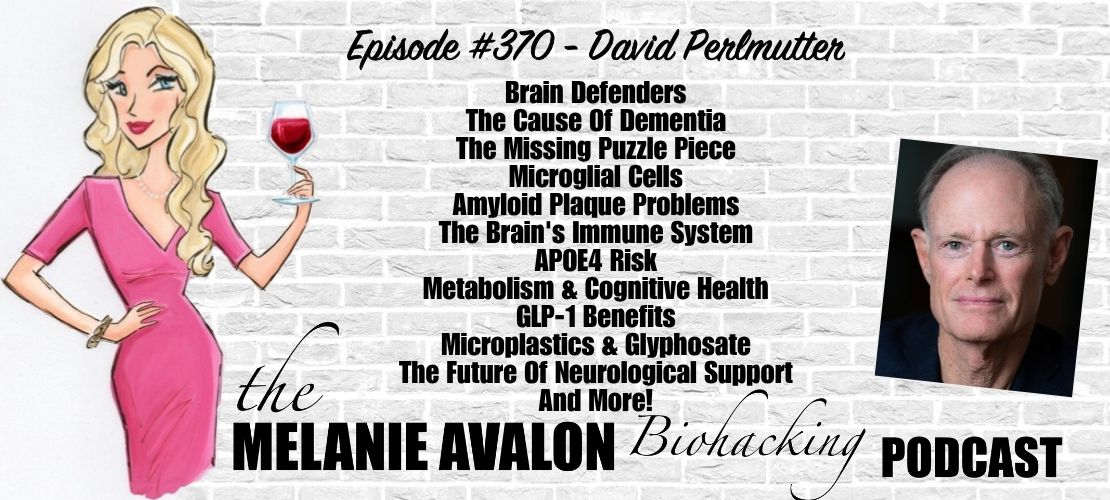
Dr. David Perlmutter is a Board-Certified Neurologist and seven-time New York Times bestselling author whose work focuses on the intersection of neurology, nutrition, and brain health. A Fellow of the American College of Nutrition, he serves on its Board of Directors and on the Editorial Board of the Journal of Alzheimer’s Disease. His books, including the #1 bestseller Grain Brain, have been published in 32 languages and sold over a million copies. Dr. Perlmutter lectures globally at leading institutions and has been featured on major media outlets including 20/20, CNN, The Today Show, and Oprah. His contributions have earned him numerous national and international awards for clinical innovation and leadership. His upcoming book, Brain Defenders, focuses on the pivotal role of microglia, the brain’s immune cells, in protecting, repairing, and reprogramming the brain for lifelong resilience, and is now available for pre-order.
LEARN MORE:
Book: https://amzn.to/4xdNRLq
SHOW NOTES
SPONSORS & DISCOUNTS
PurVine makes it easy to discover organic, lower-alcohol, and lower-sulfite wines that match your personal preferences. Easily scan bottles, take personal notes, save wines, get personalized recommendations, earn rewards, and more! Go to PurVine.app and use code MELANIEAVALON for 10 welcome points.
FACEBOOK: Join Melanie's Facebook group for a weekly episode giveaway and to discuss and learn about all things biohacking. All conversations are welcome! IF Biohackers: Intermittent Fasting + Real Foods + Life
INSTAGRAM: Follow Melanie on Instagram to see the latest moments, products, and #allthethings! @melanieavalon
AVALONX: AvalonX Spirulina is out now! AvalonX supplements are free of toxic fillers and common allergens (including wheat, rice, gluten, dairy, shellfish, nuts, soy, eggs, and yeast). They are tested to be free of heavy metals and mold and are triple-tested for purity and potency. Get on the email list to stay up to date with all the special offers and news about Melanie's new supplements at avalonx.us/emaillist! Get 10% off at avalonx.us and mdlogichealth.com with the code MELANIEAVALON. Plus, text AVALONX to 877-861-8318 for a one-time 20% off code for avalonx.us.
FOOD SENSE GUIDE: Get Melanie's app to tackle your food sensitivities. Food Sense includes a searchable catalog of 300+ foods, revealing their gluten, FODMAP, lectin, histamine, amine, glutamate, oxalate, salicylate, sulfite, and thiol status. It also includes compound overviews, reactions to look for, lists of foods high and low in these compounds, the ability to create your own personal lists, and more.
EMF: Stay up to date on all the news on Melanie's EMF collaboration with R Blank, and get the launch specials exclusively at melanieavalon.com/emfemaillist.
TRANSCRIPT
Dr. David Perlmutter
The number one risk factor for developing Alzheimer's is age. That is something that should be reevaluated and restated.
What I'm trying to do is, is give people the keys to the kingdom here by letting them do the things to rein in their metabolism, to reduce inflammation, to improve mitochondrial function. If we are careful about our body metabolism, we have a long ... a great approach to keeping our microglia on our side, to keeping our microglia supportive and not shifting to being the evil twin.
Melanie Avalon
Welcome to the Melonie Avalon Biohacking Podcast, where we meet the world's top experts to explore the secrets of health, mindset, longevity, and so much more. Are you ready to take charge of your existence and biohack your life? This show is for you. Please keep in mind, we're not dispensing medical advice and are not responsible for any outcomes you may experience from implementing the tactics lying herein.
So friends, are you ready to join me? Let's do this. Welcome back to the Melonie Avalon Biohacking Podcast. Oh my goodness, friends, what an honor it is to be back here today with six-time New York Times bestseller, the legendary Dr. David Perlmutter. Honestly, friends, he is one of the reasons that I'm doing what I'm doing. I first read his book Grain Brain years and years ago, and it really informed how I view so much when it comes to health, diet, and all the things. I've had him on twice before for his books Drop Acid and Brain Wash, and he is back today for his newest book, Brain Defenders, which posits an incredible thesis about the missing piece of the puzzle when it comes to cognitive decline, dementia, and Alzheimer's. We're gonna talk about what that is in today's episode. Hint, it involves the brain's immune system. Get ready for a deep dive into all things your microglia cells, whether or not amyloid plaque is a problem, your actual risk if you have the APOE4 allele, how your metabolism directly affects your brain, the benefits of GLP-1s, the dangers of microplastics, the future of neurological support, and so much more. The show notes for today's episode will be at melonieavalon.com/braindefenders. Those show notes will have a full transcript as well as links to everything that we talked about, so definitely check that out. I can't wait to hear what you guys think. Definitely let me know in my Facebook group, IF Biohackers: Intermittent Fasting + Real Foods + Life. Comment something you learned or something that resonated with you on the pinned post to enter to win something that I love, and then check out my Instagram Find Me Friday announcement post, and again, comment there to enter to win something that I love. All right, I think that's all the things. And now, without further ado, please enjoy this fabulous conversation with Dr. David Perlmutter. Hi, friends. Welcome back to the show. I am so incredibly excited and honored about the conversation I'm about to have. So it is with a repeat guest and a guest that I honestly believe most of you guys are very familiar with. It's somebody I've been following for years and years and years, and honestly was a main reason and figure in, like, the evolution of my journey, especially in the beginning when it comes to everything related to health. So I am here with Dr. David Perlmutter. He is a board-certified neurologist and, wait for it, six-time New York Times bestselling author, which is incredible, and he focuses on neurology, nutrition, brain health.
Melanie Avalon
I first came across him years and years and years ago with Grain Brain, which I feel like most of you guys are, you know, pretty familiar with, but especially when I was really getting into the, the first time I was realizing the problems with grains and gluten and all of that. So that was a big, big part of my life.
And then he's been on this show for Drop Acid, all about the role of uric acid in our health, and then Brain Wash, which also was really incredible. That's when we actually had a really great conversation, I believe, about the power of emojis. So I love that. And, um, I was just telling him I was interviewing his son, Dr. Austin Perlmutter, the other day, so that episode will be coming out soon as well, so definitely look out for that. So today's conversation is a heavy hitter when it comes to topics. It's something that I've done quite a few ... I mean, a, a lot of different episodes on, and that is, you know, prevention and the role and the cause of and the treatment for neurological diseases, and in particular things like cognitive decline. And this topic, it affects so many people, and I think people are often looking for hope in this topic because it can seem like there's no answer, that what we're doing's not working. In the past I've had, you know, the investigative journalist Charles Piller on, where he would talk about the, all of the fraud in the Alzheimer's data research. I've had different people on talking about how, you know, diet can maybe help it. But regardless, it can often seem like there ... n- you know, that we can do all of this lifestyle stuff, but it ... Can we actually, you know, solve this, or is there a solution out there? And Dr. Perlmutter brings to the table an incredible thesis in his new book. It's called Brain Defenders: Harness the Power of Your Immune Cells to Protect Your Brain for Life. And we're gonna talk all about it in this episode, but basically it goes into the role of the immune system in the brain, in particular something called microglia, and how they can either be good guys or bad guys, like literally switch back and forth, or, or kind of. We'll, we'll, we'll talk about it, and what we can do to affect that and how that actually ultimately affects our long-term brain health. So he talks about ... He does talk about, you know, all the factors, so diet in the book, what's actually happening in the brain, all of the new and upcoming potential treatments for cognition. So yes, I have so many questions. Thank you, Dr. Perlmutter, for all of the work that you've done for years and years and years, and thank you so much for being here.
Dr. David Perlmutter
Well, thank you. I'm so delighted to be a repeat offender.
Melanie Avalon
That you are. I am delighted you are as well. They haven't locked you up yet, so that's, that's good.
Dr. David Perlmutter
Yeah, and you, you said a lot, I think, to tee up what we're gonna talk about today, and that is that let's take a step back and think about all the places we've been in the past 15 years or so. Yes, we've been talking about the threat that processed carbohydrates pose to the brain, uh, lack of e- uh, exercise, the role of sleep, uric acid.
You mentioned that book, Drop Acid. And what is so interesting, and I think your entree was a bit appropriate saying it's a bit complicated, but we're now recognizing that all of these factors converge on a final pathway that explains, I'm just going to say it, everything. And that is, what are these various seemingly disparate inputs doing to the brain's immune system? And it turns out that these changes in the brain's immune system, the keys, as you said well, the microglial cells, from being supportive to being destructive, this is upstream of everything in the neurodegenerative world, including Alzheimer's and Parkinson's and any other neurodegenerative condition you could mention, progressive supranuclear palsy, multisystem atrophy, MS, and even the shift of these immune cells being involved in things like PTSD, major depressive disorder, and even long COVID. So it throws a very, very large net. I will grant you that it is a bit complicated, but we're gonna tease it apart and make it very understandable and approachable. But I think the, the gold keys here, the take-home message really is that we have the opportunity and the ability to rein in this immune system and keep it on our side and really change the trajectory of our brain's destiny.
Melanie Avalon
Okay, I love this so much, and I'm glad that you opened with that because that actually was a major question I had that I was gonna open with as well, so s- same page, which was, I think you used the phrase somewhere in the book, like, this is... and you kind of paraphrased it now, but, like, that it's the final piece of the puzzle. Like, like, this is the thing that we've been looking for.
A huge question I have is, uh, we'll talk about all of the factors that affect what you were just talking about. It's a lot of lifestyle factors that I think are similar things that you've been talking about for years and years. So my question is, even if we know, like, "Oh, this is the final piece of the puzzle," does it actually change the recommendations? Like, does a person even need to know about the final piece of the puzzle if the lifestyle recommendations are the same regardless of that knowledge?
Dr. David Perlmutter
The answer is yes and yes. I think, first of all, understanding what it's doing and all the inputs will allow you to recognize not just to do the things, the exercise, attention to your sleep, eat right, but when you grasp that it's changing the function of your brain's immune system and, in fact, the immune system throughout your body, it has more traction.
And the second thing is very important, and that is you don't know all that's going on, and the book reveals the leading edge in terms of other things that can now be done to evaluate yourself, to follow what's going on with your body's metabolism, and even what the future holds as it relates to even technology that is now being utilized to reprogram these microglial brain immune cells back to being supportive and away from being destructive. So, you know, that's new information, and, and for me it's hugely exciting information that while we know all the things that we can do readily right now are going to work through this pathway, how encouraging it is to know that this is really where neuroscience is now and where the, the, the resources are gonna be directed and, you know, as it relates to Alzheimer's, away from this idea that Alzheimer's is caused by the accumulation of this beta amyloid protein in the brain. Gratefully, we're moving past that, recognizing that is not the answer, and therefore all of these drugs being developed to get rid of beta amyloid in the brain are really coming up empty-handed, as we've just learned from a very global Cochrane analysis of 17 different studies indicating that while these drugs are significantly dangerous, their efficacy is almost nil, or the word used in the Cochrane analysis was trivial. So, y- you know, the point I'm trying to make is, yeah, we're gonna certainly impact the science that supports the interventions that we make, but also keep in mind that, you know, this is where leading research and technology is, is exploring how to keep the brain's immune system on track and supportive so that those microglial cells are brain defenders and not brain destroyers. High tech is great, but we have the tools right now that each and every one of us can implement.
Melanie Avalon
And how much, not to, like, start off on a controversial fight, but I'm so, I'm so glad you're, you're saying this because, um, it's confusing hearing about all the potential and, and hearing how much people are aware that certain drugs are not working and still feeling like that part is being championed. So like I mentioned that how I interviewed Charles Piller, who, like, unves- uncovered all of that fraud and, and all of the, um, like, medications for Alzheimer's, and that was one of the most, like, most eye-opening, slightly disheartening book I've ever read.
I was like, "Wow, I had no idea this was going on." And so then once I read that, I was like, "Okay, so everybody's on the same page here that, you know, we need something different." But then I interviewed, and it was an incredible interview and I, I love his book and I recommend it, but I was actually telling you this on email. I interviewed Dr. Zaldy Tan last week, and he is-- he heads the, uh, like, the Memory and Brain Center at Cedars-Sinai. Like, his book kind of still spoke favorably about these drugs and kind of was skeptical of some of the other things. And so it's hard to know. And like you mentioned in, you mentioned in the, in your book how you wrote into The Lancet because they kind of left out Didn't they, they, they left out a, like the lifestyle piece or, of prevention? They, they left out something, like, really major and they, you know, they didn't really accept what you guys wrote in. So, but you, you do feel like we are making forward movement and that this is gonna be the focus or more accepted?
Dr. David Perlmutter
It's hard to say. I have to admit it's hard to say because there is huge support for drug development, and I'm very supportive of that approach.
So that should very much, I think, nuance our conversation moving forward, that when there is a drug that's demonstrated to be effective and safe, I am 100% all in. This is a devastating condition if we're talking about Alzheimer's, 7.6 million Americans who have nothing to turn to from the world of pharmacy right now. And again, it's not that I'm your guest on your program today and I'm telling you that. We just had the publication of an incredibly large study called a Cochrane analysis, more than 20,000, I guess 20,342 individuals, 17 different studies. Each of these studies was 18 months long, looking at do the drugs work or do they not work, and importantly, how safe are they? And their conclusion was that about one in four people who use these intravenous amyloid-targeted drugs have a side effect which can be either bleeding into the brain and/or swelling of the brain and/or dying. Okay, maybe that's a risk I should take if I have Alzheimer's disease or my father or mother does. How well do they work? They don't. That's what the study concluded, that their effectiveness is trivial. So I am in the camp that would say, let's look at the work of Dr. Rudolph Tanzi and Dr. Dean Ornish that was published from the work they did at a, uh, 51 individuals enrolled in a trial with existing Alzheimer's disease. 20 weeks, we're gonna change your diet, increase your exercise, reduce your stress, and what did they find? That in 70% of these individuals, they either stabilized, which no drug has ever done, or they actually improved on their metrics of cognitive function.
Now, that's what the published peer-reviewed science is telling us. I'm not anti-drug. When you can show me a drug is working in the Alzheimer's patient, I am all in. And as you know in the book, we actually approach the, the potential future for the GLP-1 agonist drugs, the Ozempic-like drugs. And I came out i- in the book saying that when these drugs are proven safe and effective, will I be in? I'll be all in. You bet. So I'm not sure that was the response to your question you were looking for, but I wanna really clarify that I just wanna do what's best for the patients and their loved ones.
It's a rough, rough road. I've been down that road with my dad dying of Alzheimer's. It's just horrendous. And I, if there's a way I can move the needle and, and add tools to the toolbox, I'm in. If those toolboxes are lifestyle adjustments which we've seen are demonstrated to be effective, am I in? You bet. I'll write a book about it, as I just did. If it turns out to be drugs and it's effective and safe, you bet I'm all in. I'll write a book about that, too. But we have interesting tools beyond the lifestyle choices these days. We have things like hyperbaric oxygen. We know that there's some incredible pharmaceutical, uh, approaches in, in the future. What will the metformin studies demonstrate? The rapamycin studies?
Dr. David Perlmutter
We know things like ketamine are being demonstrated to increase synaptic connection, which is so important in the Alzheimer's brain. What will dimethyl fumarate, which targets something called the NRF2 pathway to reduce inflammation in the brain, do in the Alzheimer's patient already approved in multiple sclerosis? Things like methylene blue and, as I mentioned, these GLP-1 agonist drugs. So there's a lot of cool things that are being explored right now.
There are certainly some exciting things on the horizon like, oh my gosh, mitochondrial transplantation and other deep anti-inflammatory, uh, approaches. Things like transcranial magnetics, putting people, uh, raising the temperature of the brain. We call that thermo fe- febrile therapy, and even xenon gas. So there are a lot of cool things being used, uh, being explored, you know, not ready for primetime, again, risk-benefit ratio being very important. So for now, I write a book about get your blood sugar under control, increase your exercise, reduce your stress, increase your socialization skills, meet, you know, get together with people, spend time in nature. Let's look at how effective and, uh, restorative your sleep is. Let's look at the, the air you're breathing, the quality of the air that you're actually breathing. I'm sure you talked to Dr. Austin Perlmutter about that. So there's a lot that can be done, and again, ultimately focusing on how all of these inputs affect whether your brain's immune system is going to be supportive or destructive, because that is what charts your brain's destiny, and that is something over which we each have control. So again, in a very real sense, what I'm trying to do is, is give people the keys to the kingdom here by letting them do the things to rein in their metabolism, to reduce inflammation, to improve mitochondrial function.
Melanie Avalon
Paul, you are certainly doing that. Yes, I definitely appreciate the nuance.
And to bring it back to the pathway and speaking of the nuance and, and everything that you just discussed, you know, it would be, it would be one thing, it, it's, it's nuanced enough that there, there are these different, you know, pharmaceuticals. Like, and I appreciate what you're saying about, you know, if they work, then, you know, you're all for it. It's complica- it's confusing because, you know, a lot of them, their, their intention is to re- you know, remove this amyloid plaque, and yet we know that People can have amyloid plaque and be asymptomatic. Like, it doesn't necessarily correlate, and, and you even say in the book, you know, the amyloid plaque itself is not so much the problem, it's, it's the, it's when it's attacked by these microglia and, and the inflammation from that. So going into the pathway, so two things here. Number one, was it an overnight epiphany about this? Was it a slow buildup? How did you come to this?
Dr. David Perlmutter
Oh, gosh. Not an overnight epiphany. I've always, I've always been a bit, I think, skeptical of dogma. I, I think that, you know, the two things that we have that are unique about being human, we have the opposable thumb, which is a handy thing to have, and we have the ability to question, and I, I'm curious and, you know, I, I don't out of hand accept the things that, you know, that mainstream science is telling us about one thing or another because, you know, as time passes, we realize that we may have been off base, so I wanna keep an open mind.
This idea, the amyloid hypothesis that was developed in late 1980s, the original data that validated this as being the cause of Alzheimer's was very flawed. It was actually an extension of the finding of amyloid in people with familial Alzheimer's, and the idea that it should immediately out of hand be extended to the typical Alzheimer's patients that we would see in the clinic day out, day in and day out was inappropriate and... But unfortunately took hold and really charted the course for this whole al- amyloid story, uh, from then on. Ultimately, med students were being told the cause of, of Alzheimer's is the accumulation of beta amyloid, and the general public was told, "Well, there's this sticky protein called amyloid, which is the cause of Alzheimer's disease." Why did that happen? It happened because if that's the cause, that is the solution, right? If we got one cause and we can eliminate, problem solved. And so billions of dollars were dedicated to the development of drugs that could bind to the beta or activate the immune system to rid the brain of beta amyloid.
These are these monoclonal antibody drugs that facilitate the reduction and removal of beta amyloid from the brain. Do they work? They work incredibly well in terms of getting rid of beta amyloid. You bet they work. Do they have any meaningful effect on the continued decline of cognitive function in the Alzheimer's patient? They do not. So you're treating a biomarker here, the amyloid accumulation, and sure enough, you're doing a heck of a job, but the reality is, the Alzheimer's patients are not getting any better with these drugs.
And it's not, Melanie, that your guest on your program today is saying this. This is what this Cochrane analysis just revealed to the entire planet. So again, I wish the drug would work because if the drug would work and really have a meaningful effect on Alzheimer's patients, then maybe you would accept the risk because, you know, face it, Alzheimer's is a fatal condition. It is, and we don't recognize it, but in elderly Americans, this is the third leading cause of death. So sometimes when things are that aggressive, like cancer, for example, you take the risk of chemotherapy. That can have, you know, devastating side effects, but you've got nothing else, and if... But yet chemotherapy can cure people, or at least arrest the disease for a time, but these drugs don't do that, so the r- the risk is, is unacceptable.
But again, you know, i- is beta amyloid a not necessarily a good thing to be in the brain? It isn't, but it is absolutely not the whole story.
Dr. David Perlmutter
We've gotta go upstream of beta amyloid and ask the simple question, what is allowing it to accumulate in the brain, and what else is going on that's destroying the brain? That is the activation of the brain's immune system called the microglial cells.
Melanie Avalon
Let's dive in. So the microglial cells, well, first of all, are they... How do they compare to immune cells throughout the rest of the body?
Like, i- is this, is this process that goes awry happening everywhere in the body and it just manifests as that in the brain?
Dr. David Perlmutter
That's right. So these are immune cells in the body just like other immune cells. I would say they're most akin to cells in the, the rest of the body called macrophages. Interestingly, though, they are quite unique in that they don't come from the bone marrow in, during developmental, during development. They actually come from what's called the yolk sac, so their origin is actually quite different.
Interestingly, though, we've just learned some research the past few weeks that there is the migration in midlife, in our 50s, 60s, of peripheral immune cells into the brain as well that may also set the stage for inflammation as well. So but these are, I wouldn't say garden variety immune cells, but their behavior and their genetic markers that they express are quite similar to those seen elsewhere in the body.
Melanie Avalon
The yolk sac that they come from? So is that, is that within the brain? Like, is it a closed system that-
Dr. David Perlmutter
No, the yolk sac i- is outside of the brain. The yolk sac is what o- originally provides nutrition for the developing embryo.
Melanie Avalon
Okay. That's down there. That's what I thought.
Okay. Okay, so they, they make their way up, they make their way up to the brain. How are things going awry, and what is the root, the root cause if it's not the beta amyloid?
Dr. David Perlmutter
Well, the root cause, and I think that, you know, this is where the science is as you and I have this conversation, there are changes in these microglial cells that rather than existing in what is called their M2 supportive configuration, what I call brain defenders, where they are nurturing the neuron, they are nurturing the synapses, they're keeping the blood brain barrier working effectively. That they can shift, and we'll talk about what causes that shift, to being the what's called M1 configuration that actually destroys synapses, threatens the neurons, and destabilizes the blood-brain barrier. All of those things are bad.
The fact that these immune cells are gobbling up our synapses is very relevant as it relates to Alzheimer's because Alzheimer's is really a disease characterized by the loss of connectivity. The loss of connectivity of one neuron to the next neuron, which happens at the level of the synapse. So at a microscopic level, that's what's going on. At a macroscopic level, people become disconnected as well with themselves, with their environments, with people around them. So it's very much a disconnection. And one would ask, well, what would cause those microglial cells to go off-kilter and start destroying our synapses? And many things can help nudge them along to doing that. Unfortunately, one of the, the biggest influences to polarize these microglial cells is age. As we age, we develop more and more of these threatening M1 microglial cells, and it very much explains why, you know, risk for these and other neurodegenerative conditions increases as we age.
In fact, the number one risk factor for developing Alzheimer's is age. That is something that should be reevaluated and restated because the diagnosis happens when we begin to fail on various cognitive tests. Our memory is failing. We're walking into rooms not knowing why, forgetting people's names, not remembering how to do ex- uh, executive functions like dress ourselves and all of that. That's, that's well along in the time course of this disease. What shifts the microglial cells is very, very important.
What shifts the microglial cells, and that's the underlying event in Alzheimer's, are metabolic changes, changes in metabolism of the microglial cell. In other words, how it uses energy. Now, the good supportive brain-defending microglial cell primarily depends upon mitochondrial function to make the currency of energy, which is ATP. The shifted microglial cell to the M1 destructive configuration is a cell whose metabolism has changed to a different form of energy production, far less efficient, called glycolysis. Here's the take-home message for your listeners. The change in the metabolism of the microglial cell from being supportive to being destructive mirrors the change in metabolism that happens to our bodies.
Well, I understand that. Great. But that's actually incredibly empowering because it means that if we are careful about our body metabolism, we have a long, a great approach to keeping our microglia on our side, to keeping our microglia supportive and not shifting to being the evil twin.
Dr. David Perlmutter
That's why everything we can do to keep our metabolism on track, keeping our weight where it needs to be, our blood sugar, our insulin functionality, our blood pressure, our blood lipids, our body weight through looking at our diets, our exercise programs, the length and quality of our sleep, reducing risk of head trauma by wearing a helmet, interacting with other people, social interaction, spending time in nature, avoiding breathing air that is higher in particulate matter like these PM two point fives. All of these things threaten metabolism and as such threaten to polarize from being supportive to being destructive our microglial cells.
I think that's the underpinning that you're looking for because it really, you know, really ties it t- puts a loop on this. Uh, we finally get why for such a long time we've understood these relationships, for example, between type two diabetes tripling an individual's risk or more at a population level, being associated with a threefold increased risk for developing Alzheimer's disease. I mean, inflammatory chemicals in the body shift the microglial cells from being friend to being foe. And you know, when we think back about the research that was carried out, oh, back in two thousand and seventeen, you know, I use this research in my lectures, and this is research that published in the Journal of Neurology that took a group of people and followed them for twenty-four years. What they did at the very beginning of the study was they measured inflammatory markers in the blood. Twenty-four years later, they did scans to look at how big is their brain and what is your memory doing, and then made a comparison. What is the relationship between having inflammation in your bloodstream a quarter century ago and risk today to having compromised memory and a smaller brain? What did they find? A dramatic relationship. The point there is that, okay, we knew that inflammation, this study demonstrates it, is bad for the brain. But why? Why does it happen? That's the unanswered question until recently. Inflammation in the body makes its way to the brain, and it will shift the microglial cells away from being friendly to being non-supportive. So, I mean, this is important research for another very important reason, and that is starts to make us think about the fact that, you know, Alzheimer's isn't a problem that begins when your memory starts to become compromised. You don't have a heart attack. You're not attacked out of the blue. You know, tho- that coronary artery stenosis has been going on an awful long time until that heart attack happens. It's not like you're walking and you turn a corner, bang, somebody attacks you, you have a heart attack. No. You're building up to Alzheimer's. You're building up to c- this heart attack for decades. That's what is so fundamental that we've gotta really target the 30 and 40-year-olds in terms of their metabolism and say, you know, with an elevated waist-to-hip ratio, bigger belly than you should have in comparison to your hips, that's a risk for becoming an Alzheimer's patient 10, 20, 30 years from now.
Dr. David Perlmutter
If your blood sugar is elevated, if you're on your way to type 2 diabetes, you need to turn around and go down a different road. Why? Because as mentioned, having type 2 diabetes is associated with a threefold increased risk for becoming an Alzheimer's patient.
A study way back in 2008 looked at what's called central obesity, having more belly fat, and what they found was three decades later, 30 years later, those who had the, uh, largest amount of belly fat 30 years ago had an increased risk for developing dementia of threefold. And again, now you're demented. What do you do? And the pharmacy world has nothing to offer you as we have this conversation right now. And again, your guest is saying, "I'm hoping that happens," because not everybody's gonna do the, the right things right now. It's all about reining in your metabolism and start now when you're still young and cognitively intact.
Melanie Avalon
A lot of questions about the mi- microglia, but before that, so 'cause you just mentioned two studies where a significant amount of time later, the inflammatory factor or the weight gain still correlated to issues, you know, years and years later. Were all of the people still in that state from like, like similar inflammation from 24 years prior or similar weight from 30 years prior?
Dr. David Perlmutter
They didn't look at that. What they looked at was a, a unique measurement, just like in the other study that I quoted you where they measured the inflammatory markers and then the people were followed years later. So, uh, you know, but I think what, what you're getting at is, uh, okay, you had, uh, increased waist to hip ratio, you had a bigger belly when you were 30 or 40 years old. Is there benefit to, to losing that belly? You bet there is.
That's what these programs that you're hearing about are all about. Study came out in the Journal of the American Medical Association, I think it was last year, called the POINTER Study, and this is a study that it was an interventional trial on people who are, I think their average age was 69 and a half years. And these people had metabolic issues, you know, pre-diabetes, diabetes, overweight, and in a two-year period of time, people at this age should be, uh, would, would be expected to decline cognitively. That's just what happens. Th- that's well documented. But the POINTER trial did an intervention, and what the intervention was was to change their diets, to increase their exercise, reduce stress, and they did, uh, brain games. They did, you know, a- an at-home kind of online training experience. They divided the group in half, and again, we're talking about 10,000 people in each group. One group had hand-holding. In other words, during the two-year period, they had about 36 or 38 different interventions, uh, meetings rather, with coaches to see how you're doing, how's your eating, how, how's it going. The other group had three a year. So they were, I wouldn't say neglected, but they were given the program. They said, "Do your best, and we'll see how you do. We'll check back in a couple of years." So the findings were really interesting because the group that had the aggressive hand-holding had a dramatic, not stabilization, a dramatic improvement in their cognitive function.
And these were people who were overweight, getting back to your question, sedentary, poor diets. But here's the part of the POINTER trial that I, I'm taken by. Even the group that had only six interventions or interactions, a better word, with the course directors, even these guys who didn't really get the hand-holding had dramatic improvement, not quite to the extent of the people who had more interface with the course directors, but even these people are basically given the program. They said, "Do your best. We'll check back a couple times a year. Do your best." Cognitive test- testing of these individuals after the two years was remarkable. What does it tell you that this is a huge missed opportunity that the world needs to know about? One other nuance of this interventional trial. About a quarter of the people carried the so-called APOE4 genetic marker, putting them at even higher risk for cognitive decline and actually full-blown Alzheimer's disease. So these days, people get their genome sequenced. They find out they're APOE4 positive. They think, "Oh my gosh, I'm, I'm doomed." Not at all. This is the power of lifestyle modification in terms of preserving the brain and reversing decline.
Melanie Avalon
Going back to the microglia, so I was really fascinated that M1 are the, the quote, you know, the inflammatory bad guys, and the M2 are the quote good guys. So a few different questions here.
One is, I don't know if they discovered those at the same time. I'm assuming the M1 was discovered first. I'm, I'm assuming they found the pruning, gobbling up version first, or I could be wrong, and they could have gone out of order naming them. But m- my question is the gobbling that they do, the pruning that they do, is it both? Is it like pruning? Is it good pruning, like when you're, when you're growing and developing your brain and getting rid of cells that you don't need? Is it getting rid of infections? Is it like, what starts it? And does every microglia cell become at some point an M1 or an M2, or are some only an M2, or some only an M1? How fast do they turn over? Like, what is the day in the life of a- microglial cell?
Dr. David Perlmutter
Well, first of all, this was actually discovered not necessarily on the microglial cells themselves. So it was actually discovered in, in peripheral cells. So this happened around two thousand when we dis- well, when it was discovered that there are receptors on immune cells in the body called TREM receptors. TREM stands for triggering receptor expressed on myelocytes. And it was recognized that these receptors, when they were stimulated, would either cause that myelocyte to either be in one configuration or the other. And it, and subsequently it was learned these receptors, these TREM, triggering receptors expressed on myelocytes, were actually triggering receptors expressed on microglial cells. These receptors were part of the, discovered to be part of the way that the microglial cells were able to either remain in TREM two or M two. TREM two stimulates M two, easy to remember. I have it in the book actually. Or when the TREM one receptor is stimulated, that tends to morph it to being the evil twin. So the answer to the question was first discovered peripherally, then found in the brain's immune cells as well, the microglia, and, you know, it was a l- quite a bit later, uh, until we recognized that this was involved in the brain.
That really occurred around two thousand and twelve, two thousand and thirteen as I was actually writing Grain Brain. Uh, we began to see that these variants, I had to break this down a little bit, that carrying genetic variants of the TREM two receptor that would tend to keep these m- microglial cells supportive, that people who had genetic variants that would affect that receptor had an increased risk of, of Alzheimer's. Interesting. So that really, now we see that a genetic variant that affects the polarization of these microglial cells, friend or foe, supportive or destructive, if you carry a genetic variant of the receptor that's playing a role in determining good or bad microglia, you had a, as much as a threefold increased risk for Alzheimer's disease. So that's exciting. So, you know, one would wonder, you know, why didn't we write about this? Why wasn't it in Grain Brain? Why wasn't I lecturing about it? We didn't know this until two thousand and twelve, two thousand and thirteen. So, you know, this is new information. It ties up a lot of loose ends, that's for sure, because beyond the TREM receptors on the microglial cells, we would ask, "Well, what other things might that microglial cell bind on its membrane that could polarize it away from being supportive and, and pave the way for destruction or synapses and loss of neurons and all of that? What stimulates that microglial cell away from being a good guy?" And it turns out there are a lot of things. Inflammation chemicals that are called inflammatory cytokines can bind to the surface of the microglial cell and immediately shift it away from being supportive, and that inflammation can come from anywhere in the body. It can come from the gut.
Dr. David Perlmutter
Inflammatory chemicals made from, for example, a leaky gut because the microbiome is not in good shape, not supporting that barrier function of the gut, causing increased inflammation in the body, that leads to changing of the microglial cells from being friend to being foe. Well, this leads back to an earlier conversation that we had showing that when you look at these inflammatory chemicals in people decades earlier, that it predicts who's going to have cognitive decline. So again, this was, you know, twenty-four years later, if you had inflammatory markers in your bloodstream detected, this was a study of one thousand six hundred people, that it predicts having problems with your memory and a smaller brain a quarter century later. Now we understand why.
'Cause these inflammatory chemicals change the microglial cells, exactly answering your question, targeting them, shifting them away from being supportive M two brain defenders to being destructive M one brain destroyers. And let me take this a little bit further because I have had coffee today, and you can tell. Uh, let me take it a little bit further because we now have the ability to image on brain scans what the microglial cells are doing, and I talk about it in the book. There's a type of PET scan called a TSPO scan, and this TSPO is a, a protein seen in the M one destructive microglial cell and not represented on the cell surface of the supportive microglial cell. We can image it now because there are tagged binders to the protein that will bind the protein, and then it'll light up on the PET scan showing that this is a brain that's got a lot of activation of the microglial cells to M one being destructive. And then you ask the question, well, where and in what clinical situations are these TSPO scans that show the microglial activation, where are these scans positive? Yep, Alzheimer's, Parkinson's, multiple sclerosis, PSP, multisystem atrophy, uh, major depression, long COVID, post-traumatic stress disorder. I mean, these are images showing that what's going on in these brains is activation of the microglial cell. We don't see that in the cognitively intact, uh, individual without one of these issues. So, you know, that for me, and I talk about it a lot in the book, is pretty compelling. Now, you know, this isn't a kind of scan you can go get. It's, uh, purely a research tool, but- It sure, it, it sure tells us an awful lot about what's really going on acro- across a wide spectrum of neurological issues that is basically making a good brain go bad.
Melanie Avalon
Okay, so, so the, the TREM receptors on the cells, which is genetic, the, h- how much is expressed there originally?
Dr. David Perlmutter
Let me work with that for just a second. We talked about the genetics of the TREM receptor, that genetic variants of the TREM2 receptor are associated with increased risk of Alzheimer's because they're not able, because of the receptor being mutated, it doesn't keep that microglial cell supportive anymore.
But here's an interesting study. It looked at TREM1 and TREM2 activity in comparison to two things, obesity and diabetes. And what it demonstrated was higher TREM1 activation, lower TREM2 activation in both of these, and it was much worse if you had both diabetes and you were obese. Meaning much more likelihood of shifting your microglial cells to being destructive because TREM1 is overactive now and TREM2 is underactive. So yeah, there are genetic variants, but lifestyle, because it affects metabolism, our risk for diabetes and obesity, has a huge role to play in the shift or not of our microglial cells through these TREM receptors.
Melanie Avalon
Okay. Wow.
Are some people just kind of really s- set up for success where they, they just don't, like their, for whatever reason, their microglial cells do not easily switch over to M1 even when faced with things?
Dr. David Perlmutter
That's right. Absolutely.
I mean, in some individuals, the shift happens earlier in life and can be far more destructive. There are genetic variants that are clearly involved here, as I've just covered. I mean, you can have variants of TREM1, variants of TREM2. In, in research settings, you can tinker with the, the, uh, with laboratory mice and, and breed laboratory mice that overexpress TREM2 or underexpress TREM2, and if they underexpress TREM2, then their microglial cells will shift and they get brain degeneration at a younger age. That exists obviously, uh, in humans. We're, we're all different, but I think let's go back to what I think is an important point, and that is there's a huge influence on the TREM receptors based upon metabolic markers like obesity and/or diabetes.
Melanie Avalon
So when people, so like the AP- tying this into the APOE4 gene, is that related to the TREM or is that related to how much amyloid?
Dr. David Perlmutter
It's a fascinating question. So the APOE4 is not a gene. It's, it's an allele, so it's a variation having the APOE2, 3 or 4. Two is protective and protective of the microglia, I might add. Three is about neutral, and four really sets microglia up for being much more destructive.
Sarah Marzi, M-A-R-Z-I, runs the Marzi Lab at Queen's College in London. I had her on my podcast. She really, in her laboratory research, made it very clear what happens in the APOE4 allele is in a, a big part explained by what that is doing to influence the microglial cells and their shift from being supportive, making them more sensitive to influences like inflammatory cytokines and metabolic changes.
Melanie Avalon
Do people with the, um, APOE4 allele, are they more resilient against like infectious disease and things like that?
Dr. David Perlmutter
It's a great question. You probably interviewed Dr. Dale Bredesen and he has-
Melanie Avalon
I didn't actually. I want to.
Dr. David Perlmutter
Oh, okay. Well, you should because that's his, he credits the presence of APOE4 allele in humans with the, the time when our ancestors came down from the trees and started to walk on the prairie and we were at risk for more infection and injury, et cetera.
And therefore, there is some sense that carrying APOE4 was protective. If it wasn't protective in some way, why would it persist in humans today if, if it didn't offer us some benefit at some point?
Melanie Avalon
Yeah, I mean, 'cause it sounds like it, I mean, I'm taking a very, very high level, but it, it sounds like when your microglia are in a state where they're very, very quick to turn on to attack mode, I mean that, that then you get all this sub chronic inflammation. But presumably you would think you'd be more protected from something actually, you know, that's a problem like a disease or-
Dr. David Perlmutter
Yeah, I mean, for something to be present in 25% of, in this case, Americans, there has to be some protective effect. W- we know that, as mentioned, that carrying APOE4 allele does promote a stronger innate or built-in inflammatory response, and this probably served to be very beneficial in our ancestors with high rates of infection and parasites and, you know, it may have provided a selective advantage for them to survive.
Especially as it relates to certain infections, APOE4 may again offer some, some benefit. We know that it is involved in redistributing things like cholesterol and other lipids. And in the case of food scarcity in our ancestors where we don't have access to food and particularly fat calories, this may have led to some higher efficiency as it relates to transporting lipids, uh, throughout the body. So, you know, finally there is some dis- discussion that APOE4 may provide advantages during our development, so, and early adulthood as it, you know, and then later in life increases our vulnerability to cognitive decline. So I think most of the discussion on APOE4 and the upsides would be around the advantage that having higher levels of an inflammatory response when we are challenged by an infection would've been a, a, an advan- selective advantage for our ancestors. Not so much now.
Melanie Avalon
Yeah. And so if you, um, were to develop a pharmaceutical that would maybe be effective, presumably you would want something that would discourage the microglia from turning from M2 to M1, except, except when actually needed.
So, like, training them properly.
Dr. David Perlmutter
Exactly right. And the-- here's where w-we get back to metabolism. The shift that characterizes the change between M2 supportive to M1 destructive is a metabolic shift of the microglial cell. It's changes in their mitochondrial function. Mitochondria are making the energy for these immune cells. When mitochondria function is declining, that characterizes and mo- nudges the shift away from M2 to being M1. This is really kind of a central thesis in what is now being called immunometabolism, the relationship between the immune system and the metabolism of the body and the metabolism of that cell. So whatever we do that threatens mitochondrial function will help polarize those microglia away from being supportive to being destructive.
What do we do that threatens our mitochondria? Well, being sedentary, that's definitely not a good thing. Eating foods that are pro-inflammatory, challenging insulin functionality, exposing ourselves to certain mitochondrial toxins, which is incredibly common these days, and respectfully for myself, uh, even as we chronologically age, our mitochondrial function declines. So all of the things that, you know, certainly have been presented here on your program over the years that are important for maintaining and even improving mitochondrial function play into this whole idea that when we target mitochondrial function, i.e. metabolism, we're actually targeting those microglial cells to shift their metabolism back to relying on mitochondria and allowing them to return to their supportive configuration.
Melanie Avalon
Okay. Okay. Wow. So, so just to be super clear, so when the microglia are in the, the good M2 version, their mitochondria is functioning well.
When they're in the M2, quote, "bad version," they're running on... Is it they're running on glycolysis now or is it like a just a shift in-
Dr. David Perlmutter
And that is exactly what happens, that, uh, glycolysis takes over. And to clarify for your listeners, that is a much less efficient way of creating these ATP molecules that, you know, are the currency of energy in, in the brain.
So we, we spend a lot of time unpacking this in the book about how diet affects mitochondria, how exercise affects mitochondria. You know, we can talk about saunas and cold plunging and coenzyme Q10, NAD precursors, things like MitoQ and, you know, all of the things people are thinking about, hyperbaric oxygen therapy, fasting, more ketogenic diet, you know, the various things that are very de jure. You know, influencers are talking about all these things as being ways of enhancing mitochondrial function. I didn't wanna go that route. You know, it's, uh, I'm talking about what is, uh, you know, supported by science. Why should we be taking creatine? You know, creatine improves energy buffering and supplies, gives us the ability to make a reservoir for phosphorus to enter to become ATP or phosphate to become ATP by f- bonding, by creating what's called phosphocreatine. So am I a proponent of creatine t- as a supplement? You bet I am. Do I take it every day myself? A hundred percent I do.
Melanie Avalon
I just wanna be very clear.
So, so I understand, I understand that if you, if your metabolism and the mitochondria are supported, that it's in a good functioning state and if, if it's not, then it switch, it switches to this M1. However, also if, if it was in the M2 state and you're still in a good metabolism state or a mitochondria state, and then you get exposed to something that requires the M1 and the switch happens, does the metabolism also switch in the cell or can the, can an M1 cell-
Dr. David Perlmutter
Yes, it does. And so let's talk about a scenario when there's a sudden shift in these microglial cells from being supportive to their M1 configuration. Let's be clear, we need the M1 configuration because we, that is what we use to get activated to gobble up, uh, bacteria when they're in the brain, to get to a, a place of trauma, uh, immediately or a stroke. You know, that, that activates these microglial cells to do good things. But they gotta, ultimately when they've done their job, they gotta go back to the firehouse and maintain the equipment. You got the analogy?
We need them acutely. The idea is not to get rid of all the M1, but it's this persistent activation of the M1 that underlies the brain's degeneration. So yeah, head trauma is a powerful activator. But what if the microglial cells are already shifted to M1 or there's a situation that tends to keep them in one, in M1? Might that make, for example, head trauma worse? Well, let me give you an example. In, in diabetics who experience head trauma, they're hospitalized longer and their outcomes are poorer Same level of head trauma. These are looking at large data sets where, you know, you could pretty well average out the degree of head trauma. By and large, their outcome is worse. Why? Because your microglial cells are being kept in M1 because of their metabolic issue, their elevated blood sugar, and their insulin resistance. So it really behooves us to get our metabolic house in order prior to having head trauma, not that we wanna have head trauma, but really prior to being exposed to wildfire smoke, you know, having a bad infection, having a leaky gut, having a urinary tract infection, pneumonia, whatever it may be that increases inflammation in the body, you really want your metabolic house in order. I mean, as if you needed any other reasons to do that, but because that is nurturing your microglial cells to do good things for you.
Melanie Avalon
And it also sounds like the, like the effect with cancer switching to glycolysis with the cells.
Dr. David Perlmutter
Wow. It, it sure does.
Uh, it's very interesting that you say that because cancer cells, as you just pointed out, are using a different method of producing energy. They're using glycolysis. As such, we can shift the ability of cancer cells to energize themselves by depriving them of available glucose, by keeping blood sugar much lower. You know, it's why there are books written about ketogenic diets being a way to act as an adjunct way to augment standardized cancer therapies like chemotherapy, radiation therapy of course, and even consider them for more cutting edge approaches like mRNA type, uh, interventions and CAR T therapy, but using a ketogenic diet. We know that Dr. Valter Longo has really, you know, made this very clear to all of us that when cancer cells are deprived of higher levels of glucose, they're more susceptible to the targeting effects of these other interventions.
Melanie Avalon
And does ... I mean, speaking of Dr. Valter Longo, he's been on the show a few times and I love him as well.
So now I'm thinking about, like, animal studies. Does this happen ... Is this unique to humans or does this happen in animals?
Dr. David Perlmutter
No. Uh, you can demonstrate this in animals and that's where, you know, that's where this Warburg effect I think was first demonstrated.
Melanie Avalon
'Cause you talk about the role of, like, fructose generation in the brain. 'Cause you work with Dr. Rick Johnson, right, on that?
Dr. David Perlmutter
Absolutely. So Dr. Johnson and I wrote a paper actually on this, that the brain produces fructose. It, uh, has the ability to activate what is called the polyol pathway. The polyol pathway, in the presence of higher levels of, of glucose, of, of blood sugar, will convert some of that blood sugar into fructose. The problem with that is the fructose is then metabolized into uric acid, and uric acid is a, a metabolic threat. Uric acid threatens the functionality of insulin via down-regulating how nitric oxide works and also ultimately threatens mitochondrial function. So indirectly then, fructose is not good for our mitochondria.
Why might we want to ratchet down our mitochondria? Think about it. Why would we want to not be able to use fuel to create energy? Why would it be good for us not to do that? If we're starving or if we can't find food and we still need to keep the brain powered, we'd wanna throttle back the effectiveness of the mitochondria such that we preserve fuel, preserve glucose to keep the brain powered so that we will survive.
Melanie Avalon
The correlation I'm trying to think, 'cause I remember you guys talking about the, I think it was like the naked mole rat or something. There was some animal that was like really unique with this pathway, so I was just wondering if in that animal if, if they, um, presented differently in their brain with, with all of this, but that's a, that's a rabbit hole.
Dr. David Perlmutter
Well, we, you know, we are that animal.
Melanie Avalon
That does what?
Dr. David Perlmutter
That can make fructose in the brain. So that was really the thesis of, of our article, but I think if you look at this, what's called the naked mole rat, this can absolutely shift from glucose to fructose-driven glycolysis in both its brain and heart.
I mean, the real exciting thing about the naked mole rat is its ability to, uh, survive for a long period of time in the absence of, of water. So th- the idea though is that it is able to use fructose as an alternative brain fuel when it is oxygen deprived. So that's really the exciting thing if one wants to, to spend some time on the naked mole rat.
Melanie Avalon
Okay. A- another question, 'cause you mentioned this briefly. I had kind of recently Dr. Ben Rein on. He, he has a book called Why Brains Need Friends. It was basically an entire book about the effects of social relationships on the brain and completely, completely blew me away. Like, I thought I could ... I was like, "Ah, this'll ... Like, what am I gonna learn?" 'Cause like I know, I understand that social is like good for the brain. I learned so much.
Something like ... 'Cause you've mentioned like diet and, you know, exercise and losing weight, which I think are very tangible things that people can, you know, mark on a, on a chart. But when it comes to lifestyle, like having friends and, and your level of happiness, and what are the effects of that on our microglia?
Dr. David Perlmutter
It's a great question because it's oftentimes underrated, right? You know, wear your Oura Ring, get a good night's sleep, exercise. What do I do? I'll explain. Have a great diet, and pretty much those seem like the important three legs of the stool, and they, uh, they obviously are, but this social interaction idea I think is really very, very important.
When you look at the epidemiology, you see that people who are isolated, which is something that happens to us, it happens to people as they age. They become more and more socially isolated. The spouse dies or there's separation. Whatever happens, kids grow up and move away. And it turns out this has a very direct effect on Alzheimer's risk, i.e., a direct effect on the brain. I mean, this was certainly well-characterized from an observational perspective, uh, when Dan Buettner studied the blue zones and, you know, found that here's a group of people in various parts of the world that were exceptionally healthy and, for our discussion, were somewhat resistant despite their age to becoming cognitively impaired, i.e., developing dementia. So what is it then mechanistically that we could talk about that relates these social interactions to being good for our brains? And I'm gonna tie that all the way back to something called the microglial cells, the brain's immune cells. Who knew? Well, there are a couple things at play here. Being alone is stressful, and stress increases cortisol. Higher levels of cortisol are directly toxic to the brain's memory center cells in the hippocampus. But interestingly, higher levels of cortisol elevate our blood sugar and threaten the gut mi- microbiome to the extent that ultimately inflammatory chemicals are increased. We discussed earlier how those are both inroads to activating the microglial cells. Having elevated blood sugar and inflammation anywhere in the body can make its way to the brain, target the microglial cells, and shift them away from being friend to being foe. So those are powerful mechanisms that are at play day in and day out when people are experiencing social isolation, like happened during COVID, a great experiment with an associated increase in incidence of Alzheimer's disease thereafter.
Was it a direct effect of the virus? Perhaps. Was it a mitochondrial effect of the virus? Perhaps. Was it because of the social isolation? As well. All things I think have merit and should be considered. But let me give you another mechanism that I really like to describe, and I did put it in the book, and that is when we're with people and experiencing other people and loving on other people, we increase the production in our brains of oxytocin, the love hormone. You know, oxytocin is, is important for m- much more than just milk letdown when women begin to nurse. Uh, oxytocin is related to our emotional state and allows us to feel the, the things that happen when we're feeling loving towards other people. Guess what? Oxytocin receptors on the M2 microglia, like the TREM2 receptors, keep-- when stimulated, keep that microglial cell in its M2 configuration. And so go out and hug somebody.
Dr. David Perlmutter
But there's merit to connecting to people virtually as well. And, you know, if, if being, living a- at your children's home isn't an option for whatever reason, staying in touch, you know, FaceTime, whatever it may be, does good things for you.
You look at their faces. Uh, look into the face of a dog. Have a pet. It does the same thing.
Melanie Avalon
So I would actually use this as to play devil's advocate to... Well, maybe not devil's advocate. So you talk about the, the MIND diet in the book. I've had the researchers, they recently released a book called "The Official MIND Diet" f- or a few years ago, um, so I had them on for that, and that's the most, technically the most studied diet to prevent or help with cognitive decline.
And one of the things on that diet, you, you get bonus points for drinking wine, which I'm a big red wine fan over here. I would propose, 'cause I know when people say, and there's like-- and you talk in the book about, you know, the, the French paradox and everything and, um, you know, is it about the polyphenols and, like, if it's the polyphenols, you could get those from, you know, somewhere else without the, the alcohol. I feel like they're-- assuming you're not getting v-- like, assuming you're not binge drinking and you're not drinking for, like, to self-medicate yourself, I think the social aspect might be a factor in the health benefits that people experience with wine because of the reasons that you just said, possibly.
Dr. David Perlmutter
I hear you, and it's, it's funny. I remember during COVID that Austin Perlmutter and I did a-- w- we interviewed each other for social media to answer this question. And he brought that up, that, you know, there's this social relaxation interaction thing that happens when people drink alcohol, and is that an offset? And that and the polyphenol story, of course, has been, have been recognized as, you know, having some positive effects. I think that there's continuing to be a shift, uh, to the idea that any alcohol is not good for the brain.
You know, there's been this discussion of the so-called U-shaped curve where, uh, Alzheimer's risk at the very lowest end of Alzheimer's, uh, of rather alcohol consumption is at a certain level that after one, uh, glass of wine for women per day and two glass of wine for men per day, then the lo- is the lowest risk, and then more than that, the curve goes right back up. So it's U-shaped. Uh, I'm of the mind that, no pun intended, that less is best. And I've, I will be the first to admit, I've enjoyed my wine, uh, over the years, you know, being very restrictive, but I've very much enjoyed it and I might still have a glass of wine from time to time, to be fully transparent. But, you know, the idea of a glass of wine at dinner, uh, something that you do every night because that's what Italians and French people do, it's great, it's wonderful, but that's not where the science is right now. So, you know, I, I recognize that early on in the, the MIND diet that Martha Clare Morris was a bit of an advocate. You know, her first paper published in, uh, two thousand and fifteen, I think, made it clear that there was at that time considered to be an upside, but I think more recent research would indicate that it's probably not the best choice.
So, I mean, the argument, let's say, in favor of the polyphenols, get your polyphenols from other sources, from olive oil, from coffee, from Himalayan tartary buckwheat, whatever the case may be, colorful vegetables, or there are companies that make alcohol-free wines. If you want, you really wanna have that glass of wine, trick yourself and get, uh, extremely low alcohol wine or not. I mean, if it's the polyphenol part of the story, the number one source of polyphenols on the planet is coffee. But, you know, colorful foods, you're gonna get your polyphenols, and you want more, then eat sprouted foods. And as I, as I say, this Himalayan tartary buckwheat that we're hearing about is really one of the richest source of polyphenols that, that I've ever seen.
Melanie Avalon
I actually just released a coffee line, and it was, we specifically source high CGA antioxidant coffee, so I'm, I'm all about, all about the coffee. I'm a slow caffeine metabolizer, though.
I'm a fast alcohol metabolizer and slow caffeine metabolizer. So yes, a little bit of coffee and I'm good. Can you have a lot of coffee?
Dr. David Perlmutter
Yeah, I can. I really don't because, uh, you know, it makes me tired, so I'm very careful.
You know, I might have two cups a day, and I don't have coffee. I would love to have a coffee right now, but it's too late in the afternoon. I know it's gonna affect my, my sleep. But, uh, but I think you mentioned a very interesting point that there is, you know, that, that people have different abilities to handle the breakdown of caffeine. There's what's called the CYP1A2 gene, and variations of that gene can determine whether you can or cannot metabolize that caffeine appropriately. A- as such, you know, caffeine may affect you more than the next person. So it's good to know that.
Melanie Avalon
Oh, yeah. I'm, I'm very, very much aware. I wish I could drink more 'cause it, it seems like the benefits are, you know, pretty great, especially for the brain.
Dr. David Perlmutter
Yeah, a- and to be fair, you know, that gene determines how quickly you're gonna break down or metabolize caffeine, and there, there are other genes as well. We know that there's the ADORA2A gene that doesn't really have a role to play in terms of how you're breaking down the caffeine but has to do with how sensitive your brain is in terms of responding to caffeine.
So another one that people may know about if they've had their genome sequenced.
Melanie Avalon
So in the, in the book you have, you have a lot of test options. Do you recommend should everybody be getting tested or only if they become symptomatic? What's, what's best there?
Dr. David Perlmutter
No, I don't want people to wait till they're symptomatic for anything I've recommended in the book. As I said, that's way, way down the continuum, and it's not too late, but we wanna be way, way before that in terms of, uh, letting people know where they stand, i.e. testing, and here are the tools to fix it. So earlier on in life, in your 40s, you need to know your fasting glucose, your, uh, fasting insulin level, your A1C, your waist-to-hip measurement. These are fundamentally important. You should know your blood pressure. I mean, how many 40-year-olds know what their blood pressure is or have it checked?
Now, are there others that are more brain specific? I don't think it's reasonable for a 40-year-old to, uh, undergo a, what's called a p-tau217. But we now know that there's evidence that this tau protein in the brain is predicted years later, 16 years later. A study came out just, uh, a couple of months ago looking at measuring p-tau in the brain using PET scan and correlated that with lower levels of vitamin D 16 years before. So it looked at younger people, I can't remember their average age, I think it was 39.5, something like that, and it, it looked at their ... Then followed these individuals and 16 years later did a PET scan that measured the amount of tau in their brains, which then correlates with Alzheimer's risk. Those who started off with the lowest level of vitamin D had the highest finding of p-tau in their brains. P-tau is a predictor of Alzheimer's disease even in people who are cognitively intact.
Melanie Avalon
So are the ... 'Cause this is so fascinating to me that these biomarkers, which a lot of which can be changed relatively quickly if you, you know, concentrate, but they last so long. So are people just, in all of these studies, these people are just, they're living their same lifestyle the whole time, I guess?
Dr. David Perlmutter
I'm not sure I understand the question. You mean that they are evaluated and then, and then what?
Melanie Avalon
So I'm finding it really fascinating 'cause now that's, like, three different studies you've mentioned where they test a biomarker, two of which can be changed relatively ... Well, I guess it depends what's happening, but one was in- inflammation, one was weight, and now one's vitamin D, and years later it's predicting things. So are, are all of these people in these studies, they're just maintaining that same status the whole time?
Like, they're ... You would think some of the people would have changed their lifestyle or be different at the, at the end of the study.
Dr. David Perlmutter
Well, th- what happened was these are individuals who happened to have their blood evaluated where, as part of a test, and they were not necessarily given the, the results. So they, uh, didn't have the opportunity to act on that.
I think that's gets to the question, right?
Melanie Avalon
Yeah. Yeah, I guess so. Yeah, 'cause just vitamin D, uh, is something that you can ... I mean, if you, if you want to, like, really high dose, you could, like, change pretty fairly quickly.
Dr. David Perlmutter
That's right, and it should be, and it's, it's front and center in this book that why would you not wanna know, you know, your vitamin D level? It's so easy to fix.
Melanie Avalon
Yeah. Okay. Okay. And then, um, one, one last, like, big topic.
I, I was so impressed with the, um, just how extensive you go into, like, the pollution and the microplastics and all of these things. I think it can be ... S- so, so like the microplastics, so how much of the brain is actually plastic do they think?
Dr. David Perlmutter
Well, it's half. It's 0.5%, so half of 1%. The ... If you wanted to ask yourself what that represents, it's a plastic spoon. So you and I have the amount of plastic found in a plastic spoon in our brains right now.
Melanie Avalon
I will say, so- I have, for the longest time, I have been very intentional about plastic. I've been very intentional about eating organic.
You know, all ... I've been very intentional about all the things, and I recently got back a TruAge test, and I still had, like, glyphosate in me, and, like, it, like, all this stuff. I was like, "I'm s-" I was like, "I try so hard," and like, it's still there. How ... Like, how much does it actually move the needle to, to make these changes, and is it okay if, if some is still there, like, if, if we still have some glyphosate in us and microplastics? Like, how much change can we just actually make?
Dr. David Perlmutter
It's not a question I think I can answer for you right now, because we don't really know the answer to that. So, you know, it, it, it's beyond the fact that there's plastic in your brain, plastic in your body, it's what else is involved in that plastic. We know that plasticizers are, are th- contain things, or what is utilized are these forever chemicals that are endocrine disruptors, and that can't be good. So what we know is that, yes, a- as described, these microplastics and nanoplastics make their way into the brain, into the liver, into the kidney, into the gonads, and we know that at least from the experimental studies, that they absolutely activate these neuroinflammatory pathways and activate the microglia. That's, uh, you know, what we've talked about for our entire time together today.
So we don't want to do anything to activate these microglia. Uh, the other thing they do is they can compromise mitochondrial function, and that is via the connection of mitochondrial's function to the microglial cells. Very, very important. So I, I think that w- w- we need to see more of that story, but I think why wait around? I ... The results are not going to be good, in my opinion, so I think all the things that people on your program talk about as ways of reducing exposure to microplastics are, uh, are meritorious, 'cause it, it's not natural to have plastic in your brain with plasticizers that are endocrine disruptors. I can't imagine that's a good thing. It's not a good thing in the laboratory animal from the perspective of microglial activation and increasing inflammation and threaten- threatening mitochondrial function. So as far as a, a good answer for getting rid of it, I don't have one. I mean, I'm pitched, uh, frequently, as are you I'm sure, with the idea of filtering our blood to take out the microplastics. Great. What will that do to the brain? I don't know the answer to that. I, I'm not gonna speculate. Uh, I think it's, it's ... You know, in moving forward, we're all gonna have exposure to microplastics, and I think you mentioned glyphosate as well. I think the effort would be directed to hoping that we can reduce at least glyphosate with detoxification, but I think a better effort is to eat organically, to not live near agriculture concerns where we know they're spraying glyphosate or paraquat now more recently, another herbicide, that is used in experimental animals to create Parkinson's, I might add. And, you know, just do our best to get the word out that this is bad stuff, and we don't want you to tray our food with this stuff anymore. And, and just hope that there's a change.
Melanie Avalon
Yeah, I think ... I'm just thinking about this. I think one of the saddest moments for me on the show, I interviewed Matt Simon. He wrote a book called A Poison Like No Other, and it was all about microplastics, and that, that ... reading that book made me realize just how much everything is plastic, like things I didn't think of. But when I realized, I was like, "Oh, glitter is plastic," that was like the saddest day of my life.
I love glitter. I was like, "No." So I don't ... I, I s- I avoid all plastics, except I do have my occasional glitter.
Dr. David Perlmutter
Yeah. Well, I mean, he makes, you know, some claims. He said ... The co- the, the title of the book is something about, uh, uh, that this is a poison like no other, and we have a lot to learn about microplastics. But, you know, the, the levels in tissues are increasing year o- year over year aggressively, both microplastics and then the nanoplastics. Uh, again, it can't be good, and we've gotta do better, but I, I'm ... You know, they're almost here to stay.
Uh, I wish we could do other things, and you're right. They're appearing in places where we don't expect them. Glass bottles that you buy for water, well, take the cap off and run your fingernail under- un- on the underside of that cap in the, in the bottle of the, you know, the spring water, and you'll feel it's plastic. Uh, paper cups, they're lined with plastic on the inside. So, uh, y- it, it's tough to, to realize all that. Uh, canned soup, the inside has liners that are, that have microplastics available.
Melanie Avalon
Yeah, it's, it's really shocking. But on a brighter note, I cannot thank you enough for your work.
This book is absolutely incredible, and finally, you know, provides a, like a, not a solution, but a, um, you know, a, an answer for what is actually happening here and gives people so much agency. And, and friends, we only barely touched on everything in the book. Dr. Perlmutter goes through so many things, like all of the different supplements whi- you know, which could possibly help, all of these different therapies, the future of different mechanisms and ... Or, sorry, different, um, treatments that are being studied. And yeah, it's, it's a very, very valuable ... So thank you. Thank you so much for the work that you're doing. I, I can't thank you enough. Are you writing another book now?
Dr. David Perlmutter
Are you kidding? I, I can't, uh, I can't jump on that just yet.
I'm, it's ... I'm just working through this one, so, uh, yeah. It's, uh ... Wow, no one has asked me that question, and I haven't even thought of the answer to that question.
Melanie Avalon
Do they come to you because you find an idea and you have to write about it, or is it like you decide, "I wanna write my next book. What should it be?"
Dr. David Perlmutter
I think I get really fascinated with a topic, and ultimately, you know, I, I, I say to myself, "The world has to know this information." And that's what happens.
That's what happened with, uh, drop acid, 'cause, you know, who knew this about uric acid? We weren't talking about it. And the microbiome drop that was a, a brain maker. I mean, who knew? And who knew about, we didn't have a term ultra-processed foods back then. Who knew about these processed carbs back in the bra- grain brain days? So I, I identify these topics, ideas that ultimately I, I have a feeling I can do a lot with this topic to get the word out to people so that they don't have to e- uh, experience their father dying of Alzheimer's like I did. Because it doesn't have to be, you know? It, it just doesn't have to be. There was a, a study published by, uh, The Lancet Commission in 2024 that described 14 interventions that we could, uh, engage, many of them lifestyle interventions, that could be associated with a 50% reduction in the devel- risk of the development of, of, or the incidence of Alzheimer's, as it were. And, you know, no one pays attention to that, and they should. So, uh, that's the mission.
So I don't know what the next book will be. Maybe poetry.
Melanie Avalon
Oh, yes, poetry. Oh my gosh. That'd be amazing.
The, The Lancet study, that's the one that I was mentioning at the beginning. That's the one, though, where they didn't include ... You guys wrote in about something they didn't include.
Dr. David Perlmutter
You're right about that. They did not mention diet.
Having you mention the MIND diet, you know, the work of Martha Clare Morris, and they didn't mention it, so we wrote a letter. Dr. Robert Lustig and I wrote a letter to The Lancet saying, "Oh, we're sure it's an oversight. Here are a list of references about the MIND diet, about all these dietary interventions," the various studies. And we got a pat on the back saying, "Well, thank you, but we're not gonna publish your letter, and have a nice day. But keep reading the journal." So anyway, you know, you stay in the batter's box, though, and keep swinging the bat.
Melanie Avalon
Well, that you're doing. Well, thank you so much, Dr. Perlmutter. So everybody, go get Brain Defenders now. Ev- everybody. I'm serious. Everybody needs to read this book. It truly is life-changing.
Very, very last question. I ask every single guest on the show this, and it's just because I appreciate mindset so much. So what is something that you're grateful for?
Dr. David Perlmutter
I'm grateful for a lot of things. I'm grateful for my children, my wife. I'm grateful to be living in this time. I'm grateful for the skill set that I've been given, because I get to do the things I get to do in terms of my outreach. So I'm, I'm grateful that I have a, a good mind and that I'm curious. So it allows me to accomplish things that help me fulfill my goals in life.
Melanie Avalon
Amazing. Well, we are grateful for that as well. So thank you so much. Would love to have you back in the future, and congratulations on the book. It's incredible.
Dr. David Perlmutter
Do I have to write another book to come back on your show? Gosh. That's great. It's great incentive, though.
Melanie Avalon
No, no, no. I would love to have you back. Open door. You can come back tomorrow.
Dr. David Perlmutter
All right. Thank you, Melanie. You're the best. Appreciate it.
Melanie Avalon
Thank you, David. We'll talk soon.
Dr. David Perlmutter
All righty. Bye-bye.
Melanie Avalon
Bye. Thank you so much for listening to the Melanie Avalon Biohacking Podcast.
For more information and resources, you can check out my book, What, When, Why?, as well as my supplement line, Avalon X. Please visit melanieavalon.com to learn more about today's guest, and always feel free to contact me at contact@melanieavalon.com. And always remember, you got this.