
The Melanie Avalon Biohacking Podcast Episode #348 - Adrian Brambila
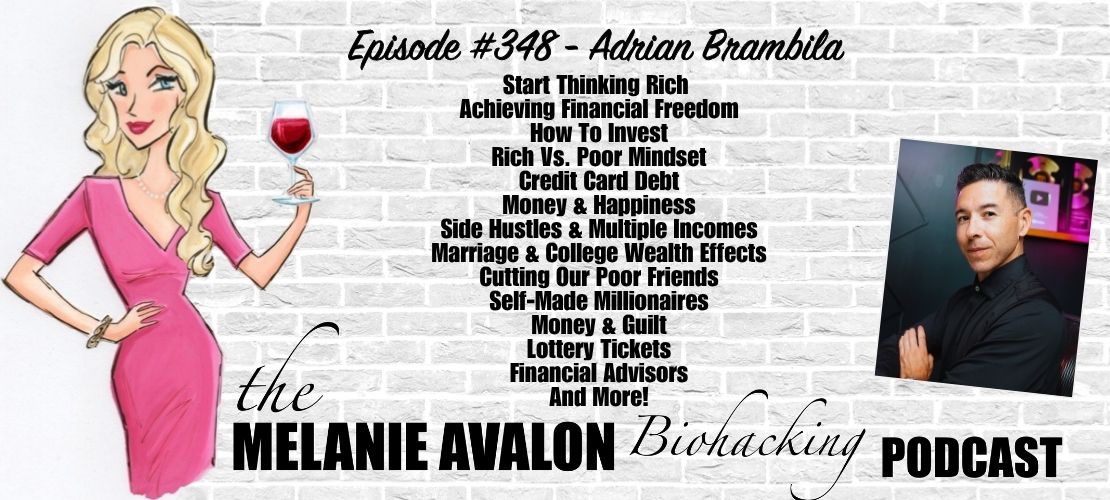
Adrian Brambila, an internet entrepreneur and former professional dancer for T-Pain, has become a leading figure in online marketing. With over 1.7 million followers on social media, His journey to success took an unconventional turn during the pandemic when he lived in a van and traveled across the USA. Documenting his experiences, he showcased how he was making upwards of $100K per month online and how wealth and minimalism can coexist. Adrian is the founder of Bramify.com and Brambilamethod.com and the author of Start Thinking Rich.
LEARN MORE:
SHOW NOTES
SPONSORS & DISCOUNTS
Melanie Avalon created Glow to be her ideal coffee. Made from 100% specialty grade Arabica beans, Glow is organically grown, rigorously tested to be mold free and free of contaminants, and thoughtfully sourced from sustainable, women led farms. Glow is thoughtfully sourced and roasted to preserve high levels of coffee’s primary antioxidant, chlorogenic acid (CGA), to support metabolic health and helps you glow inside and out! Get it at glowcofeeco.com
PERFECT IMMUNE - ACTIVATION PRODUCTS:
Perfect Immune from Activation Products is one of my favorite ways to naturally support the immune system, especially during travel or stressful seasons. It’s made from Pelargonium sidoides, a plant traditionally used to help the body fight respiratory infections like colds, sinus infections, and the flu. I love how simple it is - just a few drops whenever I want extra immune support or feel something coming on. Get a discount with the code AVALON at activationproducts.com.
FACEBOOK: Join Melanie's Facebook group for a weekly episode giveaway and to discuss and learn about all things biohacking. All conversations are welcome! IF Biohackers: Intermittent Fasting + Real Foods + Life
INSTAGRAM: Follow Melanie on Instagram to see the latest moments, products, and #allthethings! @melanieavalon
AVALONX: AvalonX Spirulina is out now! AvalonX supplements are free of toxic fillers and common allergens (including wheat, rice, gluten, dairy, shellfish, nuts, soy, eggs, and yeast). They are tested to be free of heavy metals and mold and are triple-tested for purity and potency. Get on the email list to stay up to date with all the special offers and news about Melanie's new supplements at avalonx.us/emaillist! Get 10% off at avalonx.us and mdlogichealth.com with the code MELANIEAVALON. Plus, text AVALONX to 877-861-8318 for a one-time 20% off code for avalonx.us.
FOOD SENSE GUIDE: Get Melanie's app to tackle your food sensitivities. Food Sense includes a searchable catalog of 300+ foods, revealing their gluten, FODMAP, lectin, histamine, amine, glutamate, oxalate, salicylate, sulfite, and thiol status. It also includes compound overviews, reactions to look for, lists of foods high and low in these compounds, the ability to create your own personal lists, and more.
EMF: Stay up to date on all the news on Melanie's EMF collaboration with R Blank, and get the launch specials exclusively at melanieavalon.com/emfemaillist.
TRANSCRIPT
Adrian Brambila
a lot of money and still have a poor mindset because having a rich mindset is I would say all three facets of income. How you make money, how you save money and then how you invest money for the future.
The most important thing and I don't want to scare anyone who's already in a great relationship with their financial advisor is I strongly encourage you to not just give the money but to understand what you're invested in. If you are spending money and you are trading your time to make this purchase then this thing better truly fulfill you or be worth it.
Melanie Avalon
Welcome to the Melanie Avalon biohacking podcast where we meet the world's top experts to explore the secrets of health, mindset, longevity, and so much more. Are you ready to take charge of your existence and biohack your life? This show is for you. Please keep in mind, we're not dispensing medical advice and are not responsible for any outcomes you may experience from implementing the tactics lying herein. So friends, are you ready to join me? Let's do this!
Welcome back to the Melanie Avalon biohacking podcast friends. I am so excited that you were listening to my voice right now because that means this episode has aired and it was truly one of my favorite episodes. I have ever had on the show. I do a lot of episodes on health and wellness, but I haven't done an entire episode dedicated to financial health and wellness, and what better way could I have dived into the topic than by interviewing Adrian Brambila for his epic book, which he co-wrote with Brad Klontz called start thinking rich 21 harsh truths to take you from broke to financial freedom.
And yes, this book is tough love. It is harsh truths and it is incredible. Definitely check out the free course that he has for you guys. They used to charge $1,000 for it. They're giving it to you for free. True story. Just go to start thinking rich.com slash Melanie. That's start thinking rich.com slash Melanie. There you can get a course, which was originally $1,000 all for free, as well as a lot of other free, as well as paid resources from start thinking rich. In today's conversation, we talk about so many things. I had so much fun talking with Adrian. We talk about the key to gaining wealth, which Adrian believes comes down to having a rich rather than a poor mindset. And yes, poor is different than broke. We talk about the stats of self-made millionaires and how they got there, how to deal with debt, especially with credit cards and how and when to invest the connection between money and happiness. Does money make you happy? How to have side hustles and multiple incomes, including very specific side hustles that Adrian recommends that basically anybody can do the role of guilt with money, whether or not you should buy a lottery ticket, how marriage college and owning a house affect your wealth. If you should actually cut out your poor friends, I eat those with a poor money mindset and so much more.
The show notes for today's episode will be at Melanie Avalon.com slash start thinking rich. Those show notes will have a full transcript as well as links to everything that we talked about. So definitely check that out. I can't wait to hear what you guys think. Definitely let me know in my Facebook group, I have biohackers, intermittent fasting, plus real foods, plus life comments, something you learned or something that resonated with you on the pinned post to enter to win something that I love. And then check out my Instagram, find the Friday announcement post. And again, comments there to enter to win something that I love. All right. I think that's all the things without further ado, please enjoy this fabulous conversation with Adrian Brambula.
Melanie Avalon
Welcome back friends to the Melanie Avalon biohacking podcast. I am so incredibly excited about the conversation I am about to have. So the backstory on today's conversation, it is about a topic that actually we have briefly touched on in a few episodes, but in no way have we dedicated an entire episode to it. And it's also a topic that when this book and information and fabulous person that I'm here with today came across through my emails, I was so excited. Sometimes I see a book that I want to read for the show and I just literally cannot wait to read it. And it's usually pretty sad if we're, cause we booked pretty far out as Adrian, our guest here knows today. So I normally can't actually start reading it right away. And I was just like dying to read this book. So the book is start thinking rich 21 harsh truths to take you from broke to financial freedom. So yes, friends, today's episode is all going to be about financial freedom and making money and what that actually means and how you should implement it in your life.
And what I absolutely loved about this book is it is very tough love. It is very much in your face. The chapter names are pretty funny and it just tells you exactly how it is and what you actually need to be doing to change your financial situation. We'll talk all about it in today's episode, but teaser. It has a lot to do with mindset. So do you have a rich mindset or do you have a poor mindset? But then it's not mindset and like a woo way more so in a very practical way. So like, how does that actually manifest in your life? So it talks about things like what to actually do with your money, what to do with your accounts, your savings accounts. How should you invest? Should you invest? How long should you invest? Should you get out of debt before you invest? What to do with your credit cards? Should you get married? Should you have an education? Like what should you actually do to have financial freedom? It's funny, it's personable and it's very, like I said, very practical, which I love. So I have already started implementing things from it and I wish I'd read it. Honestly, I wish I'd read this. This should be like required reading for like high school. This should be one of the courses, I think, because it would set you up for life pretty well. Yes, I am here today with, it's written by two authors and I am here with one of the co-authors, Adrian Brembila, and he is a, so formerly we can hear a little bit about his story from him, but he was a professional dancer for T-Pain, actually briefly in Atlanta, Represent. He became a leading figure in online marketing. He has millions of followers on social media. He's created a lot of content and he was able to make upwards of 100,000 per month online. And he had a whole sprint, actually, I don't know how much it has continued, but with minimalism. So he can, he's talked, he talks about how minimalism and wealth can coexist. I am just so, so excited about this. I have so many questions. Adrian, thank you so much for being here.
Adrian Brambila
Wow, that was such a good intro. I'm honored to be here and I can't wait to dive in to talk about all your questions and help anyone that's listens on their ideas of what money means to them and unlocking the next level of financial freedom for whatever that means.
Melanie Avalon
So to start things off, it's actually, it was really interesting timing reading your book, because at the same time, one of the other books that I was reading, prepping for the show, also was talking about, I wasn't using the words financial freedom, but it also was talking about that. And it was talking about that in relation to mindset. But it was more about, and this is kind of a theme that I mentioned, we've talked about this on other shows, this has been the theme surrounding this, which it's kind of this vague idea of have a rich mindset, and the money will come, like do what you love, and the money will come. Which interestingly enough, it's not that practical.
It's not like actual steps of what to do. And some of it might actually not be in line with what you're writing. So a question to start off with for you is, what is this whole idea of a rich or poor mindset? When did you realize that you had a rich mindset? And then like tying it more into you, because I would love to hear a little bit about your personal story, so listeners can get to know you. What led to this? When did you realize that like this whole money mindset, rich mindset thing was like a thing for you?
Adrian Brambila
Yeah. It's super great. And I don't want to cause controversy, but I don't believe in the idea that like, I can, I have, I'm thinking and I have a rich mindset and now all this money will show up. I wish honestly it was that easy, but I think for sure, rich and poor and my language with the rest of this conversation, I'm going to say rich people and poor people.
And when I say that, I really truly am talking about a way of thinking. Rich people think differently, make decisions differently about money. They, I would say these are rich mindset way of looking at money. If you won the lottery, there is a for sure black and white, this is right or wrong for how rich person, what they would do with that money or poor person, what they would do that money, remember a way of thinking. And you just won, let's just say $10 million, right? It's not like a hundred million, but you want $10 million. What do you do with it? Is your first thought, Oh my gosh, I am finally going to be able to pay off my house and actually I love my parents. I'm going to even take care of them because you're a good person. And then maybe you start thinking about, Oh, I've always want to travel to Fiji and essentially you are just, you were worth $10 million. And now as the more ideas you come up with, it just detracting from that. Eventually you can distract all the way from zero. And that's, this is why literally 70% of people that win the lottery don't have money after five years, what happens? And we, and, and we love to judge people that, that lose all their money. We love to judge celebrity athletes who make all this money and then lose it. Like what idiots, but the truth is you can make a lot of money and still have a poor mindset because having a rich mindset is I would say all three facets of income, how you make money, how you save money and then how you invest money for the future. And there's a lot of people who actually are really great high income earners, but are terrible at saving and investing. And you can still go back to, to zero. So a rich person, when they inherit money or when they win the lottery, there's really just one answer. They would invest a hundred percent of that money after taxes into an investment that's going to pay them some type of dividend. Let's say that dividend with a super conservative interest rate, let's say it's just for simple math, the, instead of taking the $10 million and spending it, they are able to figure out a way where they can make a hundred thousand dollars off an investment. And that investment I'll just, we can dive into investments and what type of good investments or bad investments out there. But that is essentially how they're going to then do all the things that they are the ideas I mentioned before with the dividend that's coming in, they can now purchased whatever they'd like to go on a trip. They can be generous and donate, but they will never really take out that principle. They want to keep that money working for them. And that allows you to basically never lose in terms of when you have money because you're never taking away from your net worth when you make a purchase decision.
Adrian Brambila
So that's one example I'm happy to talk about so much more, but there's definitely a rich way to view money and a poor way to view money. And I want to help as many people as I can that listen to this to help have a rich way of thinking.
Melanie Avalon
Okay, I love this. And I love starting with this, you know, very practical example.
And I have questions. Well, one, isn't it kind of a trick question? Because wouldn't a rich person not be playing the lottery to begin with?
Adrian Brambila
It's true. It's my question. You got me.
Melanie Avalon
So when I read that part of the book, and I loved it because each chapter, it ends with a challenge. And I think, going off of memory, I think the challenge related to that chapter had something to do with, like, you thought about what you would do with the money before reading the section, and then you thought about what you would do with the money after.
Before reading the section, I was like, oh, I would... My first thought was I would invest a lot of it in... I would pay off any debt, I would invest a lot of it in my business endeavors. So not, like, investments, but, like, fund projects and fund projects, I would, you know, buy things for my parents or something. And then I read the chapter, and then I was like, oh, okay, I'm investing it. However, my question is... So it really is, like, let's say you do $10 million, it really is invest 100% and wait for the dividends rather than, like, 90% and then, like, 10% I could, like, buy things for the parents and invest in projects.
Adrian Brambila
It's up for debate. I think I like to take a really extreme side on I think that like the business you're like many people first of all your answer is great. It's a great answer.
The majority are you are investing so all I can do is say you're that's amazing. Why I say 100% especially for many people who've always wanted to start a business they happen to come across a lot of money whether through an inheritance or even a spike in income they can think oh finally I got this extra money and I'm gonna put into a business despite it's different from you Melanie but having zero business experience in this niche or whatever grand idea you wanted to start what happens like and this is a statile just shared 95% of businesses fail so the idea of then taking any portion of that money that you made from the lottery and putting into a business there's if I was to take it just a blank assumption how successful your business going to be there's a 5% shot it's going to actually make a profit so to me it's better to have that 10 million dollars into a fund that's paying you an interest rate and then that interest rate money is your play money for you to test any kind of business idea because guess what if you fail at the business and all you have to do is wait until the next year for those dividends to kick in and you can try again and again and again
Melanie Avalon
Okay. Awesome. That completely makes sense.
And then actually just because that made me think of something with the interest rate. So for example, I actually just got back a pretty large refund. My tax refund took forever. It's supposed to come in April and I just got it in November. It had interest on it, which I didn't realize that the IRS gives you interest if they hold your refund too long. So that was nice.
So is that interest money that I got? Is that the play money I get to use? Okay.
Adrian Brambila
I think let's let's back up a little bit. I have an assumption of what wealth and money how it should be spent and this is my North Star and some people listening may disagree but I hope you do I hope you agree with me. I think and my belief is that I want money to buy back my time and I want to have time freedom and I take this an example in every aspect of my business. I have also applies to my personal life.
I spend money on things that I could do but I don't want to do. I have a house admin. I even have a chef that makes me food and basically every single chore from taking care of the yard I have someone that I pay to do those things because I believe my time is more valuable than money and so when it comes to investment decisions, business decisions, like before I got to this point the whole goal was like oh my gosh I don't want to drive a nicer car to go to work. I want to get to the point where I don't have to work so I'm okay driving a crappier car and then eventually that's the aspirational goal is to get to this point where you own your time. You're operating out of choice. Now your choice might be to continue what you're doing because you love what you do. That's amazing but you're still doing it by choice versus have to do it and then after you have hit that point you always want to be diligent and continue making decisions that optimize for time. I think the world would be a much better place if everyone had financial freedom and then you could truly decide what you want to do with your life, how you want to spend your time and I would say for the most part it's not working 40 hours a week for someone else in a business and I get arguments all the time oh I'm a vet. I love working with pets. I'm like that's great. You can still work with pets but on your own time. It's a total different than saying oh my gosh I have to go to work here on Monday. Time is the most important asset. People trade money for time all the time. In the beginning you have to but then along the journey of as you accumulate more money, make more money, I think people get caught up in living in nicer places that they should, driving nicer cars than they should and essentially those are sacrifices of your time. You just keep pushing away your financial freedom goal and I think this is an obsession that you have to have otherwise you can get lost in everyday distractions and shiny objects and then never get to the point of financial freedom.
Melanie Avalon
I have struggled with the time thing in that I am that type of person that loves working. So I just like, I just love it so much. And I, especially in the beginning, it was hard for me to delegate because I didn't trust anybody to do things, you know, the way I would, where I'm at now is I have people I can delegate to. And yet I still, it's like dopamine hits me doing the tasks myself. And I'm like, No, like, Melanie, just like, delegate this, don't do it the time and the freedom just before it so that I don't let it slip away.
One more quick question about the, if you were to receive like a large sum of money, because I do think it's a really good example of the different mindsets and how to approach everything. So I think, because you mentioned one of the things you mentioned as something that people would do right away is maybe like pay off their house loan or pay off, you know, their mortgage or whatever it may be, you guys do have in the book, this idea, which I think is probably not what most people would would do or think, which is you say, you know, you don't wait to get out of debt before investing. And ironically enough, ironically enough, I gave your book to somebody, and they hadn't read it yet. And then like our first like chat about it, they're like, Well, I haven't read it yet. I'm going to but I really before because they were thinking it was mostly about investing. So they were like, Well, before I start investing, I need to get out debt first anyways. And I was like, No, no, no, you need to read the book, because that's like, kind of the opposite here. So just that quick question of if people do have debt, if they have credit card debt, loans, mortgages, whatever it may be, how do they handle that versus starting to invest their money?
Adrian Brambila
Okay, this is a great example. I'll try to give the reasons why. Like for sure, credit card debt is the worst kind of debt. You will never find an investment that will outperform whatever interest rate is on your credit card.
So people see this as the excuse why they should not invest because if you invest in a, I would say conservative ETF of the S&P 500 and a specific one could be like VOO, and that is one of the more popularly referenced index funds. That one over the last 30 years is gonna be around 8%. When you measure that to a credit card, credit card is over 20%. So you're like, why would I invest? I need to pay off my credit card. Here is why you should invest. The action of investing is a mental barrier. And if you are not investing, you put investing on this giant pedestal that one day when everything is perfect and debt is cleared, finally you'll be able to invest. It's better to start the action of investing even if it's just one dollar because there's actually quite a bit of work you have to do to invest one dollar. You have to go to a website, a brokerage, put your information in, decide when you want to retire. You have to start thinking about your money, financial freedom, what that means to you. Specifically, how much money do you want to save and invest when you retire? How much money do you need? Every answer in person is gonna be different. And if you never start even just one dollar, it'll always be this giant pedestal to get over. So to be clear, if you have a lot of credit card debt, you need to put majority of your funds to the credit card debt, but you need to also be investing something that can be very small, even five dollars a month. If that's the point where you're at, that's better than saying, I'm not investing yet, I'm gonna wait until my credit card's paid off because the action is more important than the amount.
Melanie Avalon
Okay, this is awesome. I'm just so intrigued. I mentioned in the intro about how I think people should read this book in high school. I think it's really interesting how we're just not taught this stuff.
Like, this is, like, very helpful information. And so recently, recently I actually sat down with all my credit cards and made a chart of the actual interest rates and what that meant and, like, due dates and, like, all the things. I hadn't been doing that, honestly. I just had the cards and would, like, pay them off, but I wasn't really, like, thinking about it. And once I sat down and, like, crunched the numbers and made my chart, I was like, oh, it was very, like, very helpful to see. And it changed how I decided to go about things. I like what you're saying about making things easy and that barrier of just, like, sitting down and doing it. So what I did for me was I hired a financial advisor and I just let him question here. Because you just mentioned all the barriers to this and, like, what you have to actually do for it. Is it a safe or a wise approach to get a financial advisor, let them, like, just set it up and run with it? Because basically that's what I'm doing right now. I have the financial advisor. I make the maximum contribution each year that I can to my, I think, my Roth IRA. But I don't, like, know a lot about what's actually happening there or, like, who he's investing in or, like, where the money is. I'm just, like, trusting the advisor. So how was that? Because I think that's what a lot of people do.
Adrian Brambila
This is a tricky question to ask and I'm going to always keep it real. I think it's more valuable and worth your time to know what is happening. I don't want to blind trust anyone, including a financial advisor that they're going to take care of me. Maybe I'm just a natural skeptic.
Even in the financial advisor world, not all financial advisors are created equal. And I'll say something really offensive if someone's in the industry. I think a lot of financial advisors are truly just salespeople. So here's what you have to watch out for. First of all, there is such thing as a fiduciary. This is a type of financial advisor who has a legal obligation to give you advice. If someone is a financial advisor and is not a fiduciary, they're really not backed by the law, they're backed off like, quote unquote, their expertise. But I don't think we get access to someone like Warren Buffett. I don't really trust financial advisors who are not a fiduciary. So that's the first question if you start going through the path. And honestly, it's as simple as an email to say, hey, just checking. I know I've been working with you for a while, but are you a fiduciary? And if they're not, doesn't mean they're doing a bad job. But here's, let me just tell you one real example. This is very common, super annoying. I hate it. Financial advisors, they get compensated extra when they recommend proprietary funds from their company. So I mentioned VOO. This is a Vanguard ETF. And I'll just going to pick on Edward Jones, but literally every financial advisor practice firm has their own type of VOO, exactly the same. The only difference is that there's higher commission for them to push that product and it's more expensive for you as an investor, even though the funds might be pretty much identical, it costs you more as the consumer, as the investor. And I hate how complicated they make explaining. Okay. So I'm giving you $1,000 to invest. They don't say, Oh, by the way, it's after my fee for promoting my fund. And also the fund has a fee. And also I take a percentage of your entire portfolio. That $1,000 is actually 800 or 900. They never tell you. So it's all these secret and unspoken fees that, and honestly, it sounds like, Oh, what's 2%, oh my gosh, 2% over the next 30 years, it's a lot of money. It's hundreds of thousands of dollars. And the annoying thing, the last thing I'll say is like, if you, if the stock market goes down and let me tell you, it's going to go down and let's say that it goes down by 8%, you still have to pay that 2%. So this is like, I think the most important thing, and I don't want to scare anyone who's already in a great relationship with their financial advisor is I strongly encourage you to not just give the money, but to understand what you're invested in. It is totally 100% worth your time. There's so many examples of very famous rich people who did the blind trust thing, and it didn't work out. And I just think, especially this is for all the women out there.
Adrian Brambila
I don't like family dynamics where husbands and wives, where the husband takes care of all the finances. I don't like that scenario either. I've met many, many divorcees who when that happens, their whole life is turned upside down. They have no idea anything about money because they've, they just put their trust and it's very unfortunate.
And so I'll just share my example. My wife and I, we talk about money on a monthly basis. We have money meetings. And so she knows where money's going and why it's going there. And I do too. And it's just like two heads are better than one. So women, especially I would love if all women in their households took it on themselves to really learn what's happening with the money, where it's going, why it's going there. These are always good questions to ask all the time.
Melanie Avalon
Have you thought about, and maybe you've already done this, have you thought about making your own AI that people could use and it would come from your perspective and it would help people analyze their financial situations?
Adrian Brambila
I haven't. I also want to be super clear. I don't tell people what to invest in. If you say, hey, what's stock or index funds? Because I'm not a financial advisor.
I don't have licenses. I used to back in the day. But to me, I think what's more important than the tactics of like, if you've gone to the stage where you're now deciding what type of funds to me, I'm trying to get more people to that stage. Because most people aren't even at the point where they understand what to put the money in. They just don't have an account started. In the book, we talk about money scripts. This is my co-author's most famous contribution to the world of finance. He literally pioneered this concept. A money script is your inherited belief on money. So the way you were raised, I don't care if you were born rich, poor, what you saw your parents doing with money, and if you have horror stories, or if everything was taken care of for you because you were born really wealthy, all of these can have incredibly negative effects on your relationship with money. The first part of understanding a money script is recognizing what you saw your first introduction to money and how it worked just through your parents. That can bring awareness to maybe some decisions in the way you act with money, whether that is good or even sabotage, on having this awareness of like, oh my gosh, I didn't even realize I do this, or I think this way.
It's much. So the people that had a lot of money, we always said, oh, it must be nice for those people. They had to do something wrong to inherit that. That's a money script that's very common, and I feel very popular in the world of politics as well, to blame rich people for problems. On the other side, if you're born really wealthy, money was always taken care of for you. Then when you start to make your own money, you're not really a steward of it because you just got everything done for you. So you're like, oh, I'll just take care of it. All of a sudden, you've racked up credit card debt because you actually don't know how to manage it because everything was always taken care of.
So having awareness to your interaction with money, recognizing how to get to the investors, like a lot of steps before you get to investing. Then we're deciding, hey, what type of portfolio should I invest in? Should be conservative or aggressive?
Melanie Avalon
I love this so much and I'm super aware of the money scripts in my family. So for example, my dad did and does very well. So we had a lot of money, but my mom, my parents though, they both were raised very poor. So they, my dad, which by the way, random fun fact that I learned from the book, I think was like very early in the book, how many, what percent of millionaires are self-made? 70%. Yeah. And I like how you mentioned that a lot of people don't like that statistic because it takes away the ability to be a victim and it basically says you can have agency and become a millionaire, 70%. But in any case, so my parents came from a lack of money. My dad ended up making a lot of money, but my mom, I think always had a very, like a scarcity mindset and like a bit of a fear that we were going to lose the money. So I remember being told, like I know she did this to like, I think she did this to like keep us humble and make us aware that money, you know, could go away any day. But I remember being told ever since I was little, like, don't forget that your dad could lose his job any day. Like he wasn't going to lose his job, but like she would tell us this, this could all go away. So I was always like, oh my goodness, like we're going to lose all of our money. So it kind of gave me like a fear mindset around money, even though we never had a money problem.
So it was interesting to see how that manifested in my own life. I know I ended up, I kind of held on to that mindset for a bit. And then I read a book, what was the book? It's by like a comedian actually, but it's about an abundance mindset. And I literally made a decision where I was like, you know what, I'm going to try to just, I'm just going to not have that mindset and see what happens. There's like fear. And as long as that works, I'm going to keep on that train. And that worked for me, but I've seen it manifest different ways. So I think being super aware of this is really important. What was your mindset growing up?
Adrian Brambila
I think my dad immigrated here when he was 13 and my mom was born very poor just to share a story about my mom's scenario too. My dad grew up in poverty in Mexico. He had to steal food sometimes or else he'd go hungry and my mom, she shared a story that when all the kids moved out of her house, her siblings, that her dad had shared at the age of 68 that he finally had $1,000 in the bank and he felt rich. Both of them, they just didn't have money growing up.
I think the healthiest mindset I got from my parents was I could work and provide and my circumstance can change based on I have the ability to produce. This is a classic immigrant mindset. Coming to the US, it was a place that we can make it happen. That's why we came here because where my dad was at, people were dying. You couldn't make it happen over there like you could in the States. That gave me a rosy optimism on like, hey, this is the platform, we're in the right place and we can make change.
I think I'll say something that I feel like I had to work through myself is a money script that I got from my parents was like, you have to work hard to make money. If you want to make a lot of money, you have to work harder. This is so common of a belief. It's a really great middle class mindset. More effort, more pain equals more money. It's actually unhealthy.
This is where abundance mindset is a much better mindset to have, but this is something I had to work through because my very first side hustle online was teaching people how to dance the robot. This is after I was done touring with T-Pain. It took a while. I'm glossing over all the struggle, but after about two years of not making anything, I made $1,000 in a month. This is at a time where I was working at a cubicle, I made $27,000 a year. That was life-changing money living in Dubuque, Iowa.
Instead of celebrating the moment, I actually felt guilty because I was teaching people how to dance the robot. I was actually having a ball. It was awesome. It was fun. Now, I made just as much money almost as my take-home pay from my 9-5, which sucked. To me, I feel like I had to work through this idea to create money.
I needed a new money script. Not that more pain and more sacrifice equals more money. It's partial true, but now I changed it. I had to change it to the more value I create, the more money I make. That's still, I feel like, a philosophy I believe in today also with an abundance mindset. Despite having, I love my parents. My dad was the first person I hired. My second was my mom. We talked every single day. I learned a lot of great things, but even when you grow up in a great household, there's still things you have to work through like this one.
Melanie Avalon
guilt piece is really, really interesting too. I've seen that I will feel it as well with similar situations.
And then I see it. So I know somebody, I have a very close friend who massively struggles with the guilt mindset to the extent of because of being raised with money, like the guilt of having money. It's like this whole thing where it's quote, not fair that this person has money because other people in the world don't have money. Which my perspective on that is you having money doesn't affect other people not having money. I don't know. What do you think about this guilt thing that people have about just having money because other people don't?
Adrian Brambila
I wish my co-author, Dr. Brad Klontz was here. He is like the billionaire family therapist and he works with like really ultra rich people and he shares so many stories with me of like kids that were raised in really wealthy homes and wealth is relative, but they feel like they almost resent being like having all this money and, and they'll even go to extremes of like joining rallies that say eat the, like when eat the rich was happening like in 2021, like it's not, it wasn't like people that were broke. It was also really rich people that were like, like, yeah, rich people are all like awful, but no one knows that I'm actually really rich as my parents. It's, it's a wild concept.
So I think that's a great example of like of a crazy money script to adopt with and versus see how you could use that money because you like the world isn't fair. Some people are have the starting line for them is the finish line for, for someone else or people that can only dream of having the money that they are just born into a family, those people who are born to those family, like they're like, if they take a negative stance, they're just missing out on like, I think gratitude and then the opportunity to really make change. And I think this is like a deeper question that is so hard to think about when you have bills and credit card debt. But like when you actually think of like life's questions, like what should I actually do with my life? Typically you got to own your time to get to that point where you can really dig deep.
It's hard to be like, Oh my gosh, I want to change the world, but I can't because I got to pay, pay these bills. But once you, once you get that time freedom and these people that are born in rich families, like if they could just unlock the perspective that, Oh my gosh, I actually am fortunate enough that I, I was born. I actually never have to work a day in my life. What can I do to make an impact? And, and I have more means to do so. And that, that would be such a more productive way to go about it versus having any guilt or shame, because I know like with the trajectory of my family, I'm the first person in my family that's, that's leaving probably going to leave like a trust fund for my kids. Actually, I shouldn't say probably we already, we started a trust fund already. And so my, my job as a parent, I think is going to be one of my bigger challenges. How do I pass on financial literacy and work ethic and, and have, and create a great relationship with, with, with money so that, so that my kids can, can take whatever they have at their platform and, and grow it and make a bigger impact than, than I could. So I think that's, that's what, that's the ideal.
And I think if I, if I, that'd be, I think a way that I could, I could fail as a parent, parent. If I, if I don't pass on the knowledge of how to, how to look at money the right way. Do you watch white
Melanie Avalon
Yeah. It reminds me, I feel like the scene that perfectly, have you seen all the seasons? Yes. Okay, so I think the scene that perfectly captures this is when Piper, in the third season, the daughter is having the breakdown at the table about her guilt about liking nice stuff but being so guilty about having all this money and how it's not fair. I always think it's just so fascinating to me that there's this money script about having a lot of money and that's not fair and there's like an anger there.
I'm like, I don't understand. We could be using this money like you said too. Yeah, I don't know, like have gratitude and use it to help other people. So fascinating, fascinating, fascinating. Okay, so you mentioned a few different words in there that made me think of other fun topics to talk about. Okay, so you mentioned the trust fund. Here's a huge question I have for you. So admittedly, and I'm so embarrassed about this and I shouldn't make excuses, I should read this book. Have you read the book, Die with Zero?
Adrian Brambila
Yes. Amazing book. And actually he's in Austin as well.
Melanie Avalon
Oh, oh, oh, really? Okay. Yeah, I'm dying to interview him. The thing I'm embarrassed about is I actually haven't read the book.
I've only listened to him talk about it. So I don't know if I, I haven't read the entire book. So I don't actually know if the takeaway that I have about the book is correct. But my understanding of the concept is that a lot of people, and you can correct me if I'm wrong, but that a lot of people put a lot of focus on saving a lot of money for the future rather than living in the moment now when they can actually be appreciating that money rather than after they're dead. Is that a takeaway from the book by chance?
Adrian Brambila
Yes, it's definitely a takeaway. I think that there is definitely like a shared mindset around time and start thinking rich and die with zero. I think a really fascinating concept that we didn't talk about in our book that he talks about in his is the idea of inheritance. We don't talk about inheritance like at all. We only talk about if you receive it, but not like how to leave it. And I think his take is really amazing that you shouldn't leave an inheritance. You should give it while you're alive because you can benefit from the gift. When you're dead, you can't experience it.
And the shared overlap is money for sure. You got to optimize for time. You got to buy back your time. And then also the second thing is what do you do with your time? The best way to spend money is experience. And when you gift money, it is an experience like no other. If that money you're gifting, you can see it make an impact. And this is what an inheritance is, but people leave it after they're dead and it doesn't make sense. If you know consciously thought how much money you want to pass on, it'd be so much better if you could gift that money to the person, whoever it is, and you could watch it and how it impacts that person. The idea of leaving it behind, I think we have as a mass majority way of thinking, a terrible way when it comes to inheritance. And I think Die with Zeros lays it out and I was just shouting out, yes, exactly. And it takes more effort too because leaving it behind is kind of lazy. It's like, oh, keep pushing it out. Eventually I'll die and then you'll get this money. But if you actually thought about it, how much money do you want to really leave someone or gift someone? And then the other thing about inheritance is by the time you die, we're all living longer. So let's just say your kid, they're inheriting it at an age where it's going to help, but it would have been better for a kid to get money in their 30s versus their 50s. That money in their 30s can make a bigger impact than in 50s or 60s. So it's more of thinking in terms of not just a conscious thought about inheritance, but also the idea of optimizing for the right time of when to gift. Because there's also an idea of when gifting a lot of money would be a bad decision, gifting a million dollars to your kid when they're 16, probably not a good idea unless you made them a wizard about what to do with the money. But when they're in their mid 20s or 30, now they're potentially shopping for homes or trying to make decisions, that could really make an impact. So I think it's just more taking a conscious proactive approach versus a lackadaisical approach of like, oh, when I die, they'll get this.
Melanie Avalon
Do you implement that because you mentioned like, you know, having a trust fund for the kids and things how are you implementing that or are you
Adrian Brambila
I won't say the amount, but when my daughter turns 21, we know exactly how much she's going to get and then also 25 and 30 and we have accounts that are investing in and it's sizable and so it's not just like a little bit and because of, we've already thought that out and my daughter's six months old, by the way. We're like 20 years ahead of thinking of what's going to happen and then our job as parents is to make sure we pass off financial stewardship so she knows how to be diligent with the money and that's on us.
I think the worst thing you could do is just leave money, just leave an asset. If you don't leave your way of thinking, the money's going to be gone. It's just like the people that win the lottery. It's just like what they say, short sleeves are short sleeves and three generations, right? It's because leaving money behind is so easy. Leaving an inheritance behind is lazy, but leaving the way that you thought, what you had to do to climb up, what you had to do to generate wealth and if you don't pass that behind, how do you expect your kids or your family to figure it out? You have to pass off your mindset. Otherwise, you might as well just not pass off anything.
Melanie Avalon
So, like, using my family as a case study, there's three kids, including me, and we were all raised in the same family, so presumably with the same mindsets and scripts passed down to us. But it's manifested very differently with how we are now living our lives.
And I won't mention names, but, like, one of us is struggling with lots of credit card debt and becoming financially stable and things like that. How much of this do you think is passed on and actually told to the person versus do you think some of it is just we're born that way? Like, I'm like, I wonder why people turn out different ways.
Adrian Brambila
I think there's definitely variable where you have someone that watched the same experience or were in the same room and they walk away completely different from the experience and what they take of it. I think specifically to money, this is the work as a parent. You have to have conversations about money. This is not common.
We talk about money not being taught in school, but money is also not taught at the home. First conversation is parents need to be talking about money all the time, like regular basis check-in on a monthly basis minimum. On top of that, money has to be talked about to your family, to your kids. If money is not a common topic of conversation, then you're leaving it up to chance. When you leave it up to chance, you're going to have scenarios where multiple kids in the same household, one of them got rich. One of them is broke and that's because there's too much chance. I don't want to leave it up to chance and be like, well, my daughter, I got a book. I'm assuming she's going to read it and she'll be okay. No, I don't want to leave it up to chance. I'm going to talk to her about money and teach her about money. It's sad that money and politics, money is put in the same category as politics as a taboo subject if there's a difference of opinion. Money is something you have to talk about, like you talk about sports, you got to talk about money.
Melanie Avalon
So like what is that practically gonna look like? So you said her daughter six months old Like what would that even look like when she's of the age where she can like when she's like three or four
Adrian Brambila
I know I tried talking to her about a Roth IRA yesterday and she was just like.
Melanie Avalon
Go, go, go, go, go, go, go. Her first word, raw thyroid.
Adrian Brambila
Yeah. I, I feel like as we start to talk about my baby's not talking, like hasn't said a word yet. So it's like, you just wait. When, when I don't know what the right age is, I just know like, when we talk about when, when we're talking, like I imagine we'll be taught, like we're gonna, it's going to be a normal part of conversation and we're not going to have to force it because my wife and I will talk about money. So I think that, that I don't know if there's like a right time. It's just more of like the culture in our home is money is a conversation that we talk about like, like a normal piece of conversation that could come up every single day. That's the culture.
We don't have to like, like force it. We used to, by the way, like actually super transparent. Like when we, we first got married, my, we had all these assumptions on what to do with money and it didn't cause any conflict, but it definitely, it felt like we weren't exactly on the same page. So then we did have actual calendar invite meetings on the first week of the month where we did talk about money. And then we stopped doing that just because it's now just normal culture. Like it could come up, it could come up in regular conversation. That's just, that's like culture. If you're not there, you gotta like make it a habit and schedule it. And I would think as, as soon as our child has a curriculum of learning about any kind of subject, money should be one of the categories that we're, if it's not being taught, we're going to teach it. So it's just, we just, you just normalize having conversations about money.
Melanie Avalon
before leaving the Die Was Zero thing because I have a final piece about that. I'm really happy to be having this conversation with you right now because this question has haunted me ever since I, because I listened to the author on a podcast about Die Was Zero. The takeaway I took that I implemented in my life was, well, like I don't, I think I'm going to have kids. I don't anticipate having kids.
I don't want kids anyways. It made me feel like maybe I should be less concerned about, I think I, I think I applied it to the wrong place. Like I applied it to the investment side of things. So I was like, well, rather than focusing so much on like building all this money for when I'm older and for kids that I don't have, I should just spend it now on experiences. So I think it was, I think it was beneficial and that it made me feel better about spending money that maybe I should be spending now on experiences, not things. I'm not really like a things person. So it's, it is experiences for me and giving and gifting for people. Like I love, so my love language is literally gift giving. So I just love giving things to people. So I kind of felt more free to like spend it on myself for experiences and spend it on other people. But I feel like maybe I was worried that I took the wrong takeaway or that I went too far because maybe now I was thinking not enough about my future. What are your thoughts on that, on like spending money now while you can experience it on other people versus saving it for this nebulous future situation.
Adrian Brambila
This, I think if the question is really separated into like two categories. One, you're doing okay with money and now you have to make a conscious effort to like spend the money, but you're, you're not worried about like. Bills you're, or you're, you're behind or like, like it's money's really tight. And then you have people were like, money's really tight, but like life is short. And you, and, and like, you want to go and still experience that. You don't just want to work your whole life. And then now you're 65 and now you can finally travel. Cause I got 65. There's things that aren't going to be as fun for you as they are now. Like when you're in your thirties or twenties. So I think in both categories that will start with like the people who you you're doing, you're doing just fine, whatever that means for you, you're like money. You're, you're set. I'm not saying like you're super rich, but you're like, you're, you're doing great. Money's not a huge stress on you.
So for those people, I encourage you, I implore you to find ways to spend money now on things that make you like, that like fulfill you in the best way possible, like I think you have to, like for me, I am, I try to find ways to spend money on experience because I have gone to the point, like even with my dad, we just got back from a trip from Japan, a father son trip I spent, I, it was first class dealt to one, no budget. And it was, and it was amazing. We're always going to have those memories and like, whatever the price was, it was worth it, even if it was more, it was worth it because like, I know I'm not going to have my dad forever. And like, it's an example like that. It's like, I am trying to find ways to do that. You have to find that thing that for you versus like, I could have saved. I mean, I don't know what I spent, like maybe 25,000, 20,000 or let's say 20,000 dollars I spent, like, could I have saved another $20,000, invested it and could that compounded more? Yes, for sure. But I got the huge return on my investment, if you will, by, by spending the money and, and I'm, I wish I could do more of that. And, and I'm bummed that I didn't have the money or I couldn't have thought of different ways to do other father son trips. Cause that's only the second trip I've ever done with my dad like that. And it makes me sad. I, cause like, if I could go back in time, what would I do? I would try to find more ways that I could do that. And so the, I think that's one, it's just encouragement for the, this is a really interesting concept with from the die with zero book is he states, and by the way, I want to make sure this is not my words because I don't know if I agree with this completely, but he, he has an example of himself where he like racked up, uh, I believe it was like credit card debt or spent every last dollar to go like on a pilgrimage in South America, I think. And so it's one of those things where like, at that time, I think it was his early twenties and he said he got an incredible ROI and guess what life worked out and I think that's definitely like an optimistic take, but for me, I guess I'm, I'm just a little too conservative.
Adrian Brambila
I've never gone to the point where I spent my last dollar because I was like living an experience and maybe that's a challenge for me personally. It's like, I could have had better experiences in my twenties if I was, if I wasn't so conservative. So, but I do think it's better to, to invest and purchase experiences. It's always, I think a great idea and worth your money.
And it's tragic that people unconsciously spend money on all these little things like appetizers and alcohol and coffee and, and they're really not doing, making these consciously, or they're buying status through items, luxury items, and they're really making a trade of their time. And also like, because they did those, they don't have money to go on a trip to Tokyo or wherever they want to go. So I think that it's like just thinking about it more consciously and finding ways to spend money on things that you love is, is a, is a great idea.
Melanie Avalon
you mentioned like the status thing. And I loved the, you guys talk in the book about like the psychology of the flex and how, you know, why we have a love or why people are obsessed with brands. And it goes back to, you know, what it signifies about your status and the clan. And, you know, you talk about like the Vikings and all this really interesting stuff. But now today, how it manifests is like, we need, you know, Gucci or Prada and that is gonna signify something. My nuance thought there, because I agree. And I think honestly, everybody should read that chapter and it will make you feel, it will make you realize, you know, maybe you don't need to buy all this name brand stuff. And you guys do make a good case that, you know, a lot of the richest people don't, actually don't live this way. It's more people without the money trying to appear that way.
The devil's advocate idea there would be, because I agree so much about the experiences and spending it on things that really enlighten your life. And I think I made a conscious decision for me when I heard about the Stuy with Zero concept. I was like, okay, I'm gonna be very clear in my mind about what sort of experiences truly fulfill me that are expensive so that I know if it's like on the pre-approved list of something I will spend it on. And so I know what that is for me. It's things like I have to be like front row at the theater and it might be like some, you know, like hair, like the way I do my hair, like hair related things. So I know in my head, like what I'm okay to spend it on. The thing though is different things make people happy. So for example, traveling, not my forte, not my skillset. I would never, like you would have, you couldn't pay me to go on like a lot of these trips just cause I would be too stressed about it. So what about the people who like buying the brand like that's what makes them happy. Like buying that perceived status is what makes them feel good. Like what would, would you just say that they maybe need to rethink that and change what makes them happy? No, I...
Adrian Brambila
I definitely, I don't want to judge, like this is the formula for me not judging. It's whatever you spend your money on, you're not trading time for it. So if you work an hourly job that makes 10 bucks an hour and you work 10 hours, you have $100, that's not exact, but you basically, let's say you got $100 and that $100 equates to 10 hours you had to work for it. So then when you drop $100 to buy a Gucci shirt, like, and you don't have, like you use your active income to make, to buy that shirt, like that shirt did not cost you $100. It cost you 10 hours. This to me, I'm judging because, and I'm only judging as a coach, like normal people, I wouldn't never have this conversation, but like I'm judging because I'm like, dude, you, you don't realize what you just did. You traded 10 hours of your life for a shirt. That sounds ridiculous, right?
So a different scenario is let's say the person is same, same income. They, they have, they work 10 hours. They, they make a hundred dollars, but all along for the past 10, 20 years, they've been investing or, uh, and they have that investment that, that actually make a hundred dollars a month. So this person purchases the Gucci shirt. And to me, I'm like, Oh, you pass judge free because you didn't buy it with your active income, you bought it with your passive income from your, from your investment or, and to me that is now you're not, you didn't trade your time for that, your, your money made money and you bought it. So to me, that's, that's the biggest difference.
And there's, there's other, uh, different types of relationships. If you're like an entrepreneur, like I've, I think a really great entrepreneur way of looking at purchasing is like, Oh, actually everything is the same price. I just have to come up with an offer that can pay for it. So it's like, I don't think in terms of time anymore, I think of it. I have to make an offer to my customer and then I'm, that's how I, that's my, my way of paying for it versus like an hourly way. So I'm just anti trading time for anything.
I want to just make sure people are using passive income or income that purchases it, that isn't a sacrifice of your time and then it's all good. You can buy whatever you can buy all the brand labels. I don't care. Just do it the smart way.
Melanie Avalon
Okay, what do you mean about the mind game where you say everything is the same price?
Adrian Brambila
Okay. So like as an entrepreneur for the entrepreneurs listening, if you create a new, let's say you're like, you want to buy, let's say the classic, you want to buy a Lamborghini, right? Let's say the Lamborghini costs $250,000. So if you have a salary, even if it's a high salary, like if you make $250,000 a year in this scenario, you would need you to buy the Lamborghini and just to buy it, not to maintain it. It's a, you're trading a year of your life, right? To me, this is, I think, always a terrible decision.
But as an entrepreneur, sometimes in your business, you don't always trade time for dollars. Like you can create a product, like let's say you create like a class. Sorry. Let's just say you create a course. You create a course and you post on social media and this new offer makes $250,000 and maybe it only took you like a month to make or a week to make. You don't really have an hourly wage to it because it's an offer that's scaled. So I've talked to some people and entrepreneurs are like, oh, everything's the same price. Like whether it's a Lamborghini or it's a Michelin star dinner, I just have to make an offer which pays for everything. So they don't view it as time anymore because in their business, it's not a time ratio. So that's like a different framework. If you're like an entrepreneur, you have the ability to create products or offers which can fund your life.
Melanie Avalon
Oh, okay. I actually do. I actually kind of do that in my head. Like I think about things that way.
Like I think about things like if this costs a certain amount, that's kind of like because I am an entrepreneur and I have a lot of like I create a lot of content and products and stuff. And I'm like, oh, that's like this creation that I made funds this thing over here, or like this thing that I want to buy. That's so interesting.
Adrian Brambila
It's not all entrepreneurs, you know, some entrepreneurs, like they're consulting and so they still like get paid per hour. But it sounds like in your business, in my business too, like I, if I want to buy something, I don't equate it in terms of how many hours I need to work to get it.
I more just think of like, what do I need to create to pay for that?
Melanie Avalon
literally do this. Oh, that's wild. Okay.
And then so speaking of the marriage piece, there's, you guys have chapters or sections on hot topics and how they relate to money, including marriage, college, whether or not you should buy a house. So with the marriage piece, I was, okay, so I, I don't know that I'm like made for marriage. I don't know. I don't anticipate getting married. I will never say never, but I don't anticipate getting married. It was interesting to read the stats on income and marriage. I think like married couples, it was wild how much more they tend to make than like a single person. So why is that? Why do you think that is? Should people get married for money?
Adrian Brambila
Um, marriage, you know, so Dr. Brad Klontz is the, the PhD researcher. And so he studies millionaires, specifically self-made millionaires. So, but he has a lot of research on like millionaire families and couples across America. So when he's looking at this data, he's pulling insights from the data. So when he, when he pulled data on like, Hey, people that are single versus get married, who makes more money over their lifespan, for sure, 100% it's married people, and I think not to look at all the data, but to make it super simple that everyone could agree two incomes better than one income, like that's all, that's all it comes down to.
It's like two, two people working towards a similar goal. And you know, just to mention it, marriage could also be an incredibly expensive decision, because if you get a divorce, that could be half of your money gone. So it's not as simple as like, Oh, I just got to get married. That's how I'm going to get ahead. And then I thought that this is like anti, I would say what's trendy and cool for financial content, a lot of financial content is really anti-college, but I can't argue with the data when you look at college kids over the last 20 years, 30 years and 10 years, and you look at their income versus people who didn't go to college, people that went to college still make way more money than people who don't. So the idea of like entrepreneur and dropping out and making money, like we're we, we see like one story and then we think like it's true versus like when you take data sample across thousands and thousands of people, college still wins.
I think a great example, like casinos do a great example with their marketing. Like I'm not really a gambling person. My parents are, are, and like, they're always at the slot machines. They say they're always donating to the local Indian reservation. And when you, when I go there, when we have like these buffets or when we go eat there on, on the billboards, they market like someone that like made $25,000 and so looking at the stats of like how many people actually make 25 grand on a penny slot machine, it's like, it's so rare, but you see the billboard and they're like, Oh my gosh, that's what I should do. So it's like these examples of like people who don't go to college and they and become billionaires and millionaires. Like you're, you're seeing like such a fraction of a data point of 1% that like it's not realistic for the fur. And really it's terrible advice for, for the majority of people.
Melanie Avalon
actually related to that. So I had this question already after reading your book. And then I had a real life moment that happened. And it's all coming to fruition this weekend. So this is the perfect time to ask.
So you have a section on like I mentioned earlier, there's a whole section on lottery tickets. And you know, you make a very good case for not like that a rich mindset person would not buy a lottery ticket. So my initial question was, I don't buy like lottery like the number lottery tickets, I actually don't even know how they work. And they stress me out like I don't, I don't, I don't like them. But I have these fond memories growing up of whenever I was with my dad in the car, we went to a gas station, which wasn't that often because you know, my, he worked at my mom, my mom was a stay at home mom. But on the rare occasion, I was like with my dad at a gas station, he'd buy me like a scratch off lottery ticket. And it was just like a fun little thing that we had. And so every now and then for fun, I'll just randomly buy like a scratch off lottery ticket. So my initial question was, can you have a rich mindset and buy a lottery ticket? Like at all? Can those coexist? And then I don't know how we got into this conversation. But I went for like a blood jar or something. And I was talking with receptionist, no idea how we got on this topic. We started talking about lottery tickets. And she had a friend, this is like the whole example, like you just said, where you hear like one story, she had a friend who I didn't know she said it costs like 300 you buy the whole role. And it sounds like if you buy the whole role, you'll probably at least like break even. But her friend like did that and one, like, I don't know, he's like set for life. So she was saying we're talking about birthdays and my birthday is this weekend. She was saying like on your birthday, you should like buy a buy a $300 roll of lottery tickets. And now I was like, I want to buy the $300 roll of lottery tickets on my birthday and never do it again. But I don't feel like I can because I read the lottery ticket chapter of the book.
Adrian Brambila
Oh my gosh, that's hilarious. Yeah, that's a great example.
I think cryptocurrency, Bitcoin, this is the shiny object of our era. NFTs, there's so many people that lost so much money but always come down to these two things on spending money. One, are you trading your time to make this frivolous purchase? Because if the answer is yes, then it's probably not a good idea unless this purchase is a purchasing experience that is worth more than any return on investment that you can get. I feel like those are my two frameworks of thoughts of if you are spending money and you are trading your time to make this purchase, then this thing better truly fulfill you or be worth it. It should be a conscious decision.
Generally speaking, experiences are the best ways to spend money. In terms of the game of trying to win, buying the whole role, I hope you win, but it's a risk. It creates an experience of fun where you are going through it. That's an experience yourself, you could argue, I guess.
Melanie Avalon
That's so funny. That's the way I was saying it. I was like, I feel like I need to do this. Well, this is how I know it's an experience for me.
Because she was like, well, you actually, because I was like, that's gonna take a long time. I was like, I was saying, well, I better get one that doesn't, like, where you where you don't have to scratch like for an hour, just on one ticket, because I'll never get through the whole role. And she was like, Oh, you can actually just they'll just scan the role. I was like, what? I don't want to like, pay $300 and then just scan the entire, the entire role, I will scratch off every ticket. So, wait, you mentioned Bitcoin, though. Okay, interesting to hear Bitcoin being thrown, not thrown into but for you to group it together with other things like NFTs and hot topic things of today. So, okay, Bitcoin haunts me, I actually set so I have friends that are very into crypto, like very into it. So I actually like, hmm, two, three years ago, four years ago, maybe three years ago, maybe I set up a Bitcoin app to auto buy a little bit of Bitcoin, like 100 bucks of Bitcoin every week. So it was nice because it fulfills like the part of the book talking about like habits and making it like on the back burner, I don't have to think about it. I'm just constantly investing, but it isn't Bitcoin. But it is nice that I see that I have all this money in Bitcoin that I kind of forgot that I was investing in. But yeah, Bitcoin. So are you not team Bitcoin?
Adrian Brambila
Well, I put Bitcoin and all crypto and any other shiny object that you hear that could be the next best thing going to the moon under a speculative asset. So when you look at your entire portfolio of money, I believe you shouldn't have more than 10% of your entire net worth in speculative assets. And the reason is, yes, they could 10X, 50X, 100X, but they could also zero X. And because of that reason, you should make sure that it's at no more than 10%.
So it doesn't cause a dent or hurt in you because we all know stories of people that made a lot of money in crypto and got early, but there's actually so many more stories of people who lost everything or lost so much of their money on crypto. Right now, at the time of this podcast, crypto is down, everything's down, and it happens every time. As it's climbing, people get excited and they think it's going to go forever, so that's when they put money. And then when it starts going down, people end up removing it because they fear it going down because we're emotional creatures. We're not robots. We cannot just buy and hold. So if you're trading, I meet very successful people who are like, when I talk about investing, they're like, oh, well, I'm trading. I'm literally picking stocks. And that is a losing game. Over the time span of 30 years, even from professional traders on Wall Street, only 5% of them actually have a profit. So that's the pros. So you think you can go on Robinhood and pick some things and time it right? It's a losing game over 30 years. So it's not investing. That's a gambling. And crypto, not against it. Just make sure it's no more than 10% of your entire net worth. And the one thing I'll commend you on is proper investing is not an active decision. It's a passive decision. So setting up your auto contributions that hit every single month, that is the only way to invest. If you are consciously deciding, I think I'm going to invest today, that is such a losing game because you have to have a crazy mindset. I don't know anyone that has that mindset to look at the market on whatever it is happening that day. And it's going up, going down to think, oh my gosh, maybe I shouldn't. There's a lot of reasons why you shouldn't invest every single day if you're making a conscious decision. So you've got to systemize it. And then just dollar cost average, that's the way to win.
Melanie Avalon
The amount of anxiety I get thinking about consciously like doing stocks and investing in like day trading, I cannot even express how horrible that sounds. So I've found and I'm but it was interesting like so with the well, that's good to hear about the 10%. That completely makes sense. I realized at least to the Bitcoin is the only thing that I auto set up to do that. And especially after reading your book, I was like, Oh, I need to do more of this type of things where it's auto, like I need to get like this, the acorn app that you talk about. And like I need to like set up things where I can just like have it on the back burner, be investing.
Yeah, all the things. So the so okay, wait, marriage college, I agree. It's so interesting, the anti college sentiment that is out there. I understand where it's coming from. I appreciate the, like what you said now and the stats in the book about how it actually practically relates to finances. Wait, so marriage, okay, houses. So you so you spent how long as like a, like a very minimalist person situation?
Adrian Brambila
Two years total, one of them was in a backpack in like in Europe and Dublin was kind of like our headquarters. And then my wife and I lived in a van, a converted Sprinter van for a year during the pandemic. This is actually where I got really popular online because I was sharing how much money I was making online as doing like promoting other people's products. This is called affiliate marketing. And I would make six figures in a month and I would talk about that. And the background of the video is me living in a van. So it created controversy because in an accidental hook, because someone that makes seven figures a year, most people think, Oh, well that like, why would you live in a van? Like there's no way that's possible. You must be a scammer, right? It's just because people have a terrible perception of what wealth looks like. And I was advocating that, Hey, like, uh, actually was a millionaire before I lived in a van. I don't have to live in a van.
I want to live in a van. It's actually a beautiful way to travel and drive around and everything I own was in here. And it's like, and just like living a true minimalist lifestyle. And I would talk about how objects, like the more objects you own, the more it owns you. And like, I'm super liberated by like, I control my time and the, the, uh, everywhere we drove Sedona, Wyoming is like, this is our backyard. So it was a beautiful lifestyle. And it just was like a happy accident that created controversy, which actually led that whole experience is how I met my coauthor, Dr. Brad Klontz. We would have never crossed paths in our normal lives, but it was through TikTok. So he was creating on TikTok and he started sharing my videos because I like with, with what he studies, I was like, like a really odd case or example of like, Oh my gosh, this Adrian guy has got it right. He's like, he owns his time and like, he's a minimalist and like, he's talking about how wealth is not about stuff. It's about time. So yeah, we just like hit it off that way. And that's how we got connected. Thanks for watching!
Melanie Avalon
Do you remember, did you have like a defining moment where you decided you were gonna live in the van and like become the minimalist? And then did you have a defining moment where you decided to stop doing it?
Adrian Brambila
For sure. The pandemic was the reason we lived in the van. So it was never on the cards when right before the pandemic, the year before is when we lived in Dublin, Ireland. So we actually didn't own a home at the time when the pandemic hit or went back to my folks in San Diego. And then we saw, it was actually my wife who saw people living in a van, like doing this like van life. It became like a very cool, trendy thing to do before used to be like just an SNL skit. And then now like van life was like really cool. So we started looking to it and then we like had it built. And so it felt like a safe, I mean, during the pandemic, no one knew what was going to happen and no one knew anything. So it felt like a safe way to travel and like isolation. So that's why we did it.
And then the last month of van life, my wife, she was definitely at the end. We stayed at like a hotel like on every single weekend in the last month. And like the cute little things that we used to like, that we enjoyed at the beginning, like the van was so tiny that two people could not walk down the middle of it. So we like, I would try to go and then she would try to go, oh, no, you go, no, you go. We used to like giggle. And at the end, it was like, get out of the way, like, so like, it was all those little things. And I was like, all right, I think it's time. And so, but it ended up being a really cool tour around the country. That's actually how we fell in love with Austin, Texas, and decided to move here. We didn't have any connections, but when we, everywhere we went, it was kind of like a test of could we live here and Austin, Austin was it.
Melanie Avalon
Okay, did you meet like a fellow was there like a minimalist community that you plugged into or was it to like isolated being them in That lifestyle like you guys is there like a minimalist community of people hanging out? There's a reason I'm asking this
Adrian Brambila
Yeah, no, there's a whole culture of RVers and van lifers and then people that convert school buses, they call them schoolies. So we got to meet all kinds of people and we never met someone who was like, that scared us. It was actually very cool.
You'd go to a campground and then there's usually someone had a fire and everyone that was staying there, you sit and drink coffee. We had so many marshmallows, s'mores, probably like every day for a year. There's a whole culture of people that do life on the road. So it's not like we were alone for a whole year. We made some really good friends along the way.
Melanie Avalon
Okay, awesome. Yeah, the reason I'm curious about it is I, I'm curious about like the money scripts, like the mindset that leads a person to minimalism. And because I do know somebody really, really well who identifies as a minimalist. But my theory is that they're doing it because they can't afford the things they, actually it's kind of like, it's like Piper in White Lotus, although wait, she can't afford the things. The idea is like the person wants to live this rich lifestyle, but can't for whatever reason, either because they can't afford it or because they feel guilty about it.
And so then they do, and so then they do minimalism to like either alleviate guilt or because they can't have the things they want. So it's like approaching minimalism from either like fear or guilt. So I was just curious if, if you felt like you, like you, and then like people you met, like do people come to minimalism from different, you know, reasons and how that manifests and how they live.
Adrian Brambila
I mean, you could take any concept that might sound good and someone could take an unhealthy approach to it like maybe your friend. So like minimalism at its core is this idea that like the stuff like doesn't fulfill you, it traps you. And even in the category of minimalism, I was like a moderate minimalist. To like a normal person when I say I lived in a van, they think I'm crazy. But in the world of like minimalism, some people think I actually had probably too much.
Like you can really be extreme. I know one minimalist story of right when she got married, it was the first time she had a ring. It was her wedding ring. And then after like a month of having this ring, she kept like waking up in the middle of the night, like traumatized almost of like this idea that she was carrying this ring and she was like getting an attachment to it. So then after a month, they both pawn the rings and like we don't want the rings. So like to me, it was like, wow, like that's I'm not like that. Like that's like a really hardcore belief of like taking like objects or you're attached to objects to an extreme where you don't even want a wedding ring to be so you're not attached to the wedding ring. So like there's definitely like limits, but you can take an unhealthy approach. I think I have a really nice home now. I have a pickleball court. Like I'm not a minimalist, but I still feel like I'm an intentionalist. So when I do make a purchase for an object, I want to like, there's intention behind it. And like we've lived in a home for four years now and I'm super proud to say that not every cupboard has stuff in it. Not every closet is full or even half full. Like we have empty closets. So to me, that's a sign I haven't lost my way to blind consumerism. We're like, we just have like, oh, there's space here. Let me fill it.
Melanie Avalon
The thing I do, and this makes me, I cannot even express how happy this makes me. So I have a little mantra and it's throw one thing away every day. So every single night I go around and I find something that, and I don't have to like throw it away per se. I could like, you know, give it to, you know, Goodwill or something, but I have to find one thing from my house or my apartment and get rid of it. And then I put a sticker on a calendar to like have streaks going and I've been doing this for probably like two years. And cause it can, it can really add up if you throw like one thing away every day, there's always something else.
That's amazing. I love this. I love doing it. Talking about, so earlier in the show you were talking about this idea that you were, when you were raised, the idea was like, you have to work really, really hard to make money. So there's that idea, which you have posited a counter idea that, you know, it's not, it's more about like working smart rather than hard. At the same time, I think if people, so like you have a whole chapter on, on side hustles, which is so valuable. I love that you guys go through like very specific things, like all these things you could be doing to make money, but it does fit. So my questions are, well, A1, it was really interesting reading that chapter because I like as a podcaster, entrepreneur, all that stuff, I like, I thought I was doing a lot, but then I read that chapter and I was like, oh, wait, I could be, there's like 500 other things I could be doing. So what are your thoughts on multiple streams of income, passive income, side hustles? And how do you reconcile that with not necessarily having to work harder to be really rich?
Adrian Brambila
Great questions. I think for sure Having multiple income streams is super important. The average millionaire has seven That's a very I feel like it's a common stat about millionaires it's just this idea that like not all money comes from your w2 or your main 9 to 5 job and there's examples right now that are happening where Companies are laying off people because of AI So people put way too much trust into their employer and to have all their income come from it And I'm even talking about people that have high incomes and they like to call it.
Oh, I have golden handcuffs That's why I can't do this side hustle thing. I have golden handcuffs I was like like they say almost like it's like a humble brag like yeah You make a lot of money at your w2, but to me I'm always like there's still handcuffs, right? It's still trapping you in some way side hustles are I think this it's really hard. There's so many different variable stages that I'm trying to talk to right now like Someone has family and kids like your time is so much more less to start a brand new side hustle And the idea of making money fast is not gonna happen. So it's like you got to make sure it's the right one But overall, I still I still try to encourage people There's a lot of different ways to Increase your income at your current employer or start a new income where you're not necessarily starting from scratch I'll just is it okay if I give like two specific examples.
Oh, I love that. Yes. Okay, cool This is a not sex example, but if you are actually just looking for more money Whatever your background your skill set could be at your nine to five or your extracurriculars. You've done your whole life Someone's probably willing to pay for your time or expertise for you to do it as a service and so there are marketplaces of E-lancers where you can basically look at potential jobs. Let me take that back. I don't say the word jobs contracts or gigs where you can apply and Add on an extra thousand two thousand even ten thousand dollars with your current skill set and if you're listening to say Oh my gosh, I don't know anything. Guess what? You can still be someone's assistant online Which means you just kind of handle all their busy work and you can still make a thousand two thousand three thousand dollars extra month So one specific platform, I'm not endorsed by them at all It's called up work and it's basically a website full of companies every single day hundreds of Different gigs are being posted. These are not long-term contracts These are literally like someone saying hey I need 10 hours of work a week and you might have an extra 10 hours and you might be a perfect fit They got all kinds of stuff like even if you if you know how to read palms There's like a gig on there for you like there if you're a content creator There's so much stuff on there if you're a nurse There's tons of different companies like really cool example with nursing I don't know why I have a lot of nurses and people like that nurses that follow me I think it's because nursing is just such a hard job.
Adrian Brambila
And so like it's very taxing I have had a nurse multiple nurse that follow me and then gone on up work and there's like biomedical health companies that need blogs written for them and instead of Outsourcing to like a blogger that has no idea about the like health space or medical space They would much rather have a nurse is the truth and they'll pay you extra for that So like that's just like a really great example It's not sexy because it's not passive income people want to make money online while you sleep, right? But if you just need money, that's it and then a second example.
I'll just say if you shop on Amazon Amazon has a really cool program. That's called the Amazon influencer program. You don't need to be an influencer I know people who get accepted to this program. They have like less than a hundred followers and all you have to do is make a video with your phone in one take and review the stuff that you've purchased on Amazon and you can upload it to Amazon and Amazon will pay you if people watch that video and then purchase the product that you talked about You don't have to share this on your social medias You don't have to like blast it around and to know your friends to buy stuff You just got to make the videos and upload them once you get accepted That's a great one because I feel like pretty much everyone shops on Amazon It's not a big money maker, but that one can make like an extra 500 to 1500 a month but so it's like there's all different types of like Micro income streams you can start that don't require you to work an extra 40 hours a week that are great I'm a big fan of I I'm I still like playing the game of like trying to make money online from scratch I'm like a romantic. I love the idea of like it's like a video game You like you start from zero and all of a sudden money comes. It's like it's amazing
Melanie Avalon
I mean, so many different takeaways from your book like had profound effects on my life but one of them one of the things you said in that chapter on the side hustles and the online content creation is I think because so much of my business is content creation online I mean I have physical products but the you know a majority is you know like podcasting and creating content like that so I I think I had this like I had this a fear like under the surface fear about you know I'm a content creator but there's so many content creators and is it going to be sustainable and then you pointed out that even though it looks like there's a lot of content creators like the majority of people online are consuming content not creating content now it was literally like a sigh of relief I was like that's so true like there will always be consumers of content the Upwork thing I mean it goes both ways like on the flip side I mean I use Upwork for I use Upwork so much it's so amazing you can find people to do like you know anything so it's it's and it's funny I almost sometimes feel bad because I will use Upwork this ties into the guilt money thing like I'll use Upwork to get somebody to do something for very cheap but I'm like ah you know am I like should I be paying somebody more for this but I can find people who will do it for cheaper on Upwork so I don't know it's interesting I guess it relates to the whole guilt money mindset thing and one other question about that oh and then the Amazon influencer piece that was a moment for me because I have been wanting to would that include writing like reviews of books and things like that as well
Adrian Brambila
the medium with that one is it has to be a video, but you can do a product review or a book or a book review in a video and it's the same thing. So next time you're shopping on Amazon and you pull up a product and you look at all the different images, you're going to see a video section and you'll notice that there's going to be videos that actually are not from Amazon.
They're from just like a regular person. So this is exactly that Amazon influencer program. And I'm not talking about when you scroll down to the review section where people post videos, like it's actually in the product page. So you can, as long as it's on Amazon, you can make a video on it and get paid for it.
Melanie Avalon
So my idea here now, which I don't know if this is going to make me seem like a bad person. I've been wanting to write, I've been wanting to write reviews of every, of all the guests who have come on the show, of their books, and I just have it. Like I've been wanting to do that to support them.
And now with AI increasing and everything, like it makes it so much easier to do more. I know there's like a lot of concern about job security with AI, which you kind of touched on with people losing jobs from it. But at the same time, you can use it a lot to do a lot more. So I've been thinking, hmm, I have all these notes for all these books. I could be giving it to AI and have it like write an actual detailed review, not like a made up review because it would come from my like 30 pages of notes. And then I could kind of like really quickly write a lot of reviews of, you know, this back catalog of like 300 guests I've had on the show. But hearing that it needs to be video, so now I'm thinking like, hmm, I know there's AI that can do things in your own voice. Maybe I could have an AI write this script and then I can have another AI turn it into an audio of my voice. And then I just shoot this still image of holding the book or still video. And then I put it together. Do you think they kick you out if they really, if they think it's like an AI voice, if it's your voice?
Adrian Brambila
I don't think so. I think Amazon really only cares that if people watch the video, will they buy the book more? That's all they care about.
I would encourage you to use AI, everyone using AI. I think for sure it's already causing disruption, but I think if you, it's like we have to use it now. It's like if people, when Google came out and people are like, I'm resenting against Google. I'm not going to use Google to help me. It's like, that was a losing bet. So like we have to all learn how to use AI with whatever industry we're in.
Melanie Avalon
Yeah. Do you have any fears of like job security fears of what you do in AI, or do you just see it as empowering or I'm very curious?
Adrian Brambila
don't have fear over, I think right now, I have financial freedom. So to me, my work is content creation and I help other content creators monetize. That's one service, and I have programs that is geared towards that. I honestly think if an AI could teach, I would want to buy that AI because I'm always learning. But I do feel like AI has, in terms of content creation, has made a lot of crappy content. And I actually think if AI starts to populate the internet with content, human-based content is actually going to actually be more favorable for being more raw and real. But ultimately, I'm using it. I don't fear it.
I'm embracing it. And I think there's a run rate right now. I don't know how long, but here's one crazy example. In my Facebook page, in the last 90 days, I have the most views I have in my whole content creator career, and I've been creating content since 2010. 560 million views off Facebook, and it's actually all from text-based posts, not videos. And who made the text? Chat TVT. There's an example where because of AI, I have received the most views I ever have.
On my TikTok channel, I've been on TikTok for I don't even know how many years. That's more than I did in the last 90 days and all TikTok. It's crazy. You got to use AI. I don't fear it. You have to embrace it. And right now, there's a run rate where people who are using AI right now are ahead of everyone.
Melanie Avalon
I have a very similar thought slash hope, which is that my hope is that as more and more AI content is created, like you said, the real raw humanness will go up in value because it'll become more of a scarce commodity, especially if you've been a preexisting audience. Hopefully that's my hope, going there.
Okay, one other topic to touch on, this one, actually really quickly, did you guys know right from the beginning when you wrote the book that you wanted to take this approach of the harsh truths and be in your face and tough love, or what was that conversation like coming to that idea?
Adrian Brambila
We did know this from the beginning because if you were to look at a lot of our most popular TikTok content for Dr. Brad Klontz and for myself, I feel like TikTok changed the way that all contents made. Because of TikTok, everyone that is a content creator knows that you have to create a punchy hook. So a lot of our punchy hooks, the way that we talked about money, were really shock and awe.
So we would say things like this ended up being a chapter in the book which came from a TikTok. If you want to get rich, you have to get rid of your poor friends.
Melanie Avalon
Yes, that's where I was going with this.
Adrian Brambila
So that hook is like off if people never watch the video people could definitely assume wow Adrian isn't like what a jerk like that he like that's that's so terrible way of thinking but then in the video we break down the love part which is like like your friends and your circle they heavily influence all your decisions especially about money. So first of all when I say poor friends rich friends I'm not talking about how much money they have I'm talking about the way they think.
So a poor friend is gonna is gonna be like someone says hey don't save it your man you don't save your money let's go spend it like let's go out let's have a let's like the stock market's too risky like but a rich friend's like in regular conversation like when I talk to my rich friends we talk about money it's like so how's your investments going or like oh I just I just made money from this like oh you got a job like like oh you're struggling with your money like we'll have let's talk about it like it's it's totally different mindset so it's not like hey how much are you worth oh you're only worth a hundred thousand dollars you can't be my friend no it has nothing to do with that has to be with the way of thinking.
Melanie Avalon
So that was literally where I was, yeah, where I was going, the topic of cutting out the, the poor friends. So it's so interesting about, and you talk about this, but like the stats on how, you know, even like with like obesity and stuff, like they say that it's contagious in a way, like people who are a certain weight, it relates to people who, they're like their friends.
And then it carries on to even like their friends' friends. And the same goes with the money situation. So if a person, so practically, let's say a person reads your book and realizes, oh, all their friends are a poor mindset, like that's what they're surrounded with and probably poor as well. I mean, what do they do? How do you, how do you go make new, rich friends, like have that agenda and do that in a healthy way?
Adrian Brambila
It's a great question. This is definitely a tougher subject because you might have friends that are so close to you and have been with you from thick or thin. It's tougher if you're trying to elevate your income. But here's what I'll say. If you have a friend that has a poor mindset, terrible with money and is making you terrible with money, when you start making the right money moves and you continue to open up your time and you don't change anything, you just change your habits, typically what happens is the person, this friend of yours has a poor mindset, will start saying or acting or doing things based on you making better money decisions that detract you. They might say things like, oh, it must be nice. You just got a promotion. Well, I know who's going to be buying the food tonight because money bags over here. They start making these jabs at it. Here's the thing. They actually are doing this out of love for you because in our brains, what's happening is you're now elevating your income and you're leaving the pack. You're making it to a new level. That friend is afraid of you leaving them. They're like to stop you from leaving. It sounds weird, but your friends will say these negative things and it's because they're scared and they actually love you and they don't want you to leave them.
It's such a weird thing, but I can tell you one thing that rich people do. We're having a conversation we've never met in person. I don't know any poor people that do this. We'll just take the time. Part of their agenda is not just sit on the couch and watch Netflix. They might go to networking events. They might go to events. In Austin, there's an event called Internet Marketing Party. If I'm ever in Austin, when it happens, it happens every month. I'm always there to try to meet people. That's a rich habit, rich skillset that I have. Poor people are like, ah, what's the point of that? I'm not going to spend my time. Let's go out and drink. It's just a different way. If you do need to find new friends, there's tons of rich people everywhere you live. You can find them. By the way, rich friends could be someone that is actually broke but is trying to make the right money moves. Rich friends does not mean millionaire. Rich friends means this person is on the path to become one. You need just to find people who are like that. There are people like that all the time. I know the majority of people want to get ahead in life.
Melanie Avalon
Yeah, and that's one of the things I think you guys actually open the book with, is like the difference between broke versus poor, you know, and how those can be, can mean different things. That's so true about them having a long conversation with a stranger.
I have realized with podcasting that I didn't start it for networking, but it literally is the most, for me, like perfect manifestation of that because I get to just talk with very high achieving people, you know, most days, and it's not superficial because I actually dive into their work and like actually, you know, learn all about them and read their book and then I get to talk to them. So it's, I'm just so grateful for like the podcasting sphere and being in it.
Adrian Brambila
I'll say like when we promoted the book, we did a hundred podcasts and you, you are like in that top, like 3%, I would say of people like who really, like you, you got a system down, you definitely did your work. You actually care like a lot. So props to you.
Melanie Avalon
Thank you, that means a lot. I'm so grateful and I love doing it.
My favorite thing, I think, really is getting to... Because I only have people on the show where I am so very much intrigued and fascinated by their work and know it's going to really help me and then by extension going to help the listeners. So it's such an honor to talk to you right now after reading your book. Honestly, Adrienne, this has been one of my favorite podcasts that I've ever done. I keep thinking that. I'm like, oh man, this conversation is so great. Okay. Well, speaking of, yeah, this has been amazing. And I will say, or maybe a topic question to kind of end on is... And I think this is near the beginning of the book, how the book opens, but the question of can money buy happiness? Yes. What are your thoughts?
Adrian Brambila
I think that it's very hard to be happy when you can't put food on the table, when you're struggling for bare necessities. To me, happiness is a variable that everyone's answer is different, but money can definitely have a higher chance of you achieving happiness.
When you're in financial stress and debt and you don't know where your next meal is going to come from, you're not even thinking about being happy, you're thinking about how do I not be hungry. To me, this idea that money can't buy happiness, I think it's wrong and I think it's a poor mindset when people say it. Dr. Red Clines actually makes a good point because he hears this usually from people that are rich say it. People that are rich say it more than people that are poor because if you've actually been poor and I have not, my parents, I was raised in middle class, but my dad, I've learned through his stories and his struggle, he actually did go hungry. That's a feeling I've never had. I've been hangry before, I've never been hungry. He would never say something that stupid. He would never say because he's like, oh really, imagine not having enough money to eat. Money can buy happiness, but there's nuance, it can give you the opportunity to achieve happiness and when you're financially stressed, it just makes it incredibly difficult.
Melanie Avalon
Yeah, I agree. And yeah, like you said, it's interesting. It's people who have money or it's people who don't have money and are in a poor mindset and don't think they'll ever have money. So I think they say it so that they don't feel like they have to make money. I feel like I see that a lot.
And it's kind of like money topic in general. I feel like it's very difficult to have this conversation because I do objectively. Like money has allowed me to feel very happy. It's not the money that's making me happy, but it alleviates stress. Like you said, it takes care of your needs. Oh, I love the section where you guys talk about, you guys, you make a case about Maslow's hierarchy of needs and how money is related to every single one of them, which I, so listeners get the book and read that part. I have a lot of reflections in life where I'm like, I'm very, very grateful that I have this money and that it can provide access to this thing that does actually make me happy.
So wow. So friends, listeners, okay. So you have an incredible link with resources. So if people go to StartThinkingRich.com slash Melanie, so what type of content can people get at that link?
Adrian Brambila
So the, we have a huge offer. Uh, this is a way we can say thank you, Melanie, for ha for having me on, but it's like, it's basically a free masterclass. We have charged a thousand dollars for in the past.
Dr. Brad Klontz and I going through like, really, if you were like, are loving like the start thing, your rich concept, like if you want to go more tactical with kind of the frameworks and mindsets and like more applicable, like day-to-day strategies, that's kind of the offer that people will get. And then there's also community in there. And then the newsletter that we send an email every two weeks, just talking about like, what's happening in the stock market and then reminding everyone to stay the course. That's really like a part of, part of like, once you know what to do, the hardest job with like money is if, when you're investing is like, whatever's happening in the stock market to not feel the emotional tug to like, just like derail your own plan. So a lot of our content is just funny, like reminders of like, Hey, yes. Like the government shut down and this could be really bad. But by the way, you should probably still keep investing because everything's going to work out 30 years from now.
Melanie Avalon
Oh my God. Okay. I'm signing up for this. This is great.
So friends, go to StartThinkingRich.com slash Melanie right now. Get all the things. Get the book. Start Thinking Rich. It will change your life. Like it has changed mine. So the last question that I ask every single guest on this show, and it's just because I am so obsessed with this mindset idea and gratitude. So what is something that you're grateful for?
Adrian Brambila
I'm super grateful for my baby Estella to just at six months and our first child was a stillborn. So that's been, it's been like a crazy journey.
I never thought my wife and I would have to deal with that because we were both healthy and it just like totally like, was it like, just like totally just like didn't expect it to happen. And then, so it's been a journey to like try again and then finally we get here. Yeah. So Catalina, our first daughter is in, is in heaven. We got Estella here. She just turned six months. So I'm super grateful for that. And yeah.
Melanie Avalon
Oh my goodness. That is well, first of all, I'm so sorry about that. That happened. And that's such a haunting, sad and beautiful story.
And yeah, shout out to Catalina in heaven and congrats on that. Stella Estella Stella Estella Estella that's beautiful. Well, thank you so much. Adrianne cannot extend enough gratitude for what you're doing. I think it is changing so many lives. I, the content you're creating all the things I just want everybody to check it out now and I will eagerly be following your work and hopefully we can talk again in the future and hopefully I can see you when I come to Austin for one of the biohacking conferences.
Adrian Brambila
Let's make it happen. Thank you so much for having me.
Melanie Avalon
Awesome, thank you. Have a good rest of your day. Bye.
Thank you so much for listening to the Melanie Avalon biohacking podcast. For more information and resources, you can check out my book, What Win Wine, as well as my supplement line, AvalonX. Please visit MelanieAvalon.com to learn more about today's guest. And always feel free to contact me at contact at MelanieAvalon.com. And always remember, you got this.