
The Melanie Avalon Biohacking Podcast Episode #355 - Thomas Legrand
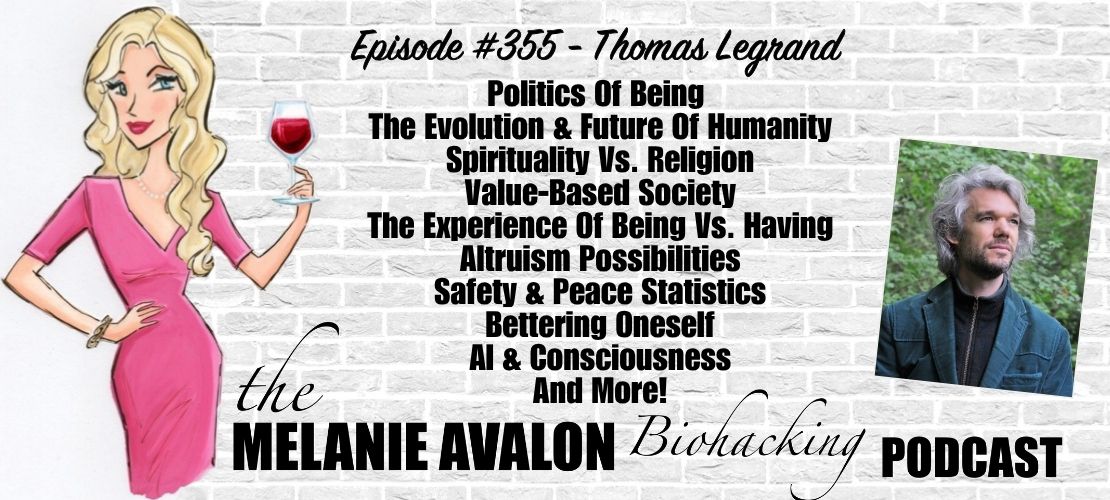
Born in 1979 in Paris, France, Thomas Legrand is a wisdom’s seeker, a social scientist, and a sustainability practitioner. He holds a Ph.D. in Economics and has studied international development, political science, and management. Thomas works in the field of sustainability for UN agencies, private companies, and NGOs. His focus is on forest conservation, climate change, sustainable finance, organizational transformation, and leadership.
His spiritual journey began at the age of 23 with an encounter with native spirituality in Mexico, before embracing the wisdom of a wide range of traditions and practices, including meditation, energetic healing and Tai-chi-chuan. He lives with his wife and their two young daughters near Plum Village, the monastery of Zen Master Thich Nhat Hanh in the Southwest of France.
Thomas’ spiritual search, his thought as a social scientist and his professional experience have gradually converged on the importance of spiritual wisdom in humanity’s ongoing transition. Searching for a way to mainstream this understanding in the political and sustainability conversation, he has dedicated much of the last 10 years to researching and reflecting how we can radically rethink our model of development. The result is this book.
LEARN MORE:
SHOW NOTES
SPONSORS & DISCOUNTS
PURITY WOODS:
Purity Woods creates USDA certified organic skincare designed to support healthy aging with clean, effective ingredients, including their revolutionary maple leaf extract, clinically proven to reduce the appearance of fine lines, wrinkles, age spots, and uneven skin tone, while supporting collagen and elastin production without irritation. Melanie is obsessed with their Age-Defying Dream Creams and Hyperlift Serum! Get up to 38% off at puritywoods.com/melanie.
FACEBOOK: Join Melanie's Facebook group for a weekly episode giveaway and to discuss and learn about all things biohacking. All conversations are welcome! IF Biohackers: Intermittent Fasting + Real Foods + Life
INSTAGRAM: Follow Melanie on Instagram to see the latest moments, products, and #allthethings! @melanieavalon
AVALONX: AvalonX Spirulina is out now! AvalonX supplements are free of toxic fillers and common allergens (including wheat, rice, gluten, dairy, shellfish, nuts, soy, eggs, and yeast). They are tested to be free of heavy metals and mold and are triple-tested for purity and potency. Get on the email list to stay up to date with all the special offers and news about Melanie's new supplements at avalonx.us/emaillist! Get 10% off at avalonx.us and mdlogichealth.com with the code MELANIEAVALON. Plus, text AVALONX to 877-861-8318 for a one-time 20% off code for avalonx.us.
FOOD SENSE GUIDE: Get Melanie's app to tackle your food sensitivities. Food Sense includes a searchable catalog of 300+ foods, revealing their gluten, FODMAP, lectin, histamine, amine, glutamate, oxalate, salicylate, sulfite, and thiol status. It also includes compound overviews, reactions to look for, lists of foods high and low in these compounds, the ability to create your own personal lists, and more.
EMF: Stay up to date on all the news on Melanie's EMF collaboration with R Blank, and get the launch specials exclusively at melanieavalon.com/emfemaillist.
TRANSCRIPT
Thomas Legrand
But the spark is in each of us and it's the soul that is guiding us back to the divine, to its own divine nature. And I found the answer in the Earth Charter which says human development is primarily about being more rather than having more.
I think my main point is that society should be organized to help us become who we are and be a better person, simply.
Melanie Avalon
Welcome to the Melanie Avalon Biohacking Podcast, where we meet the world's top experts to explore the secrets of health, mindset, longevity, and so much more. Are you ready to take charge of your existence and biohack your life? This show is for you. Please keep in mind, we're not dispensing medical advice and are not responsible for any outcomes you may experience from implementing the tactics lying herein. So friends, are you ready to join me? Let's do this!
Welcome back to the Melanie Avalon Biohacking Podcast. Oh my goodness, friends, you are in for an inspiring, special treat today. It was such an honor to connect with Thomas Legrand for his incredible work, Politics of Being. This episode is a little bit different from a lot of the episodes I have on this show. It is really a discussion of worldviews, paradigms, and the ultimate state of humanity. Thomas does so much incredible work for our world. He even works with the United Nations, and it is all in the mission of creating a better world for all of us. In his book, he proposes the idea of a political system for the world based on spiritual values and a state of being rather than a state of having. And we will define all of this and talk about it in the episode. And while what he's saying may seem a little bit like a utopia, Thomas does provide very practical ways that it can be implemented and actually happen. In this episode, we talk about things like the evolution and future of humanity, the difference between spirituality and religion, what a value-based society looks like, whether or not you can truly be altruistic, does selflessness actually exist, whether the world is actually safer and more peaceful than it ever has been before, how to truly better oneself, and so much more. The show notes for today's episode will be at melanieavalon.com slash politics of being. Those show notes will have a full transcript as well as links to everything that we talked about, so definitely check that out. I can't wait to hear what you guys think. Definitely let me know in my Facebook group, I have biohackers, intermittent fasting plus real foods plus life. Comment something you learned or something that resonated with you on the pinned post to enter to win something that I love. And then check out my Instagram, find the Friday announcement post. And again, comment there to enter to win something that I love. All right, I think that's all the things. Without further ado, please enjoy my conversation with the incredible human, Thomas Legrand. Hi friends, welcome back to the show. I am so incredibly excited and honored about the conversation I am about to have. So it is about a very inspiring, beautiful topic and not one that I focus on much, usually not entirely.
Melanie Avalon
It comes up tangentially, the topics we discuss here, but as a whole, I have not done an episode, I don't think, on a paradigm surrounding politics. And in particular, a new version of politics, one that is really about supporting the true meaning and purpose of humanity, one rooted in sustainability and spirituality, which we're going to define all of these words because I know definitions are very important.
The title of the book is Politics of Being Wisdom and Science for a New Development Paradigm. It is written by Thomas Legrand. He holds a PhD in ecological economics and he studied international development, political science and management. And he works in the field of sustainability for UN agencies, companies and NGOs. And friends, this book, I was so, when it first came across my consciousness, I was really intrigued by just the title, which seemed a little esoteric. I was curious what the work was actually going to entail and advocate for. I was excited because when I started reading it, pretty near the beginning, it introduced the work of Charles Eisenstein, who I have had on this show as well. I will put a link to that episode. He came on for his book, The Coronation. But in any case, the Politics of Being is just a grand exploration of so many topics. Like I said, basically, it's a proposal for a new paradigm of viewing the world, one where values really inform the decisions that we make as a society, as a system, what that all means. It touches on so many things, things like education and, of course, things like diet and the environment and mindfulness and meditation and just what this new approach would practically look like in society. And so I have so many questions. I'm really excited to dive into this. Thomas, thank you so much for your work and thank you so much for being here.
Thomas Legrand
Thank you Melanie, my pleasure.
Melanie Avalon
So to get things started, in the beginning of the book, you tell the story of your personal journey and what led you to doing this profound work because this is not for everybody, the type of person who does this sort of thinking. So what was your personal story?
I know you had an epiphany in Mexico, I believe. What led you to doing what you're doing today?
Thomas Legrand
Yes, thank you very much Melanie.
So indeed I think this vision for society I have to recognize is of course rooted in my own personal experience of awakening we could say to the deep inner dimension of our lives and recognizing how much potential there is in each of us and how little society is actually helping us in manifesting this potential while actually it's what also we need collectively to deal with many of our challenges. So for me that awakening was in when I was doing a student exchange in Mexico when I was 22 years old I was about to finish my study and as part of that I was a student exchange of six months in Mexico and I had different experiences too of we could say reconnection to myself and especially through the reconnection also with mother earth in contact with native spirituality in Mexico I made some commands and when I was able to for the first time of my life to see clearly a spiritual pass something in me recognized that this was what I've always longed for without able to put a name on it until then so I recognized that was what I was looking for and I decided to completely reprioritize my life putting that spiritual pass at the center and knowing that that spiritual pass would be a pass of service and in particular to to mother earth so this led me to when I came back I had you know like last semester of studies to do in France and I took some extra courses to change my kind of major into international development to be actually you know in service to yeah to others and later on I did a PhD in ecological economics really to be in service of the forest because I in that recognition in that reconnection to myself had experience also very deep natural connection to the forest and to me that was really what I wanted to do.
Melanie Avalon
I love this so much and I already have so many questions. So you're using the word that you have this spiritual awakening and one of the things you talk about in the book is what the word spirituality actually means and how is it different from religion.
And I know for me, for example, I was raised very religious, so I was raised in like the Bible belt Christian South and then I feel like I developed into more of a spiritual appreciation of the world. So my question here is like what is the difference between religion and spirituality and also you share a really fascinating statistic in the book, something about how I think societies with like less religion overall are happier, but then within a society, those who pronounce themselves as religious are happier. So it's like this paradox. So I'm really curious, the difference between spirituality and religion and how do both of those relate to a person's experience of happiness or fulfillment or contentment?
Thomas Legrand
Thank you, Melanie. So, to me, spirituality is a kind of spark that has been at the roots of all religion. And it's rooted in that experience. There are, you know, different names that mystics put to that experience of oneness, of unity, consciousness, or interbeing. So, I think it's, you know, that experience of all divine nature, basically, which connects us with everything.
And spirituality, to me, is a science, art, and practice of that inner connection, transformation, and fulfillment. So, it's really about how to transform ourselves to be able to manifest our true divine nature, let's say. And religion then are more like historical institutions that have grown out from this experience, from the spiritual experience. And as such, you know, they are, you know, they are facing all the limitations of, you know, social institutions, human institutions. So, you know, search for power, for example, or for control, etc. My focus really is on spirituality itself. And I think at this moment of time, and that has been very much part of my own past, we have access to so many spiritual traditions that I think if you really are searching for God, yes, it's good to be rooted in one tradition to go deep, but I don't see, you know, the reason why one should limit himself in his connection to God to, you know, one book, for example. I think all the knowledge and experience of humanity in search of the divine can be a fuse for anyone looking for that, you know, divine connection.
Melanie Avalon
Gotcha. And that searching nature, I've always been really interested by this. You spoke about how you were longing for something prior to your epiphany, but you didn't have language for it, really. And then you had your realization and embraced this spirituality, you know, new insight that you had. Prior to that, when you were in the searching phase, there's this like trope or type of person you'll come across, which maybe that's what you were, where it's like, I'm searching for something, like I feel like I'm missing something and I'm searching for this thing. And I feel like some people have that experience and others don't.
Like for me, I'm always searching for new information and knowledge. Like that's why I have this show, is to like, I love learning and sharing. I haven't had the experience that I hear people talk about where they feel like they're missing something though, and they're searching to fill that. And so I'm wondering when it comes to a person's journey with all of this, does it matter if you're coming from just looking, not just, but looking for new information versus coming from you feel like you're missing something or lacking something? Does that make sense? I've seen this in people and I've wondered why I don't have that experience of feeling like I'm missing or lacking something.
Thomas Legrand
Well, it seems at least you're missing the miss, so that's already a first step.
Melanie Avalon
So that's so true. Oh my goodness. Do you have thoughts? They're like the actual like what's driving somebody to look for this information?
Thomas Legrand
Yeah, well, I think it's a soul inside each of us who is more or less active and to the front, but inside each of us, there is this calling, there is this need, but it can be blurred, let's say by our mind or desires or our mind or habits, all this, the very more human part, let's say, but the spark is in each of us, and it's a soul that is guiding us back to the divine, to its own divine nature. It's a soul that I think that is helping us really connect with itself.
Yeah, I think this is not necessarily purely, I mean, when we are missing something, it's not necessarily comfortable, and that's why we tend to probably not want to feeling that so much, right? So, I think as part of this path, there is a very which we could call also, in general, the suffering, and that's, I think, a very noble truth, as they say in Buddhism, that this is the start of the Buddhist path, it's a recognition of suffering, and what I've seen around me when I was young, etc., is that, you know, I saw that, and I say in the book, I saw when I was young that people were pretending, and then that they were all fine, etc., and then I just realized they were just unconscious, because they were not able to accept the fact that something was wrong. To me, that's really the important, the first step on the spiritual path.
Melanie Avalon
Okay, so that probably hits on my personal fear that I have here because, and maybe it's just because of the way I'm categorizing what I'm searching and looking for, and I'm using different terminology, but that is what I sometimes wonder. I'm like, because I don't have what I perceive as like this missing thing that I'm trying to find. I'm like, oh, maybe I'm just not even in tune at all to the spiritual journey. And like you said, I'm like waiting to be awoken.
That is really interesting. Another related question, and I've been haunted by this since high school. Like I literally remember it was our first honors English class, and it's when they were introducing us to, I remember they were like, our teacher was like, do you know what the word metaphysics means? And he was like, do you know what the word epistemology means? And then thus entered the concept of paradigms and knowledge and how do we know what we know? So I'm really curious because in your book, you profile quite a few different leaders over the past, like spiritual leaders. And you talk about the role of our paradigm and how we are defined by our paradigm and it limits the future that we can envision because we're in our paradigm. So my question is, which is one that's haunted me for ages, is how do we know, like how do you know who to follow and whose knowledge to take into your paradigm and how do you know, like if you're seeing everything from your paradigm, how do you know it's the paradigm that is the paradigm that you want to be promoting if it's from your paradigm? Just how do we know?
Thomas Legrand
First, my search with this book has been what is a wisdom-based approach to development or human development. To me, that's very important because I think, first, the wisdom-based approach is the only legitimate approach. I think that's the best compass that we can find. And maybe I've come to realize that as part of my spiritual journey that if there was something I can trust and that is foundational enough to guide my life, it should be a spiritual compass or it should be wisdom. I'm personally quite surprised that we are not realizing that collectively because, to me, that the legitimate approach to ask the question, what is a wise or wisdom-wise paradigm, let's say, for humanity.
And I found the answer in the Earth Charter which says human development is primarily about being more rather than having more. And then I realized nobody really, this was a very important document. There was a huge consultation process, religious, ethical, tradition. I've been very involved into it. And I realized nobody really defined what it means theoretically and in practice, being more. And that's what the book is about. It's called The Politics of Being. How do we organize society for being more? So, yeah, I would say in general, using other words, I've personally taken refuge in that spiritual understanding of life and in wisdom in general. And I can't see a better foundation to think about the world and our lives.
Melanie Avalon
I love it too, and I was thinking a similar thought while reading your book, which is not that it's obvious, but it's like this approach of what you're saying makes so much sense. It is kind of like, why are we not thinking about this or embracing this more?
Which I think I'm a little bit biased because in my world of like biohacking, which maybe that's a good question to talk about. It's all about self-improvement, physically, mentally, emotionally. It's all about that search of trying to better yourself as a human. So when it comes to this idea of like being more versus having more, how does that role of bettering yourself factor into that? What are the values of... We should start there. What are the values of being more? What does that practically look like?
Thomas Legrand
Yes. So being more, I define it very simply as becoming who we really are and the best version of ourselves. So there is this two dimension, let's say, or truest being, and this is very subjective and personal, and there is a highest being. And this is about the highest human values and qualities. So that's at a personal level.
And I think my main point is that society should be organized to help us become who we are and be a better person, simply. And what this means in society is to center the highest human values, whether it's truth, goodness, and beauty. For as Plato has been promoting, or whether I think nowadays these values are emerging at the core of many social change paradigms, and are also becoming fields of research so that we can, science can tell us how to cultivate them at the individual, but also at the collective level. So there we're talking about values such as, I call it in the book, understanding, basically understanding the interconnected nature of the world. So that's systemic, complex thinking, for example. Centering life and nature as a pattern that can, a wise pattern that we can imitate, happiness, love, compassion, empathy, peace, mindfulness. I think all these values can become the really the foundations for our institutions, for our policies and laws, for the ways we are organizing ourselves in many sectors. And I give a lot of examples on how to do that, on what this means concretely in many sectors in the book.
Melanie Avalon
All of this sounds really great, like, you know, you'd be hard pressed to find somebody who would outwardly say that they don't want society to support this. What values are being supported currently in society?
Is it instead like GDP and, quote, progress and consumerism and materialism? What is actually being supported today?
Thomas Legrand
Exactly so you know if you're looking so it's really about understanding you know what is the current paradigm. Both cultural paradigm and in terms of. Development paradigm the way we see progress so i think all culture in a let's say western. Societies but more and more all over the world is really shaped by the modern mindset and values such as. Materialism individualism reductionism and tropocentrism just to say a few ones so these are values that are really that i've really become central. Through that process of modernity.
And what has been so that's a cultural level and how does it translate into a program for societies in terms of progress it's it has been really shaped by the the centrality of economy. And seeing progress in material terms which we didn't we didn't do before a few centuries ago. And sourcing progress in material terms and especially i think this vision of human nature of what we call in economy or more economic use where we are assuming that human. Nature is to be selfish competitive and looking only people would be looking only at their own material gains and that's a mistaken vision of human nature very simplistic but the problem is that most of our. Institutions rely on that and i actually are enacting it so you know even the. The most time i'm quoting for example in the book elena austrom who have been the most influential scholars analyzing or institutions and she received a nobel p she was the first woman to receive a nobel piece of the nobel price of economics and she really say that that. You know what she learned from all of the work, the main lesson she drew is that instead of assuming that we are all selfish and competitive and enacting that. We should rather design institution that bring out the best in humans that's our own sentence, we have to understand that at the moment, all societies are actually. Bringing out really things that are not the best in humans, whether it's greed it's competitions selfishness and we should become aware of that and redesign or institutions, so that we can bring out. The values that I mentioned the highest human values because what's happening right now is really a result of these all paradigm worldview of modernity and its vision of human nature.
Melanie Avalon
Amazing. Yeah, so a question there, and that's something that I've actually noticed in my, just like conversations with friends and people, especially like the selfishness part and the safeness of society.
So starting with the... Which one should I start with? Well, the safe one. So I have heard... I've heard that we actually... Actually, you say this in the book, I think, that we actually live in the safest time right now, or most peaceful time, I think. And you talk about something I hadn't heard about before, which was positive versus negative peace. Well, first of all, so is that true that we actually live in the safest time right now and the most peaceful time?
Thomas Legrand
Yes, physically, we could say in terms of if you look at omniscient rates, we are in a very low historical level. So there is definitely less people killed in terms of statistics than in any other time of history.
Melanie Avalon
And so it's, I'm assuming it's just the, like the news and the cultural, you know, perspective we have that has created this feeling of that, you know, it's everything's unsafe and everything's really horrible.
Thomas Legrand
Yeah, on the other side, I think in terms of psychological safety, this is also different, and maybe even economic or livelihood safety. And I think that's a very important topic.
So the way the economic system, for example, has evolved, has made us completely dependent on the market. We all need to find a job to sustain ourselves. In the past, everybody was self-sufficient through their own farm, and there was not that insecurity, let's say. I mean, sometimes maybe there was some bad harvest, bad year, but we were not so much dependent on external conditions economically. I'm saying that because people have analyzed in the 1930s the rise of fascism as a result of the crisis of 1929 and the fact that people had been made dependent on markets to sustain themselves. So just an historical background that we can also be used to analyze or present times. So I think this economic aspect is important, and I think more generally, in the past, when everyone was self-sufficient, having their own farms, et cetera, let's say, we also had our community. And so there was not, right now, people are also feeling much more isolated and much more unsafe, I would say, socially, because we all need relationships, community, human connections, and this has become much more unsafe at another level.
And there are other psychological unsafety that can be linked to other conditions of the modern times, whether it is the social media, the fact that we are so connected. Yeah, these, I think, are creating other psychological unsafety.
Melanie Avalon
We talk a lot on this show about the negative effects of social media and what it's doing to us psychologically and affecting our mental health and wellness. It's really ironic that we're more connected than ever, like connected to so many people, and yet we're seemingly lonelier than ever.
And it's interesting that in a way, because like you were saying, we no longer are a primarily like farming-based society, like we're not, you know, creating and taking care of our own needs ourselves. We actually are relying on everybody else, like as society, and yet ironically enough that makes us feel, you know, less safe and less taken care of, even though we're like relying on each other in a way with society. So I just, it's just really ironic, it's a paradox. The selfish piece, so this is haunting me so bad, because I, the idea of altruism. Do you think it really is possible to be altruistic? I have argued with friends about this for as long as I can remember, which is basically the idea that I don't know, I really can't understand how you would do a completely selfless act, because I feel like everything you do, this is my paradigm, everything you do is you want to do, like you can't do something you don't actually want to do, I don't think. So the concept of altruism, can we actually do selfless acts?
Thomas Legrand
Yes, definitely. I think some people are putting their own lives at risk in a moment to save someone and they don't think too much about it. And you're true to mention that in the modern paradigm, the homo economicus paradigm, we have been educated, taught to think of ourselves as entirely rational and as entirely selfish somehow. But to me, it's just obvious, there are people who are sometimes losing their lives or putting their lives at risk just to save someone else.
And you can't, I don't think it's very honest to interpret that as another mechanism of selfishness. So then maybe beyond your question, there is also the question about can we build some communities or societies that can allow this altruism to flourish? And I would say, yeah, definitely yes. And there are some rules that are allowing this altruism to be valued and also, which is also about sanctioning the one that are not acting in the interest of the community. If you're being more down to earth, the community also needs to be able to sanction gradually those that infringe the rules and affect negatively the community. So this has been designed by researchers and very well studied. And to say, I wanted to add that and I mentioned some examples in the book about how we tend to, in all societies, we tend to not recognize how much we are or potential for goodness. And there have been some studies who actually demonstrated, like they're asking people, when you ask people about their own values, and then when you ask people about what do you think are the values of society, of others, it doesn't match. People always tend to think that the problems are the fact that the other ones are not ready to play that game of solidarity and helping each other. But we are maintained artificially in that belief, which prevent us from coming together and support each other. And I think there are some powerful interests that are supporting this vision and preventing us from realizing that.
Melanie Avalon
Okay, two big questions there, clarification. So in the studies on the values, people think that the values of other people are like not good values or they think they are good values.
Thomas Legrand
So, in this study, they have grouped values in two categories. One are more compassionate values and the other are not so compassionate, let's say. And they are asking and people tend to, it might be, I can't remember exactly, but it might be like 70% of people declare their own values as compassionate values. But when they are asked what are the values of others in society, compassionate values will come only at 50%, for example. So, there's a mismatch between what everybody thinks.
A lot of people are ready to play that game of solidarity, let's say. But they think it cannot happen because others are not ready and they will lose if they are the only ones playing that game.
Melanie Avalon
So that's so interesting, because earlier in the episode when I was asking, when I was saying, well, clearly everybody would want this to be the way it is, like these values leading society, I was assuming everybody holds these values. And when I was saying that, I was thinking, you know what, maybe I'm making a false assumption here about others' values.
It's kind of like the opposite of what that study found. Like I think I over-assume everybody has these values, although maybe they do. This is really, really interesting. Okay, question about going back to the altruism. So you gave the example of somebody saving their life for somebody else. And that's an example of a selfless act. And my question here, so say you have a situation where somebody could save somebody else, like sacrifice their life in that moment for the other person. I think one person might do that and another person might not. And I would still argue either way that, or I would posit that either way, the decision the person makes, like whether or not to sacrifice themselves for somebody else, it's still what they want to do. So that's why I feel like it's hard to escape or it's hard to say that there's actually a selfless act because in the end, they did what they want to do. It's just that one person, it makes them, for whatever reason, they wanted to sacrifice themselves for this other person and then another person maybe didn't want to. And so then it makes me think, well, then it really just comes down to what do people actually want deep down. And we just have to hope that people want things that look like altruism. Maybe altruism exists, but I've been skeptical since I was little. I don't know if there was a question there. But do you have thoughts on that?
Thomas Legrand
Yeah, I mean, I don't think it's obviously, even if they don't think too much about it, if you're considering that they are taking a decision, you can say that they want to do. But the fact that they want to do that doesn't mean it's selfish. They want to do that for the good of someone else. And when you put your life at risk, I don't think you can deny that. So yeah, I don't see why the fact that people decide to do something or want to do something would prevent it to be an altruistic act.
I think these are just two different things.
Melanie Avalon
That's actually a really good reframe. I hadn't thought about that before.
I thought about this for so long. So, okay. Well, speaking of, so related to that, because I guess I am viewing and framing things by what does the person actually want, and that's the way I'm using it as a measure of things. When it comes... This is a question I have for you, because it's something I feel and experience. When it comes to happiness and contentment with cultivating the state of being that you're talking about, becoming your true self, supporting those sorts of values, does it matter the types of things that you do in life that make you feel like your true self and content, what they actually are? And what I mean by that is, I kind of self-identify as a workaholic. So, I love work. It makes me feel alive and passionate. But then I wonder, is that going into the world of workaholism? And is that a negative thing? So, do we need to judge what makes us feel like our true selves?
Thomas Legrand
No, I mean, from an individual perspective, definitely no. Maybe my reflection is more about how can we align our personal development with what is good for society. We tend to think of these two things as almost antagonistic in the paradigm of having, where for me to have more, other people need to have less somehow. That's in the material paradigm we're in.
But in the being paradigm, actually, I can be more if you are more. And there are some very good research that shows that human flourishing or inner development is actually good for people and society. So the two can really reconcile themselves. And I would say the pathway to that is through thinking about human flourishing as an inner development, as a deeper connection to self first. So that has been in all wisdom traditions. You can become happier just by working on yourself and your attitude towards life, your perceptions, the way you choose to look at what's happening to you and react to it. And connections also with others. All the happiness studies really emphasize the importance of our social relationships with friends, partners, families. That's our primary source of happiness. And in connection with nature, we have also more and more scientific evidence of the benefits of being in nature and being connected to nature for health, physical health, mental health, even mental functioning and performance. And I think these three connections are the pathway to the ultimate spiritual mystical experience of our true nature, which I think is of oneness, of unity, of interbeing, whatever words you want to choose. So all these connections, at the end, they are just one. And that's why someone who is in this path of spiritual realization can cultivate its own wellbeing and at the same time serve the wellbeing of others and take care of mothers.
Melanie Avalon
So big question there. For society to function, like for us to live as humans, we have to be, but we have to have resources, shelter, food, all of these things. And presumably, people have different passions and things that make them feel alive. And then that would manifest as different roles in society. I'm just guessing here.
A person, as far as what they actually do in life, like their job or their vocation in this ideal society, I'm assuming would align with their true being. So would it just work out that if everybody is living their best life, being their fulfilled self, that it would result in a society where all the quote jobs are covered that we need in society?
Thomas Legrand
Yeah, that's a good question. And I think it, what you just say also relates to what I presented at the beginning in terms of viewing being with these two holes of our true self or true being on one side. So, you know, we all have our own personal callings and directions in this life. And at the end, or, you know, the best version of ourselves, which is more, you know, a little bit more objective, we could say, of, you know, cultivating human values that are good for society too.
So getting back to your question about, yeah, there might be jobs, you know, I think a more evolved society would try to, would recognize that there are some jobs that are not very fulfilling and that, you know, maybe no one would choose to naturally, and they will try to minimize them and maybe to distribute them in a fairer manner if we can't completely get rid of them.
Melanie Avalon
Yeah, I'm so fascinated by it. Like would this society, like actually, like what would it actually, you know, look like practically?
Are there societies today that are doing this, like in their own microcosm?
Thomas Legrand
Yeah, and I realize as I'm speaking that it sounds, you know, so counter-cultural that, you know, a society can intentionally try to, you know, think in this term and try to, you know, reduce some jobs, etc. Because I think we're just being so used to not being able to give any direction to economic and technological progress. And I think a lot of this is about, you know, getting back the power over our lives and over how we organize society and technological or technology and economy being a means for us to realize that. Instead of what they have become now, which is their end in themselves, because we have lost completely our compass as societies. So getting back to your question, what was...
Melanie Avalon
Is there a society today that might be its own? Yeah.
Thomas Legrand
Yeah, yeah, this is a common question. Which societies are closer to this paradigm of being? And sometimes the question comes, are there rich society? Is it only for rich society? And I think we can find them at two different levels. On one side, I would say the Nordic societies in Europe, Sweden, Norway, Finland, maybe Denmark, Iceland, these are countries that are being considered as the most evolved culturally. And they are culture of care, culture of partnership. And they identify with these values and image of themselves. And a number of very concrete policies that I recommend, whether in terms of education, of early childhood and family of work, gender, governance, justice, many of these policies, you can find them in these European Nordic countries. And they are the ones that are, you know, not only the most evolved culturally as per some, you know, the dominant view, such as the World Value Survey, for example, they are also the ones that are performing better according to all social indicators.
So it really tells that there is something about politics of being, because where it is more implemented, these are the societies that are actually performing better. And on the other side, I think, you know, Nordic European countries are also, you know, have some limitations and, you know, may not be the more spiritually inclined, for example, which could be also a limitation in that agenda. The other part of it would be more indigenous societies. I'm working myself, for example, with Bhutan, you know, this small Himalayan country, which have championed gross national happiness as an alternative development paradigm to economic growth. These are very indigenous societies, in that case, with, you know, Buddhist values that are very much alive. And we can see that in other indigenous communities in different parts of the world.
Melanie Avalon
So you live in south of France, the actual town you live in, why did you choose where you live?
Thomas Legrand
Yes, so I live next door to a famous mindfulness practice center or a Buddhist monastery called Plum Village of Zen Master Thich Nhat Hanh, who has been one of the most influential Buddhist teachers in the recent times and who have been sometimes recognized as the father of the mindfulness movement. And I've been living here for the last 11 years, really as a result of giving priority to my spiritual past and in agreement with my wife who is on the same path.
Melanie Avalon
It's incredible. I remember the first time I heard about Tik-Nok Kong and it was actually Charles Eisenstein's book, The Yoga of Eating, because I was recording the audiobook for it and I was like, I don't know how to say this guy's name. That's amazing.
I'm curious because you were mentioning technological developments and what would this society look like. I'm very curious. What do you think about the rise of AI? How do you think it will factor into the ideal future that you see? Do you use it? Do you use chat TBT and stuff?
Thomas Legrand
Not so much, I do for very specific use, but not so much in general. I mean, the way I see AI, if you think about the evolution of humanity, and from a biological perspective, let's say, where there's the body, there's a development with animals of the more vital parts, we could say, with emotions and desires, etc. And then there is the development of the mental sphere, the mind, and we're getting more intellectual. And in the 20th century, humanity has even started to fight for ideologies. So to me, that's a kind of cultivation of the mental age. And I think that AI also is really about what our mind can do. And I think we are at this stage of humanity to become more reflective about our mind. And recognizing that at the end, our mind are also somehow a big biological machine. And that can open the door to search for who we really are behind all that. Are we only our minds and what we are thinking, or is there something behind?
Which I think there is, and we could call that the soul or the spirit. So I think what's interesting with AI is that it's really externalizing most of what our mind can do in terms of thinking and giving it to a machine. And then we should become more reflective because our mind and our thinking are outside of us, and we can look at it. And that's where we can start to reflect where this is coming from, how this knowledge is produced and start to be more reflective about our thinking and our mind. And at the same time, wondering if all what we think was defining our humanity was our capacity of thinking somehow. But that is no longer the case with AI. That can be done now by computers. So what is now defining our humanity? I think this question will lead us to increasingly search for our true self as souls rather than minds and redefine what can be our added value as human beings, which will no longer be about knowledge, but maybe more about that capacity to be maybe self-reflective. Even AI maybe is starting to add a little bit of that because you can do that mentally. But maybe it's more about the heart or capacity to love or capacity to connect with each other, to collaborate. So I think, yes, there is a lot of obvious risk with AI, and they are very deep because of the societies we're in. But every challenge has also its evolutionary potential. And I think these are some of our new creations that are leading back to the question of our times, I believe, which is getting to understand who we really are and what we are here for.
Melanie Avalon
If you could see all of the conversations I have with AI, because I am seeking, I'm like asking at these types of questions, like you're saying, I'm so curious about because it presents as something that seems self-aware, but I'm assuming it's not unless it is and it's going to take over. But in any case, it is a good sign, I think, because presumably, you know, these machines are trained on the entirety of the information out there, like on the internet.
And I have found in my interactions that it seems to be pro, you know, the sort of values that we're talking about on the show, as far as like, if I'm talking to it about, you know, personal things I'm doing or needing like advice, or I don't know if I should use the word wisdom, but I guess it's a good thing that at least the way it talks is in support of, from my experience, values that I respect, although it could just be all, it could be all an act. At the end of the book, you propose a wisdom council. So what is that that you're proposing there?
Thomas Legrand
Yeah, so this is in the chapter on governance, right? And I've been looking into some, so there's some good reference for these work on, on governance. I like to tell the story of, you know, a book that I've been very important for my reflection, which is about it's called intelligent governance in the 21st century and what they've done, they have searched for an ideal systems of governance and they have asked Asian researchers, some of the best in political science and also Western researchers, some of the best also too. And both have, have worked separately and they have come with a very similar system, actually, I won't describe it too much now, but it's also a system that are very striking parallels with the way one religion is being organized, a Baha'i face for people who don't know the Baha'i is a religion of more than 5 million people is it has based on a, on a prophet coming from Iran in the 19th century and with very interesting teachings about, you know, saying that all the prophets, all the religions were coming from the same divine source. And they just vary because their message needs to be adapted to the times and space where they are, where they appear to support human evolution, basically. And they say that they're, they realize that every prophet, new prophet was injured by the way religions were organized because religions becomes, you know, an institutional power and they don't want their power to be threatened. So he wanted to think about the administration of its own tradition in a way that would prevent that, which is to say, without clergy. And he designed a system of governance. And he said that these could become a template for the world. And, you know, so I found it striking that at the beginning of the 21st century, when political scientists are thinking of an ideal governance systems, they are getting back to very similar system than the Baha'i Feds.
So just as an introduction about my way of thinking about governance and this in that, you know, institutional system that I proposed, there is this wisdom conceal, and this wisdom conceal is about, it's, its mission is to steer the direction of societies in, you know, if we put, let's say that we need to organize for being more and put that in the constitution, let's say of a given country, then is the role of the wisdom conceal to steer the evolution of societies through the right research and the right debates and give them some power, yeah, to ask government to report on that, and even to ask the parliament to develop and the governments to develop some policies to address the issues this body would find. So yeah, that's in a nutshell, the vision of this wisdom conceal.
Melanie Avalon
Well, this has been absolutely incredible. Was there any particular topics? Because there's so much in the book. And so friends, I cannot recommend enough getting Politics of Being.
It goes so, so deep into all of these different topics. We can't even briefly touch on all of it. Was there any particular topics you wanted to draw attention to for our listeners?
Thomas Legrand
I'm not sure maybe just to clarify maybe where we are at the moment and what this poly-crisis or meta-crisis or crisis of civilization that we are facing because I think we have to understand each true nature also in these difficult times to really make sense of what we are experiencing so I think it's just as I said we have been organizing for the more and more for the last two centuries according to the modern paradigm and this has provided a lot of benefits material progress technological progress democracy human rights etc but now it has come to the limit this model this paradigm has come to its limit of what it can do for us because it has also created a lot of problems that it cannot address to address this problem especially inequality especially the environmental crisis or the mental health crisis the human alienation crisis we need to move to another paradigm so what we are living now is an evolutionary crisis so it's the more we stick to the same paradigm the the worst it will go and that's we are seeing that and but we have to remind also that this evolution this collective evolution we are called to do to solve our challenges can be a wonderful breakthrough of humanity and I actually believe of the that humanity is about to enter adulthood and obviously teenage out is a very difficult times but we have to understand that we are going through this so that we can establish much better foundations for the world to come and I think these people have been waiting for very long for this age and the spiritual evolution also has been announced by many prophets including Jesus Christ which you know was main message what about the the you know establishing the kingdom of God and that's you know in a secular perspective also because I think we need to bring these we need to be able to think about these things in also in rational and secular terms this is what is about the politics of being is about how do we you know because if we start to organize our societies for being more this is how we will nourish the kind of human being the kind of culture that can bring us to this better world so just a message of hope and understanding that many times you know in that evolutionary process the worst and the best are you know competing with each other and sometimes we need the worst so that people really have the courage to go for for the best too
Melanie Avalon
When you're saying this idea of humanity as teenagers and it's a hard time and then entering adulthood and this maturation level, you're saying for the entire history of humanity or humans within a certain period of time, because if we had these other societies in the past with these indigenous cultures that potentially were already hitting that mature level of adulthood, so is it like the entire history of humanity? You're saying we're moving finally towards this adulthood?
Thomas Legrand
Yeah, I would say at least for you know what we know of history of let's say which is often you know a couple of thousands of years I would say this is yeah this is really the first time that we can establish this global enlightened we could call it society because that's where lie the the answers to the problems we are facing so evolution evolution is pushing us in that direction right now yeah some you know some cultures have the idea that there have been many many cycles in human history of thousands of years and there have been ups and downs etc we I think we don't know very precisely about that but for the history we know I think this is a very unique time indeed
Melanie Avalon
Oh, wow. Okay, that is amazing. Have you and do you see something that indicates that
Thomas Legrand
Yeah, I mean just to explain a little bit more, I mentioned about my experience in Mexico in the early 2000s. One of the first things I learned when I started to live in Mexico at that time was that Mayan prophesied about a change of consciousness in 2012, which was supposed to be the end of a 25,000-year cycle and the beginning of a new cycle. There are many others. I was just mentioning the Baha'i face, which is one of the latest prophets, has also announced that actually humanity was about to enter adulthood. That was the kind of language he was using. I see a lot of people, especially Jews that are more spiritually inclined, really leaving that understanding that we are in a very special time of history and that is a time of spiritual evolution.
In my own work, I've not mentioned that I'm working with United Nations. I'm working with Conscious Food Systems Alliance, where we are making the case that we need this inner development for the transformation of food and agriculture. We are being successful and considered as very relevant. I think this is quite new. Maybe a couple of years ago, this would have not been possible. But right now, working with decision makers, working with people that are deep thinkers around sustainability and social change and what is needed, I think there is a consciousness growing very quickly, an awareness growing very quickly that the answers to our problem imply looking inside and this kind of inner transformation at the collective level.
I think this is growing very quickly. I really hope and trust that it would become mainstream, in the coming years and decades, because that's the way to go.
Melanie Avalon
Thank you so much for all of this work that you're doing. How can people, how can listeners practically make choices daily that move towards this?
So does just, I don't like this word, just working on yourself as a person and doing what makes you feel fulfilled and happy and working in service of others, is that enough to move towards this? How should people practically, does it come down to even things like how you shop and what you buy and who you vote for? Like how do people best help move humanity collectively towards this?
Thomas Legrand
Yes, I think an important aspect is a realisation that all these good behaviours don't come out of nothing and we all have a responsibility to cultivate ourselves, to become more compassionate, to become more conscious, to become wiser. So I think that's to me the first step.
And then how to bring that in the world through, as we said, through being engaged in the world and trying to support others, trying to live in harmony with nature. And also, what is the kind of narrative, of paradigm, of culture that we are cultivating, that we are nourishing the way we speak, the way we relate with people. I think our ways of being, they can be quite subtle, but we need to really become aware of what is the kind of consciousness that each of us is promoting around us. And that's, I think, our responsibility in that process of collective evolution.
Melanie Avalon
I love this so much. I mean, it's interesting because I know this is all about, quote, politics, but a new paradigm for that. And I personally, when it comes to the colloquial word of politics, I don't watch the news. I don't really get politically super invested.
And again, this is the definition of it as it's understood today. And yet everything I do with this show is because I feel like my purpose is to find information and share it with people so that they can better their own lives. And so I love this idea of agency and working on ourselves and having the whole... Because you have all these beautiful paradoxes in the book of the parts being in the hole and the hole in the parts and all the things. So I guess it's just a call to action of people to keep on keeping on and finding the things that make them feel alive and supporting each other.
And I cannot thank you enough for your work. It's so, so incredible. Which to that point, how can people best follow your work, support your work? Are you writing any new books? What is on the horizon for you?
Thomas Legrand
Yes. So they can buy the book on all platforms. They can go to the website, politicsofbeing.com. We're starting also a book club for those that want to discuss with others around the book. There's a YouTube channel, and I'm on social media too, especially LinkedIn. So yeah, they are all welcome to connect.
And yeah, I think I'm still building that community. I've been very busy in the last few years since the book was published, but especially with this book club, now building that community to see what we can do together. My vision is really about developing that network with people from different fields that can help each other to implement that broader vision of a politics of being. But also more simply, I think what I'm on the website, there is a page with a book club. And I think that's something people can bring to their community, bringing people. And I will I'm testing that and I will develop some guidance. But I think that's something that people can organize, read the book with their friends and neighbors and just discuss it. We will have some materials to help people do that.
Melanie Avalon
Amazing. Well, thank you so much. I will put links to all of this in the show notes so listeners can check all of that out and I'm just thinking about how I'm thinking about how like when I was in school and was reading all of these different books and historical works and philosophers and all the things and I think your book should be required education for children so that we can instill these values and ideas in them early on. So thank you so much for all that you've done, Thomas.
I really appreciate you doing this, especially I know with the time change, it's evening there for you and just thank you for all that you do and I look forward to connecting with you more in the future. Oh, I almost forgot. Oh my goodness. Wait, one last question. So the very last question that I ask every single guest on this show and it's just because I am so passionate about the role of mindset. So what is something that you're grateful for?
Thomas Legrand
something. There's so many things what I'm grateful for, you know, my wife, my family, my house, my community, my spiritual path.
So maybe grateful for life to bring to me each time what I need to evolve, right? I think that's maybe what's the deeper look at it probably.
Melanie Avalon
Amazing. Thank you so much, Thomas. This was absolutely amazing and I look forward to connecting with you more in the future.
Thomas Legrand
Thank you so much, Melanie, for your work and likewise stay connected.
Melanie Avalon
Thank you. Thank you so much for listening to the Melanie Avalon biohacking podcast.
For more information and resources, you can check out my book, What Win Wine, as well as my supplement line, AvalonX. Please visit MelanieAvalon.com to learn more about today's guest. And always feel free to contact me at contact at MelanieAvalon.com. And always remember, you got this.